
24/7 Customer Support

Free returns

Same-day & Next-day Delivery

Quality Guaranteed

Unlock Your Welcome Offers: FREE Delivery | Up to 80% OFF | Free 30-day JoyPlus trial
Download the APP
Whether you are a professional artist preparing for a commission, a student stocking up on art supplies or simply rediscovering the joy of colouring, selecting the right set of coloured pencils can feel overwhelming. The market is filled with options, each promising vibrant colours and smooth application. This guide is designed to help you navigate the choices, understand the key features to look for and find a set that truly suits your creative needs.
As the Joybuy Product Recommendation Officer, my role is to provide clear, practical advice to help you make an informed decision. We will look at what makes a good drawing pencil and highlight a few standout options available today.
Before diving into specific products, let's outline a few key factors to consider. Thinking about these points will help you identify which features are most important for your projects.
The "lead" of a coloured pencil is made from a mixture of pigment, binders and fillers. The two most common types are wax-based and oil-based.
When looking at product descriptions, pay attention to terms like blendable coloured pencils and pigment quality, as these indicate how well the colours will mix and the richness of the final result.
There is little more frustrating than a pencil lead that constantly snaps when sharpening or applying pressure. High-quality break-resistant pencils feature cores that are securely bonded to the wooden casing. This process, often referred to by brands with specific terms like "secural bonding (SV)," significantly reduces breakage. This is a particularly important feature for students, younger artists and anyone who tends to be a bit heavy-handed.
A coloured pencil set can range from a dozen basic shades to over a hundred. For general sketching and colouring, a set of 24 to 36 colours is often sufficient. Professional artists or adult colouring enthusiasts who rely on subtle shading and gradients may prefer larger sets.
Consider the packaging as well. Pencils in a tin offer excellent protection, keeping your art supplies organised and safe from damage, whether they are stored in a studio or carried in a backpack.
Based on their features, materials and suitability for different users, here are a few coloured pencil sets worth considering.

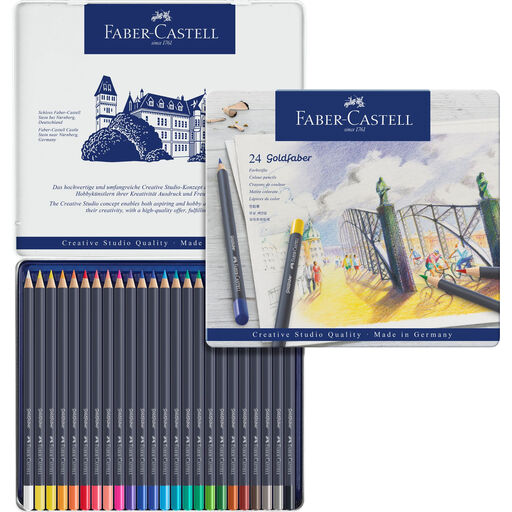
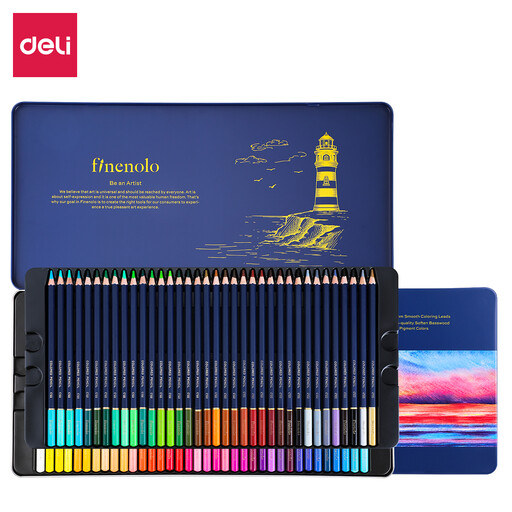
If these recommendations aren't quite what you had in mind, or if you'd like to browse a wider selection of sets, there are many other choices available. From smaller starter packs to extensive professional collections, you can find a variety of art supplies for drawing to match your specific needs.
Explore Our Full Range of Art Tins
The primary differences are in the quality and concentration of the pigment, the type of binder used and the lightfastness rating. Artist coloured pencils have a higher pigment-to-binder ratio, resulting in richer, more vibrant colours. They also undergo lightfastness testing to ensure the colours do not fade over time. Student-grade pencils are more affordable and are designed for durability, making them great for practice and general use.
To prolong the life of your pencils, use a sharp, high-quality sharpener to minimise wood and lead wastage. Avoid dropping them, as this can cause the internal lead to fracture even if the wooden casing appears undamaged. Storing them in a protective case, such as the pencils in a tin they often come in, will also prevent accidental damage.
Not necessarily. A large set is fantastic for artists who need a wide range of specific shades for complex work like botanical illustrations or portraits. However, for beginners or those who enjoy blending, a smaller set of 24 to 36 high-quality pencils can be more manageable and just as effective. It often comes down to personal preference and artistic style.