
24/7 Customer Support

Free returns

Same-day & Next-day Delivery

Quality Guaranteed

Unlock Your Welcome Offers: FREE Delivery | Up to 80% OFF | Free 30-day JoyPlus trial
Download the APP
Navigating the cat food aisle can feel overwhelming. With shelves packed with brightly coloured packaging and compelling claims, it's difficult to know if you're making the right choice for your feline companion. As the Joybuy Product Recommendation Officer, my role is to help you see past the marketing clutter and focus on what truly matters for your cat's nutrition. Many well-meaning owners fall into common purchasing traps that can be a waste of money and may not suit their cat's needs.
Let's look at a few common pitfalls:
grain free cat food label has become a popular marketing tool, but it isn't automatically a sign of a superior product. Many cats digest high-quality grains perfectly well. The key is the overall nutritional profile and digestibility, not just the absence of one ingredient group. Some grain-free foods simply substitute grains with other starches like potato, which may not be any better for your specific cat.Before you add any complete cat food to your basket, take a moment to check these three non-negotiable parameters. Understanding them will empower you to make a more informed choice.
This is the single most important distinction to understand.
dry cat food and most mainstream wet cat food pouches or tins will be labelled as "complete."A cat's nutritional requirements change dramatically throughout its life.
sensitive cat food needs also fall into this tailored approach.There is no single correct answer here, and many owners in the cat food UK market choose to feed a mixture of both.
Cat food pouches offer convenient, single-serve portions.Based on these practical criteria, here are a few options from brands like Purina cat food and Iams, matched to specific cat profiles.
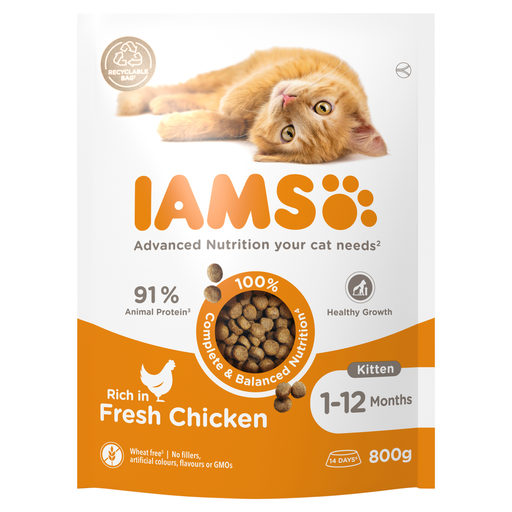
Why This Fits Their Persona: This dry kitten food is designed for the crucial first year. It's packed with high levels of animal protein and DHA, nutrients essential for healthy brain development and muscle growth in an active, growing kitten.
It directly avoids the "one-size-fits-all" trap by being a purpose-built formula for kittens, addressing their specific growth needs rather than offering a generic adult recipe.
Features a high proportion of animal protein (91% of total protein) with fresh chicken and crunchy kibbles to help with dental health from a young age.
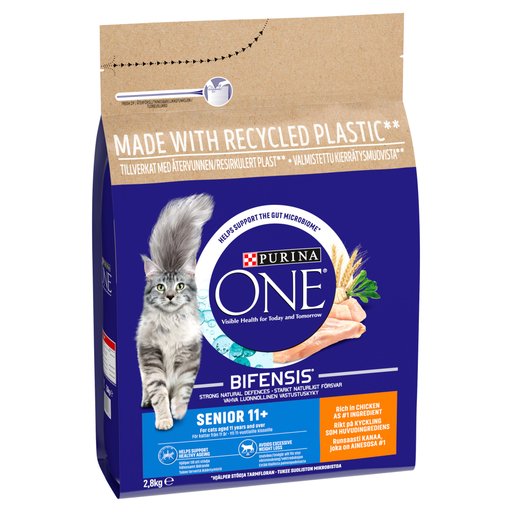
Why This Fits Their Persona: This senior cat food is tailored for cats aged 11 and over. It has an adapted nutrient profile to support healthy ageing, including an optimised protein-to-fat ratio to help maintain lean muscle mass without excessive weight gain.
This formula is the opposite of a one-size-fits-all food. It specifically targets the needs of very senior cats, acknowledging that their dietary requirements are different even from a 7 or 8-year-old "senior."
Contains a Bifensis formula with lactobacillus to help support the gut microbiome and balanced minerals to promote good mobility and strong bones in later life.
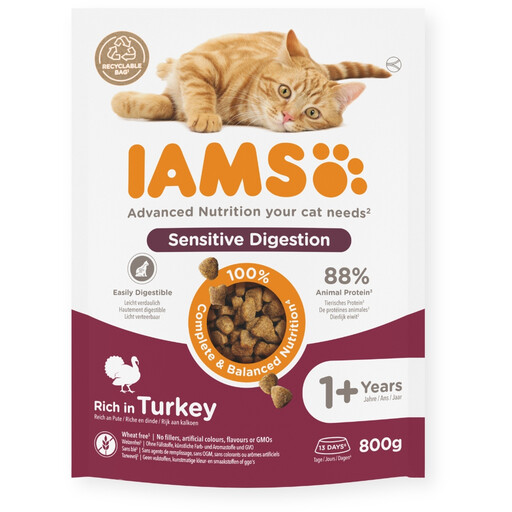
Why This Fits Their Persona: For owners of cats who are prone to digestive upset, this sensitive cat food is a practical choice. It is formulated with highly digestible ingredients like turkey and rice and includes prebiotics (FOS) to support healthy gut flora.
It moves beyond the simple "grain-free" marketing trap by focusing on a holistic approach to digestive health, using a tailored fibre blend and prebiotics alongside easily digestible proteins.
This is a high-protein recipe (88% animal protein) that doesn't compromise on nutrition while being gentle on the stomach. It also contains Omega 3 & 6 for healthy skin and coat.
We have compiled a complete, real-time list of products that fully satisfy these strict selection criteria and UK safety regulations.
To avoid digestive upset, transition your cat to a new food gradually over 7-10 days. Start by mixing a small amount of the new food (around 25%) with their old food (75%). Every couple of days, slowly increase the proportion of the new food while decreasing the old, until you are feeding 100% of the new diet.
Neither is inherently "better"; they simply offer different benefits. Dry food is great for dental health and convenience, while wet food is excellent for hydration and palatability. Many owners find that a mixed-feeding approach, offering both wet cat food and dry cat food, provides a good balance of benefits for their cat.
The feeding guidelines on the packaging are your starting point. These are usually based on an average cat's weight and activity level. You should adjust the amount based on your individual cat's needs to maintain a lean, healthy body condition. If you are unsure, your vet can provide guidance on your cat's ideal weight and daily calorie needs.