
24/7 Customer Support

Free returns

Same-day & Next-day Delivery

Quality Guaranteed

Unlock Your Welcome Offers: FREE Delivery | Up to 80% OFF | Free 30-day JoyPlus trial
Download the APP
As temperatures rise, finding an effective way to stay comfortable at home or in the office becomes a priority. The market is filled with cooling fans of all shapes and sizes, each promising relief from the heat. Navigating these options can be confusing. This guide is designed to help you understand the key features to look for, so you can choose a fan that genuinely meets your needs without the marketing hype.
We will explore different types of fans and highlight some practical considerations to help you make an informed decision, whether you need a powerful unit for a large living room, a quiet fan for your bedroom or a portable solution for your commute.
Before looking at specific models, it’s helpful to consider a few key factors. Matching the fan's features to your environment is the first step towards a cooler, more comfortable space.
The most common fan types each serve a different purpose.
Beyond the basic type, certain features can significantly improve your experience.
Here are a few cooling fan options that stand out for their practical features and design, catering to a range of common needs across the UK.
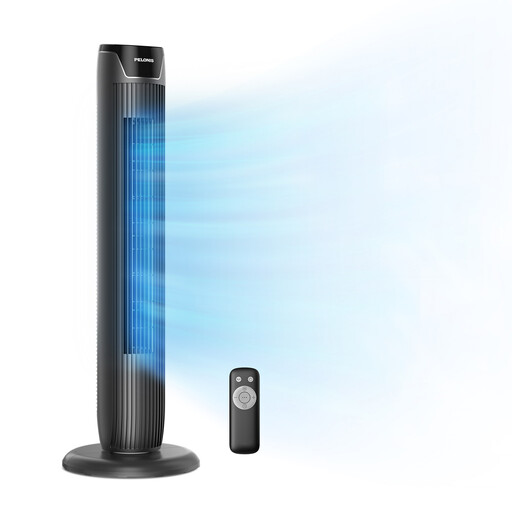
Why It Stands Out: This model combines a slim, space-saving profile with features designed for undisturbed comfort. Its AI Smart Mode, which automatically adjusts airflow based on the room's temperature, offers a set-and-forget convenience that is genuinely useful.
The ultra-quiet operation is its main appeal for light sleepers or those working from home. At its lowest setting, it operates at a very low noise level, while the dedicated 'slumberous mode' gradually reduces fan speed through the night.
Pros:
Who is it for?

Why It Stands Out: This is not a typical handheld fan. It packs a powerful turbine engine capable of reaching 9700 RPM, delivering a surprisingly strong breeze for its compact size. The standout feature is the 100-level speed adjustment, controlled by a simple scroll wheel, which gives you precise control over the airflow.
The smart LED display, showing both wind speed and remaining battery, removes the guesswork often associated with portable devices.
Pros:
Who is it for?
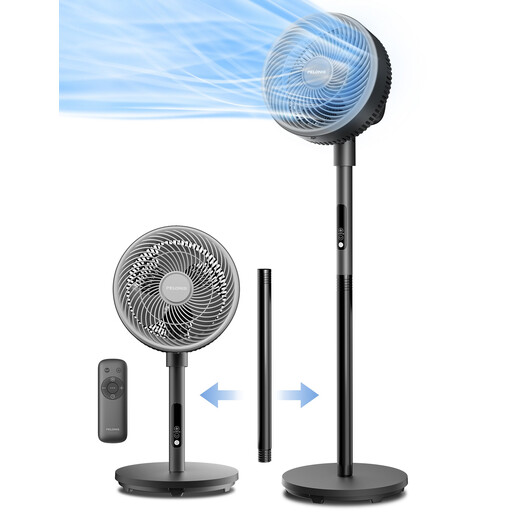
Why It Stands Out: This fan’s adaptability is its greatest strength. It can be configured as a 110cm pedestal fan for broad living room coverage or a 60cm desk fan for more direct cooling, all without needing any tools.
Its 3D oscillation, combining 85° horizontal and 72° vertical movement, creates true whole-room air circulation rather than just a simple breeze. This helps to eliminate stuffy spots and maintain a consistent temperature throughout a larger space.
Pros:
Who is it for?
If the options above don't quite fit your requirements, or if you're interested in a fan that also adds moisture to the air for extra cooling, you might want to explore other solutions.
For more choices, including models with humidifying capabilities, feel free to browse our wider selection of Mist Cooling Fans.
1. What is the difference between an air circulator and a regular fan? A regular fan creates a direct breeze that you feel when you are in its path. An air circulator fan is designed to move a larger volume of air throughout the entire room. It creates a vortex-like airflow that bounces off walls and ceilings to keep the air in constant motion, helping to balance the temperature in the whole space rather than just one spot.
2. How much electricity does a cooling fan use? Most modern cooling fans are quite energy-efficient. A typical pedestal or tower fan might use between 30W and 60W of power. To put that in perspective, it's significantly less than an air conditioning unit, which can use over 1000W. An energy efficient fan running for several hours a day will have a minimal impact on your electricity bill. Always check the wattage (W) in the product specifications.
3. What should I look for in a quiet cooling fan for a bedroom? For a bedroom, the most important factor is the noise level, measured in decibels (dB). Look for a fan with a dB rating below 40dB on its lowest setting. Other useful features include a 'sleep' mode that reduces speed and noise over time, a timer to turn the fan off automatically and a remote control so you don't have to get out of bed to make adjustments.