
24/7 Customer Support

Free returns

Same-day & Next-day Delivery

Quality Guaranteed

Unlock Your Welcome Offers: FREE Delivery | Up to 80% OFF | Free 30-day JoyPlus trial
Download the APP
Achieving that flawless, showroom shine on your vehicle's paintwork is incredibly satisfying. A quality cordless car polisher can make the difference between a good result and a professional one, all from the comfort of your own garage. However, the market is filled with options that can be confusing. Many buyers find themselves with a tool that doesn't meet their expectations, often due to a few common but avoidable pitfalls.
As a Product Recommendation Officer, my role is to help you see past the marketing clutter. Before you invest, let's look at the frequent traps that catch out UK car enthusiasts and how to sidestep them.
To choose the right car polishing machine, you need to understand what the key technical terms actually mean for you and your car. Focusing on these three areas will ensure you get a tool that performs as needed.
This is perhaps the most critical factor. The way the pad moves determines the machine's effectiveness and safety.
For a cordless car polisher, the power system is everything. Don't just look at the brand name; look at the numbers.
The size of the machine and its polishing orbit dictates what jobs it's best suited for.
Instead of a single "best" tool, the right choice depends on your specific needs and goals. Here are our recommendations, matched to different types of users.
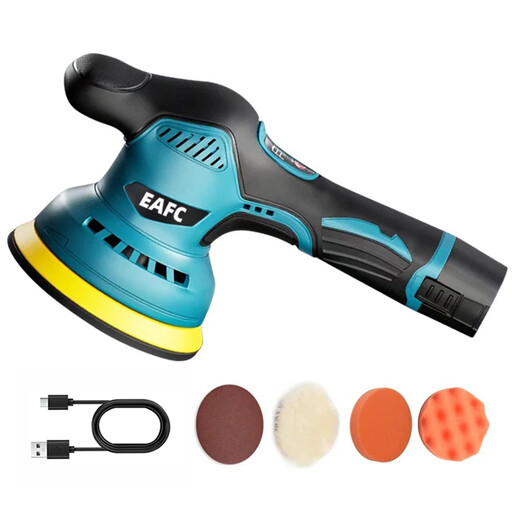
Why This Fits Their Persona: This is an ideal entry point for those new to machine polishing. It's designed for applying waxes and sealants efficiently, taking the hard work out of the final stage of detailing without the intimidating power of a professional correction tool.
It avoids the "wrong tool" trap by being clearly positioned for waxing and light polishing. Its eccentric action is gentle on paint, making it a safe starting point that won't cause damage.
Features eight adjustable speeds (2800-5500 RPM) for good control. The user-friendly design with clear displays makes it simple to operate straight out of the box.
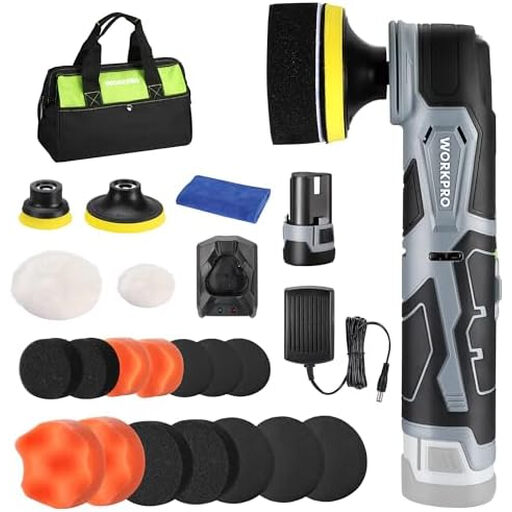
Why This Fits Their Persona: For the person who obsesses over every detail, this mini car polisher is the perfect companion to a larger machine. It's built for polishing tight, complex areas like grilles, door handles and spoilers where a standard polisher simply won't fit.
This tool sidesteps the "value kit" illusion by providing a focused, high-quality car detailing kit for a specific purpose. The included pads and accessories are sized for detail work, ensuring they are genuinely useful.
Extremely lightweight (0.85 kg) and compact for one-handed use. The kit includes multiple backing pads and a variety of small foam and wool pads, providing everything needed for precision polishing.
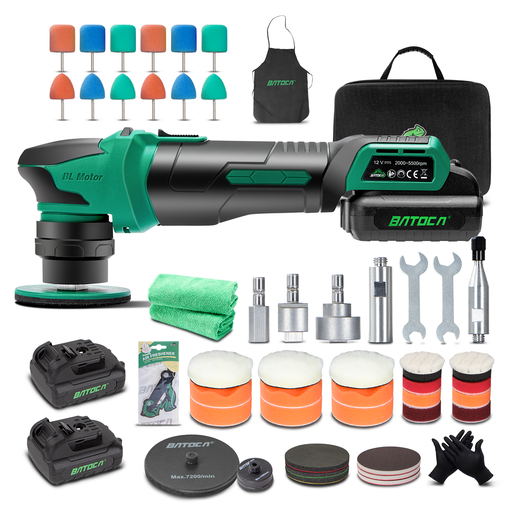
Why This Fits Their Persona: For the user who wants to tackle everything from light swirls to more significant defects, this machine offers true versatility. It's a serious battery powered polisher for those who demand control and professional-grade components.
It directly counters the battery life and power traps by using a modern brushless motor for efficiency and including two 2.5Ah batteries. The switchable drive system (Rotary, 3mm DA, 12mm DA) means it's the right tool for multiple jobs, not a one-trick pony.
The dual-system functionality allows you to switch between aggressive rotary cutting and safe DA finishing with one tool. Includes an extension rod for reaching difficult areas.
We have compiled a complete, real-time list of products that fully satisfy these strict selection criteria and UK safety regulations.
1. How long will the battery on a cordless car polisher actually last? This depends heavily on the battery's Amp-hour (Ah) rating, the speed setting you use and how much pressure you apply. For intensive paint correction, a 2.0Ah battery might last 15-25 minutes. For light waxing, it could be longer. This is why we recommend models that include two batteries and a fast charger, allowing you to cycle them and work without interruption.
2. Can I use a car polisher for other DIY jobs like sanding? Some models are designed for multi-purpose use. Polishers like the EAFC 21V or WORKPRO kit come with sanding attachments, making them useful for small woodworking projects or removing rust. However, always check the product description. A dedicated car buffer may not be suitable for sanding, whereas a more versatile tool will explicitly list it as a function.
3. What is the main difference between a dual action and a rotary polisher? The key difference is safety and action. A rotary polisher spins in a single, powerful circle, which is effective but can easily damage paint if you're not experienced. A dual action (DA) polisher has a random, oscillating orbit that is much safer, generates less heat and is the recommended choice for enthusiasts and beginners looking to remove swirls and polish their car without risk.