
24/7 Customer Support

Free returns

Same-day & Next-day Delivery

Quality Guaranteed

Unlock Your Welcome Offers: FREE Delivery | Up to 80% OFF | Free 30-day JoyPlus trial
Download the APP
A cordless car polisher can make waxing, paint refinement and small-area detailing more convenient, particularly when working around a driveway, garage or motorcycle. Without a mains cable across the floor, you can move around bumpers, wheels and door mirrors more freely.
However, not every battery car polisher is suitable for full-vehicle paint correction. Some compact models are designed for spot work rather than large panels, while others include impressive accessory counts but lack useful battery capacity or speed control. The right choice depends on your vehicle, working time and the type of finish you want to achieve.
A high maximum speed does not automatically mean faster or safer polishing. A rotary car polisher spins the pad directly and can remove defects efficiently, but it may generate heat quickly if held in one place. A dual action car polisher combines rotation with orbital movement, which can be more forgiving for many DIY users.
For waxing and finishing, lower speeds and softer pads are generally more suitable. Scratch removal and oxidation correction require the correct compound, pad and technique—not simply the highest RPM setting.
Battery capacity is often shown in amp-hours, but advertised runtime may be measured without load. Pressure, pad size, compound, temperature and working speed all affect usage time.
For example, the WORKPRO mini polisher includes a 2.0 Ah battery and has an automatic overheat protection feature that may temporarily stop the tool after around six to seven minutes of high-speed use. This is an important operating detail rather than a feature to overlook.
If you plan to polish an entire vehicle, a rechargeable car polisher with two batteries or a spare compatible battery can reduce interruptions.
A large car polishing kit may contain useful accessories, but only if the backing plate fits the machine. Check the pad diameter, attachment system and spindle or drive connection before buying replacement polishing pads for cars.
Small 25 mm or 50 mm pads are useful around badges, wheel spokes, mirror housings and tight trim areas. A 125 mm pad is more practical for larger painted panels. Do not fit an oversized pad to a mini polisher unless the manufacturer specifies compatibility.
Choose a rotary polisher when you need direct, concentrated movement for small areas and have experience controlling heat. Choose a dual-action or orbital design when you want a more general-purpose car detailing polisher for polishing and finishing.
Some compact machines, such as the BATOCA S6 and S4, allow switching between rotary and orbital systems. This can make one tool more adaptable for cars, motorcycles, wheels, plastics and painted trim.
Always keep the machine moving, use suitable pressure and begin at a low setting. Test the compound and pad combination on an inconspicuous area first. Paint thickness varies, and aggressive correction can permanently reduce the clear coat.
A useful cordless polishing machine should offer more than one fixed speed. Lower settings are generally suitable for spreading wax or working with finishing compounds, while higher settings may be used for more demanding correction when appropriate.
The WORKPRO operates at five settings from 600 to 3,000 RPM. The BATOCA S2 provides six settings from 2,000 to 4,500 RPM, while the S6 offers separate ranges for its standard and mini polishing systems. These figures should be treated as operating ranges, not guarantees of a particular finish.
For occasional waxing, one battery may be sufficient. For longer detailing sessions, look for two batteries, a clear charge indicator and a manageable tool weight. A compact body can be especially helpful when working on motorcycles, alloy wheels and narrow body sections.
Also check the charger instructions, supplied plug type and safety information for UK use. Use the charger supplied or an approved replacement, keep the tool dry unless it has a stated damp-use rating, and remove the battery before changing pads or backing plates.
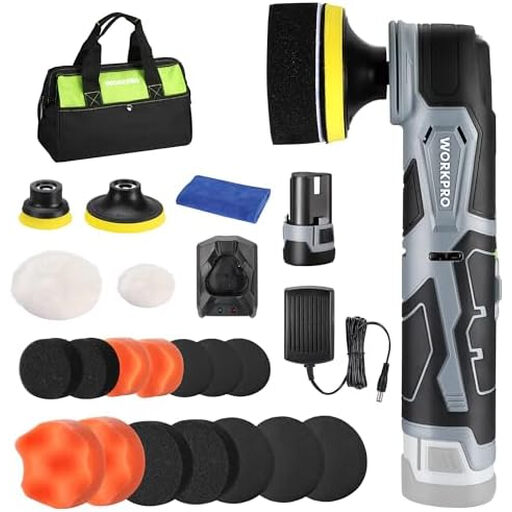
Why This Fits Their Persona: A practical starting point for UK vehicle owners who want a compact tool for waxing, light polishing and detail areas without investing in a larger machine.
Its five speed settings and published overheat protection information give buyers clearer expectations than a tool with only a headline RPM figure.
Five settings from 600–3,000 RPM, 0.85 kg weight, 2.0 Ah battery and a kit containing pads, sandpaper, charger and carry bag.
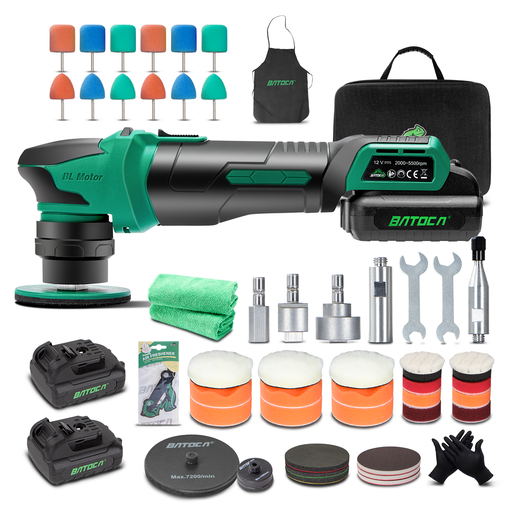
Why This Fits Their Persona: Suited to detailers and hobbyists who want a more adaptable mini system for paintwork, bumpers, mirrors, wheels and confined areas.
The rotary and random-orbital systems provide a choice of movement, helping prevent buyers from being limited to one polishing style.
Brushless motor, two 12 V 2.5 Ah batteries, 25 mm and 75 mm backing plates, extension rod and four speeds from 2,000–5,500 RPM.

Why This Fits Their Persona: A larger-pad option for users handling longer sessions across cars, SUVs, vans, boats or motorhomes.
Two batteries reduce reliance on a single charge, while the LCD display makes speed and battery information visible during use.
8 mm orbital movement, 125 mm polishing sponge, six speed levels from 2,000–4,500 RPM and two stated 5 Ah batteries.
We have compiled a complete, real-time list of products that fully satisfy these strict selection criteria and UK safety regulations.
The machine is only one part of the process. Harder pads can provide more cutting action, while softer foam pads are generally used for refinement, waxing or brightening. The polishing sponge set listed above includes several foam styles and a synthetic wool pad, with hook-and-loop attachment and an M10 drill adapter.
Before use:
A mini car polisher is particularly useful for isolated marks, wheels and narrow sections, but it may take considerably longer on a large bonnet or roof. For broad panels, consider whether the pad size and battery arrangement are practical.
A compact machine with variable speed can be suitable for beginners when used carefully. Start at the lowest setting, use a clean soft pad and avoid concentrating on one spot. A dual-action model may offer a more forgiving starting point than a rotary machine, although technique remains important.
Runtime varies according to battery capacity and workload. The BATOCA S6 lists up to 30 minutes without load and includes two 2.0 Ah batteries. The BATOCA S2 is supplied with two stated 5 Ah batteries and lists approximately 60 minutes per battery. Actual results depend on speed, pressure, pad and surface resistance.
It may improve the appearance of light surface marks or oxidation when paired with a suitable compound and pad. Deep scratches that have passed through the clear coat may not be safely removable with a consumer car buffer and polisher. If you can see primer or bare metal, consider professional bodywork advice rather than repeatedly polishing the area.