
24/7 Customer Support

Free returns

Same-day & Next-day Delivery

Quality Guaranteed

Unlock Your Welcome Offers: FREE Delivery | Up to 80% OFF | Free 30-day JoyPlus trial
Download the APP
A steady supply of fresh ice can transform your daily drinks, from a morning iced coffee to an evening cocktail. A countertop ice maker promises this convenience without the need for plumbing or freezer-tray Tetris. However, the market is filled with models that often over-promise and under-deliver. Many buyers find themselves with a machine that is noisy, difficult to clean or simply doesn't produce ice as expected.
As a Joybuy Product Recommendation Officer, my role is to help you navigate these choices. This guide cuts through the marketing jargon, focusing on the practical realities of owning a home ice machine and highlighting the key features that truly matter for UK households.
Before you add any model to your basket, be aware of these common issues that can lead to buyer's remorse.
Focus on these three specifications to find a machine that fits your actual needs.
The advertised "ice in 6-9 minutes" refers to the time for the first batch of cubes. This is a useful metric for a fast ice maker, but it's not the whole story. You must also check the ice basket capacity. A typical basket holds around 0.5kg to 0.7kg of ice. If you're hosting a gathering, a machine that produces ice quickly but has a tiny basket will require constant attention. Balance the cycle time with how much ice the machine can hold at once.
A small ice maker is ideal for a crowded kitchen, but its dimensions are critical. Measure your intended countertop space, remembering to account for the required ventilation clearance (usually 15cm around the sides and back). If you plan to use it as an ice maker for camping or in an RV, weight and the presence of a sturdy handle become primary concerns. A true portable ice maker should be light enough to move comfortably and compact enough to store in a vehicle.
Look for features that simplify upkeep. A large, easily accessible water reservoir is simpler to fill and clean. A dedicated drain plug, usually on the side or bottom of the unit, is non-negotiable for easily emptying the machine before cleaning or storage. Without it, you'll be left trying to tip a heavy, awkward appliance over a sink. This, combined with a simple control panel, makes the difference between a helpful gadget and a cupboard-dwelling chore.
Based on these practical considerations, here are some models suited to different UK users.

Why This Fits Their Persona: This is a straightforward, reliable choice for daily use in a family kitchen or small office. It provides a consistent supply of ice for drinks without overly complex features, striking a good balance between performance and simplicity.
Its simple one-touch operation and clear 'ICE FULL' and 'ADD WATER' indicators manage expectations well. The self-cleaning function is presented as a convenience feature for freshness, not a replacement for manual cleaning.
Offers two different bullet ice sizes to suit various drinks. The 6-9 minute cycle time provides a quick first batch for immediate needs.

Why This Fits Their Persona: Designed with portability in mind, this model is ideal for those who need ice on the go, whether in an RV, at a campsite or for a garden party. Its integrated handle and relatively low weight make it genuinely easy to transport.
It provides a specific noise level rating of ~48 dB, allowing buyers to make an informed decision about its suitability for smaller, quieter environments like a caravan. This transparency helps avoid the "quiet" machine pitfall.
The built-in portable handle is a significant practical advantage for moving the unit. Its compact footprint and durable ABS construction are well-suited for travel and outdoor use.
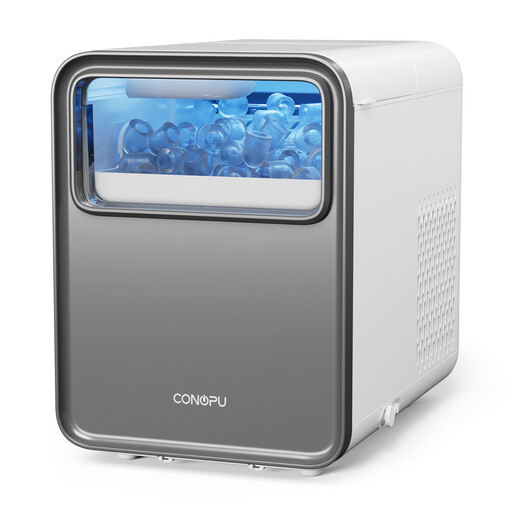
Why This Fits Their Persona: For someone who frequently entertains, speed and convenience are paramount. This machine's fast 6-minute cycle for 9 cubes ensures a rapid turnaround, while the large viewing window lets the host monitor ice levels at a glance without stopping production.
By highlighting its 1.5L water tank and fast cycle time, it sets a realistic expectation that it's a machine designed for quick, continuous production, implicitly acknowledging the need to empty the basket during high-demand events.
The 30-minute self-cleaning cycle and side drain hole make post-party cleanup more efficient. The transparent window with ambient light is a practical feature for busy hosts.
We have compiled a complete, real-time list of products that fully satisfy these strict selection criteria and UK safety regulations.
No, this is a critical point to understand. The ice basket in a countertop ice maker is not a freezer. It is insulated to slow down melting, but the ice will begin to melt over time. The melted water typically drains back into the reservoir to be made into new ice. For long-term storage, you must transfer the freshly made cubes to your freezer.
The running cost is relatively low. A typical ice machine for home use has a power rating of around 120-150 watts. When it is actively making ice, it will consume about 0.12-0.15 kWh per hour. Based on current UK electricity rates, this translates to just a few pence per hour of operation. The cost will be highest during the initial cool-down and becomes more efficient as it runs.
For optimal hygiene and performance, especially in hard water areas, a cleaning routine is important. It is good practice to drain and wipe the interior dry after each use, or at least weekly if used daily. A full cleaning cycle using a dedicated descaling solution or a vinegar-water mix should be performed every 3-6 months, depending on usage and water hardness, to keep the machine running efficiently and ensure your ice is fresh.