
24/7 Customer Support

Free returns

Same-day & Next-day Delivery

Quality Guaranteed

Unlock Your Welcome Offers: FREE Delivery | Up to 80% OFF | Free 30-day JoyPlus trial
Download the APP
Navigating UK roads comes with its own set of challenges, from unpredictable weather to the unfortunate rise in "crash for cash" schemes. A reliable car camera is no longer a novelty but a crucial tool for protecting yourself, your vehicle and your no-claims bonus. With so many options available, choosing the right system can feel overwhelming.
This guide is designed to cut through the marketing jargon. We will walk you through the key features to consider and present a selection of dash cams that offer practical solutions for UK drivers. Our goal is to provide clear, objective information to help you find a dash cam front and rear system that suits your needs.
Before diving into specific models, it helps to understand the features that make a real difference. Here are a few key points to consider when making your choice.
The primary purpose of a car dash camera is to capture clear, usable footage. While 1080p (Full HD) is a common standard, a 4K dash cam provides four times the pixel density. This significant increase in detail can be the deciding factor in identifying number plates or road signs, especially at a distance or in poor visibility. Also, pay attention to the field of view (FOV), measured in degrees. A wider angle (e.g., 130°-150°) captures more of the scene, reducing blind spots at the front and rear.
Modern dash cams offer more than just recording while you drive. A dash cam with parking mode provides surveillance even when your vehicle is unattended. This feature uses motion sensors or impact detection to automatically record incidents like bumps or break-in attempts. For this to work, the camera needs a constant power source, typically from a hardwire kit connected to your car's battery.
Furthermore, a night vision dash cam is essential for UK driving, where daylight hours are short in winter. Look for models with High Dynamic Range (HDR) technology and quality image sensors (like Sony's STARVIS range), which balance light and shadow to produce clear footage in low-light conditions. Finally, a dash cam with GPS automatically embeds your vehicle's location, speed and time into the video file, providing indisputable context for any recorded event.
A dash cam records large video files, so it requires a high-endurance microSD card designed for constant rewriting. Cheaper cards can fail quickly, leaving you without crucial footage. For power, many modern dash cams use supercapacitors instead of traditional lithium-ion batteries. Supercapacitors are more durable and perform better in extreme temperatures, from a frosty winter morning to a hot summer day, ensuring more reliable operation.
Based on features, performance and user feedback, here are our recommendations to help you find the right dual dash cam setup for your vehicle.

Why It Stands Out: While this is a front-only camera, its performance makes it an excellent entry point. The A200 records in 1080P at 60 frames per second (FPS), which is double the standard frame rate. This results in exceptionally smooth video, making it easier to capture details on fast-moving vehicles. Its HDR technology and 70mai's Night Owl Vision algorithm work together to deliver clear footage in challenging light.
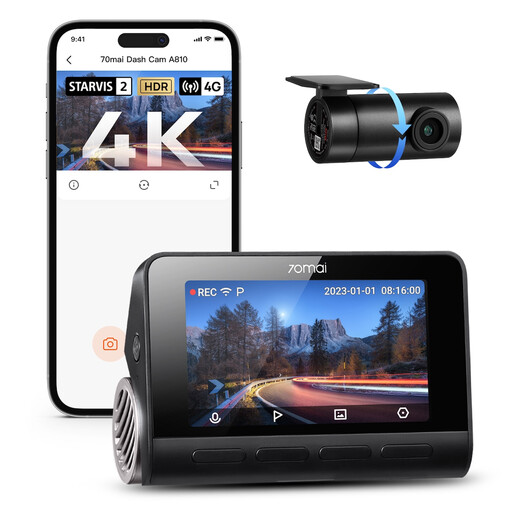
Why It Stands Out: This system is a complete solution for drivers seeking top-tier video quality. It pairs a true 4K front camera with a 1080p rear camera, both equipped with high-performance Sony STARVIS 2 sensors. This combination delivers outstanding clarity. The dual-channel HDR recording ensures that both cameras produce balanced, detailed footage, making it an exceptional night vision dash cam. Smart features like the built-in GPS and an AI-powered dash cam with parking mode (requires a hardwire kit) provide layers of security and data.
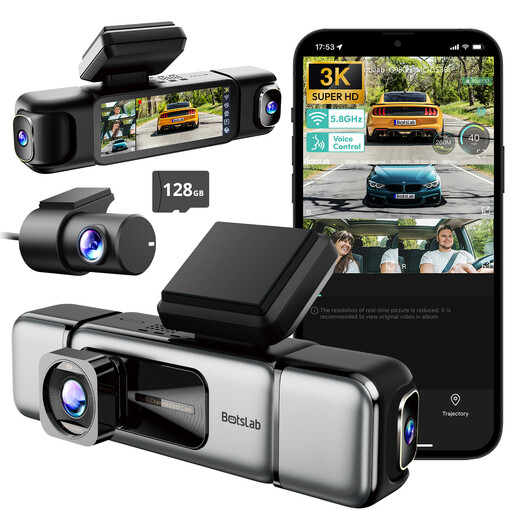
Why It Stands Out: For those who want to leave no angle uncovered, this BOTSLAB system offers a remarkable 560° all-sides view. It combines a front, rear and two detachable side cameras to eliminate blind spots entirely. This is particularly useful for navigating tight city streets, multi-lane motorways and car parks. The system is highly flexible, allowing you to switch between 4-channel, 3-channel or standard dual-cam modes. It also comes with a 128GB SD card, so it is ready to use straight out of the box.
A reliable dash cam setup depends on consistent power. Whether you need a hardwire kit to enable parking mode or a replacement car charger for on-the-go power, having the right accessories is essential. To ensure your car camera is always ready, explore our full range of power solutions.
Explore our range of Camera chargers.
Is a dash cam front and rear worth it in the UK? Absolutely. A dual-channel system provides a complete record of events around your vehicle. This is invaluable for proving fault in rear-end collisions—one of the most common incident types—and can help protect your no-claims bonus and defend against fraudulent claims from any direction.
How does a dash cam with parking mode work? This feature allows the camera to monitor your vehicle when it is parked and the engine is off. It uses a G-sensor to detect physical impacts or an AI algorithm to detect motion around the car. When triggered, it automatically wakes up and records the event. This function typically requires a continuous power supply from a hardwire kit, which connects the camera directly to the car's battery.
Do I need a 4K dash cam? While 1080p (Full HD) is often sufficient, a 4K dash cam captures four times as many pixels, resulting in a much sharper and more detailed image. This can be critical for reading a number plate from a distance or identifying small details in the footage, especially during playback on a larger screen. For those who want the clearest possible evidence, 4K is a worthwhile upgrade.