
24/7 Customer Support

Free returns

Same-day & Next-day Delivery

Quality Guaranteed

Unlock Your Welcome Offers: FREE Delivery | Up to 80% OFF | Free 30-day JoyPlus trial
Download the APP
Waking up to condensation streaming down your windows is a familiar sight for many in the UK. That persistent damp feeling in the air, the musty smell in wardrobes and the slow-drying laundry are all signs of excess humidity in your home. Left unchecked, this can lead to more serious issues like damp patches and mould growth, which can affect both your property and your well-being.
An electric dehumidifier is a practical and effective tool for managing indoor humidity levels. However, with so many models available, choosing the right one can feel overwhelming. This guide is designed to cut through the clutter, offering clear, practical advice to help you select a home dehumidifier that suits your specific needs, whether you're tackling a damp basement or simply want a quieter bedroom.
Before selecting a model, it's helpful to understand a few key features. Focusing on these will ensure you find a unit that performs effectively for your space.
A dehumidifier's primary job is to remove moisture from the air, measured in litres per day. A small dehumidifier with a lower extraction rate is often sufficient for a single bedroom or a small office. For a large room dehumidifier, or for tackling significant damp in a basement, you will need a model with a much higher extraction capacity (e.g., 20L or more per day). The water tank size is also important; a larger tank means you'll be emptying it less frequently, which is convenient for continuous operation.
If you plan to use the unit in a living area or bedroom, a quiet dehumidifier is essential. Noise levels are measured in decibels (dB)—a model operating under 40 dB is generally considered quiet. Beyond this, consider features that match your lifestyle. A dedicated laundry mode is a key feature for a dehumidifier for drying clothes indoors during winter. Timers allow you to schedule operation to save energy, while a portable dehumidifier with wheels or a handle offers flexibility to move it between rooms.
For those who appreciate convenience and technology, a smart dehumidifier can be an excellent choice. These models connect to your home Wi-Fi, allowing you to control settings, monitor humidity levels and set schedules directly from a smartphone app or via voice assistants like Amazon Alexa and Google Home. This allows you to manage your home's environment even when you're not there.
Here are our recommendations, selected to address common household needs from small-space moisture control to tackling serious damp in larger areas.
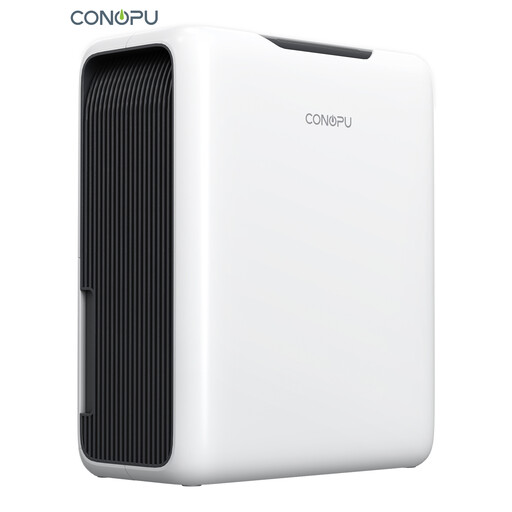
View Product: CONOPU Dehumidifier CS13, 3L Water Tank
Why It Stands Out This CONOPU model uses Peltier technology, which allows it to operate very quietly, making it an excellent choice for bedrooms and offices. Despite its compact size, it features a surprisingly large 3L water tank, reducing the frequency of emptying. Its automatic defrost function ensures it can continue to perform in cooler temperatures, a useful feature for unheated rooms.
Pros
Who is it for? This is an ideal bedroom dehumidifier or for anyone needing a quiet dehumidifier for a small room (up to 20㎡). It's a great starting point for managing localised condensation and mustiness without intrusive noise.
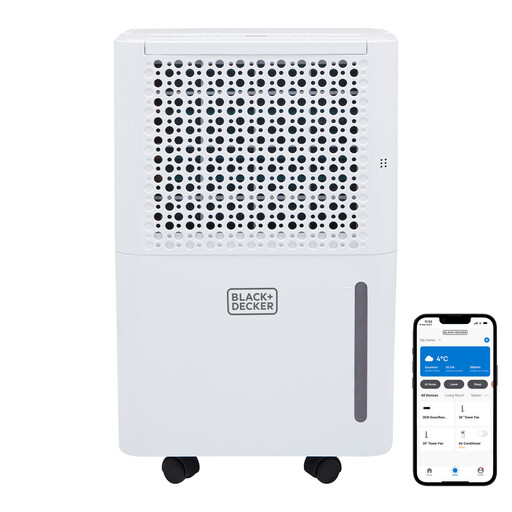
View Product: BLACK+DECKER 12L Smart Dehumidifier & Ioniser
Why It Stands Out This model combines effective moisture removal with modern convenience. As a smart dehumidifier, it connects to the BLACK+DECKER Home app and voice assistants, giving you full control from anywhere. Its 12L per day extraction rate is substantial for its size, and the built-in ioniser helps to freshen the air as it dehumidifies.
Pros
Who is it for? Perfect for the tech-savvy user who wants to integrate their dehumidifier into a smart home setup. It’s a strong all-rounder for living rooms, bedrooms or home offices where both humidity control and air quality are priorities.
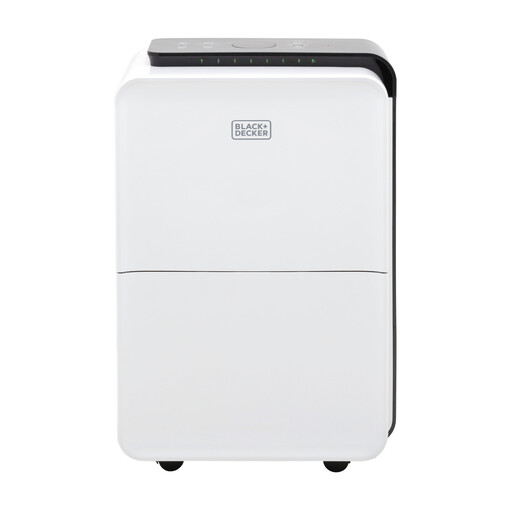
View Product: BLACK+DECKER 30L Smart Dehumidifier – 4-in-1 Function
Why It Stands Out When you need serious performance, this 30L unit delivers. It's built to handle large spaces and significant humidity problems, making it a powerful tool against widespread damp and mould. Its 4-in-1 functionality includes an Air Refresh mode with a carbon filter to tackle odours. For continuous operation, it has a large 4L tank and an option to attach a hose for continuous drainage, making it a true set-and-forget solution.
Pros
Who is it for? This is the solution for homeowners dealing with persistent damp in large rooms, open-plan living areas, utility rooms or basements. It is also an excellent choice for anyone who regularly needs a dehumidifier for drying clothes quickly and efficiently.
Our recommendations cover a range of common needs, but the right choice is always personal. If you're looking for a model with a specific timer function or a different capacity, we have a wider selection to explore.
Browse our full collection of Timer Dehumidifiers to find the perfect fit for your home.
Where is the best place to put a dehumidifier? For general use, place the dehumidifier in the centre of the room, ensuring there is at least 50cm of clearance around it for good airflow. Avoid placing it directly against walls or furniture. If you're targeting a specific problem, like condensation on windows, placing it nearby can be more effective.
Can a dehumidifier help with mould? Yes. A dehumidifier for mould is a preventative tool. Mould thrives in damp conditions, so by reducing the relative humidity in the air to below 50%, a dehumidifier creates an environment where it is difficult for mould spores to grow and spread. It is highly effective at preventing new mould from appearing.
How long should I run a dehumidifier each day? This depends on the humidity level in your home. When you first get a dehumidifier, you may need to run it continuously for several days to bring the humidity down to a target level (typically 40-50%). After that, you can use the built-in humidistat on an auto mode to maintain that level, or use a timer to run it for a few hours each day to manage energy consumption.