
24/7 Customer Support

Free returns

Same-day & Next-day Delivery

Quality Guaranteed

Unlock Your Welcome Offers: FREE Delivery | Up to 80% OFF | Free 30-day JoyPlus trial
Download the APP
From a perfectly risen sourdough loaf to a precisely managed meal plan, the secret to consistency in the kitchen often comes down to one simple tool: a reliable set of digital kitchen scales. Guesswork with cups and spoons can lead to disappointing bakes and inaccurate nutritional tracking. Whether you are a passionate home baker, a health-conscious individual or a coffee connoisseur, having the right instrument to measure your ingredients is fundamental.
This guide is designed to help you navigate the options available. We will explore the key features to consider and present a few standout models tailored to different needs, helping you find the ideal scales to bring greater accuracy and control to your kitchen.
With so many models on the market, focusing on a few key criteria can simplify your decision. Here are three practical points to consider before you buy.
The level of precision you need depends entirely on your primary use. For general cooking and baking, standard baking scales with a 1g graduation are perfectly suitable. They provide the accuracy needed for flour, sugar and other common ingredients. However, for tasks like brewing speciality coffee or precise dietary portioning, a precision kitchen scale 0.1g offers a much finer degree of measurement. Also, consider the maximum capacity. Most scales handle up to 5kg, which is ample for the majority of home cooking tasks, but it is always worth checking if you regularly work with larger batches.
Beyond basic weighing, certain features make a huge difference in day-to-day use. The 'tare' function is non-negotiable; it allows you to reset the scale to zero after placing a bowl on it, so you can measure ingredients directly into your container. A clear, backlit display is also crucial for easy reading in any lighting. Look for models with multiple unit conversions (g, oz, lb, ml) for recipe flexibility. Finally, consider the power source. While many reliable electronic food scales use standard batteries, some newer models are rechargeable kitchen scales, often using a convenient USB-C connection.
Your choice here depends on your goals. A standard digital scale is a straightforward tool for measuring weight. A smart kitchen scale, however, connects to a smartphone app via Bluetooth. These are often called nutritional food scales or calorie counting scales because the app can access a food database to calculate and log calories, protein, carbohydrates and other macronutrients from the weight of your food. For anyone following a specific diet or fitness plan, these diet scales can be an invaluable tool for effortless tracking.
After analysing the features that matter most to UK users, we have selected three distinct models that cater to different kitchen needs.
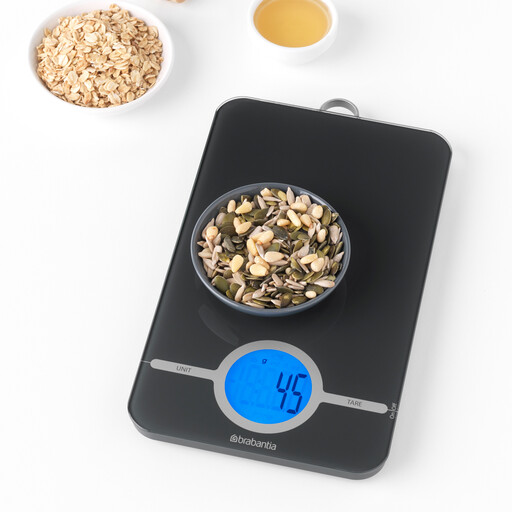
Why It Stands Out: The Brabantia Tasty+ is a superb all-rounder that combines sleek design with practical functionality. Its large, tempered glass surface is hygienic and easy to clean, while the illuminated LCD display ensures readings are always clear. It is a reliable workhorse for any home cook.
Pros:
Who is it for?: The everyday home cook or baker who needs a dependable, stylish and straightforward set of food weighing scales for general recipes and meal preparation.

Why It Stands Out: This smart kitchen scale is built for anyone serious about tracking their dietary intake. By syncing with the RENPHO Health app, it goes beyond simple weight measurement to provide detailed nutritional analysis, making it an excellent tool for health and fitness goals.
Pros:
Who is it for?: Fitness enthusiasts, individuals on a managed diet or anyone who wants a powerful nutritional food scale to simplify calorie and macro tracking.

Why It Stands Out: The TIMEMORE Black Mirror Basic 2 is a specialist tool designed for the art of coffee brewing. It combines ultra-fine precision with a built-in timer and a unique flow-rate function, giving you complete control over every pour-over or espresso shot.
Pros:
Who is it for?: The dedicated coffee enthusiast who understands that precision is key to a perfect brew and needs a specialised scale to match their passion.
If these specific models are not quite what you are looking for, there are many other excellent choices available. Whether you need a different size, colour or a specific feature, you can find a suitable match for your kitchen.
Explore our full collection of digital kitchen scale models to find the perfect fit.
Are digital kitchen scales more accurate than manual ones? Yes, in general, electronic food scales offer a higher level of accuracy and consistency compared to traditional spring-based manual scales. The digital sensors provide a precise readout, often to the gram or tenth of a gram, removing the guesswork involved in reading a needle on a dial.
How do I calibrate my digital kitchen scales? Most modern digital scales arrive pre-calibrated from the factory and do not require manual calibration by the user. To ensure accurate readings, the most important step is to always place your scales on a completely flat and stable surface. If you ever feel the readings are off, you can perform a 'zero' reset by pressing the tare button before placing any items on it. For specific calibration instructions, it is always best to consult the product's user manual.
Can I weigh liquids on a digital food scale? Absolutely. This is one of the key advantages of a good digital scale. Most models include a unit setting for millilitres (ml), which allows you to measure liquids like water, milk or oil by weight. This method is often more accurate than using a measuring jug. Simply place your jug or bowl on the scale, press the tare button to zero it out, and then pour your liquid until you reach the desired weight.