
24/7 Customer Support

Free returns

Same-day & Next-day Delivery

Quality Guaranteed

Unlock Your Welcome Offers: FREE Delivery | Up to 80% OFF | Free 30-day JoyPlus trial
Download the APP
An electric contact grill can make quick work of steaks, burgers, paninis, toasted sandwiches and vegetables without relying on an outdoor barbecue. However, choosing the right model involves more than comparing wattage or trusting phrases such as “family size” and “non-stick”.
The useful question behind the search for the best electric contact grill is: which appliance suits your cooking habits, available worktop space and cleaning expectations?
Power affects how quickly a grill heats and how well it recovers temperature when cold food is added. It does not, by itself, guarantee even cooking. A grill with 800W may suit sandwiches and smaller portions, while an 1800W–2200W model is more suitable for thicker steaks or frequent family cooking.
Also check the cooking surface. A powerful grill with small plates may still require several batches.
Non-stick coatings can make cooking and cleaning easier, but they still need careful use. Metal utensils, abrasive scourers, excessive heat and stacking heavy items on the plates may damage the surface.
Look for clear information about whether the plates are removable, dishwasher-safe or designed for wipe-down cleaning. If the listing only says “easy to clean” without explaining how, check the manual and product specifications before purchasing.
A contact grill cooks food between two heated plates, but not every model opens in the same way. Some have a floating top plate for thicker food; others open to 180 degrees and become a flat tabletop grill. This increases flexibility but also requires extra clearance behind and around the appliance.
Measure your worktop and storage cupboard, including the handle and power cord. A large family-size electric grill may be practical during use but inconvenient to store in a compact kitchen.
For occasional toasted sandwiches, a compact sandwich maker or panini press with around 800W can be sufficient. For steak, burgers and repeated batches, look for approximately 1800W or more.
An adjustable thermostat is useful when switching between bread, vegetables and meat. Simple indicator lights show heating status, while rotary controls allow you to select a setting. More advanced options, such as the Tefal OptiGrill Plus, add automatic programmes and thickness measurement; these features may appeal to households that want more guidance, although they usually come with a larger footprint and higher price.
Compare the actual plate dimensions rather than relying on labels such as “large”. For example:
Grooved plates can create grill marks, while a flat-open design gives more usable surface area. A floating upper plate is helpful for food of different thicknesses because it can sit more naturally over burgers, steaks and filled paninis.
A removable drip tray can collect cooking juices and excess fat, helping keep the worktop cleaner. Sloped or curved plates may direct grease towards the tray, but they do not remove the need to monitor food or clean the appliance after use.
For UK homes, check that the appliance is suitable for the 220–240V mains supply and follow the supplied instructions. Place it on a stable, dry, heat-resistant surface with ventilation around it. Always unplug the grill and allow it to cool fully before removing plates or cleaning. Keep water away from the electrical housing, and use wooden, silicone or nylon utensils on coated surfaces.

Why This Fits Their Persona: A compact option for students, couples and smaller UK kitchens that mainly prepare toasties, paninis, burgers or individual portions.
Its listed 22.5 × 14cm plates and 800W output make its intended capacity clear, reducing the risk of expecting family-sized batches from a mini grill.
Double-sided heating and food-grade non-stick plates; combines a grill, sandwich maker and panini press.
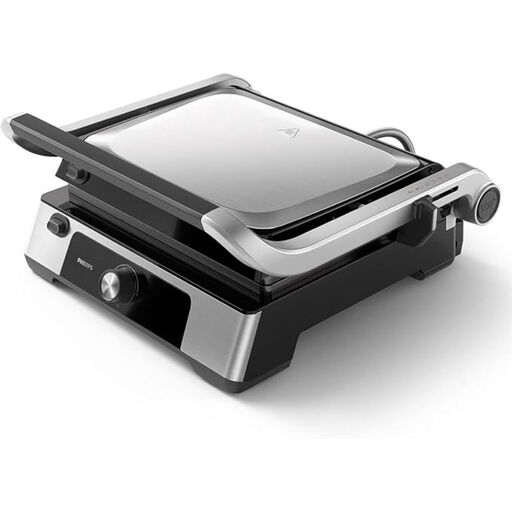
Why This Fits Their Persona: Suitable for regular home cooks wanting adjustable control, a larger surface and flexible indoor grilling for different food thicknesses.
The specifications identify removable plates, an adjustable-height top plate, adjustable temperature and a removable grease tray.
Up to 2200W maximum power, 180-degree opening and removable non-stick plates.

Why This Fits Their Persona: A practical match for busy families and frequent cooks preparing steaks, burgers, vegetables and toasted sandwiches in larger batches.
Its 28 × 22cm plates give a clearer indication of capacity than vague family-size wording, while 2000W is suited to faster batch cooking.
Double-sided heating and large food-grade non-stick plates for steaks, paninis and vegetables.
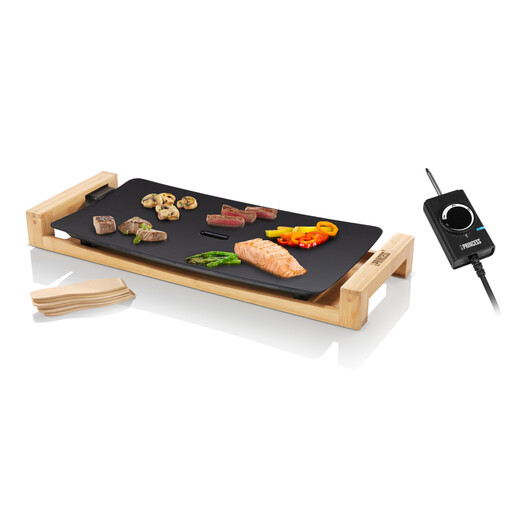
Why This Fits Their Persona: Designed for households that prefer serving grilled food at the table during family meals or informal entertaining.
The 50 × 25cm cooking surface is clearly specified, so shoppers can judge table space and portion capacity before ordering.
2500W output, integrated grease collection tray and natural bamboo housing.
We have compiled a complete, real-time list of products that fully satisfy these strict selection criteria and UK safety regulations.
Yes, provided the appliance is suitable for the UK’s 220–240V mains supply and is used on a stable, heat-resistant worktop with suitable ventilation. It should not be placed close to water, curtains or other flammable materials. Follow the supplied instructions and avoid leaving it unattended while switched on.
Running cost depends on the appliance’s power rating and how long it operates. A simple calculation is:
Power in kW × usage time in hours × your electricity tariff = approximate cost
For example, an 800W grill uses 0.8kWh if operated continuously for one hour, while a 2000W grill uses 2kWh in the same period. In practice, preheating and cooking times vary, and the grill cycles as it maintains temperature.
Lifespan depends on construction, frequency of use and maintenance. To help preserve the plates, avoid metal utensils and abrasive cleaning products. Allow the appliance to cool before cleaning, keep the electrical housing dry and inspect the cord, plug and coating regularly. Stop using the grill if it becomes damaged and consult the manufacturer’s guidance.