Whole-wall post-move cleaners
If tiles cover substantial wall sections, particularly above shoulder height or near the floor, reach and a controllable brush angle matter more than a small head for tight spaces.


Choose a telescopic scrubber if the post-move clean involves broad tiled walls with high or low sections. A compact handheld brush offers closer control around fittings, while a small detail scrubber suits grout and tight edges rather than covering the whole wall. Before choosing, check the supplied heads, the exact model’s wet-use instructions and whether its battery and charger are included.
If tiles cover substantial wall sections, particularly above shoulder height or near the floor, reach and a controllable brush angle matter more than a small head for tight spaces.
If dirt is concentrated in grout, corners or around utility-room fittings, a narrow head that can get close to those areas matters more than pole length.
For a one-off move-in clean followed by smaller household jobs, consider the heads supplied, charging arrangement and storage needs alongside wall reach.
Choose it when: High, low or broad tiled sections would otherwise mean frequent stretching, bending or repositioning.
Trade-off: A long handle takes more storage space; check whether a battery and charger come with the particular tool.
Choose it when: The tiled area is within easy reach and close control around pipes, taps or shelves is the priority.
Trade-off: A handheld brush does not solve the problem of reaching overhead tiles.
Choose it when: Grout channels, corners and the edges around fittings are the main remaining jobs.
Trade-off: Small heads are less suited to covering an entire tiled wall.
| Concern | What to check | Who this matters to |
|---|---|---|
| Reach and posture | Check the extended handle length, head angle and whether you can comfortably control the tool at the wall’s highest and lowest tiles. | I have a large area of high and low tiles to clean and want to avoid repeatedly stretching or crouching. Around 36% of consumers would make reach their primary concern. |
| Grout and awkward edges | Confirm which narrow, side or cone-shaped heads are supplied and whether the instructions permit their use on your surfaces. | Dirt is concentrated along grout and around fittings, where a broad brush may not reach. For around 29% of consumers, cleaning those details comes first. |
| Use beyond the move-in clean | Look at the included attachments, settings and surface instructions for the other household jobs you expect to tackle. | I want to keep using the scrubber for smaller jobs after cleaning the wall, without relying on one head for every surface. Versatility would lead the decision for around 21% of consumers. |
| Power and wet-use setup | Check battery and charger inclusion, the exact model’s water-resistance wording and how to obtain suitable replacement heads. | I need the tool ready for a wet cleaning task and do not want to discover that essential power equipment is separate. Around 14% of consumers would put this setup first. |
Ryobi says its R18TPS-0 comes without a battery or charger, and its stated runtime depends on the battery used.
Check that you have a compatible 18V ONE+ battery and charger, or select a package that includes what you need.
Without compatible equipment already at home, the battery and charger are additional items to obtain.
Bosch specifies IPX5 splash protection for the UniversalBrush, while Ryobi specifies IPX7 for the R18TPS-0. Neither rating should be transferred to a different model.
Follow the exact scrubber’s wet-use instructions; do not infer that it can be immersed from its cordless design or appearance.
Flat tile faces, narrow joins and corners call for different head shapes. An attachment suitable for one surface may be inappropriate for another.
Check the heads supplied and the model’s surface instructions before using a brush or scouring pad on the tile or a nearby fixture.
The Health and Safety Executive warns in its cleaner-safety guidance that some cleaning products can cause skin burns or eye damage.
Follow both the cleaner label and the scrubber instructions. Ventilate the room, limit splashes and use suitable protection when the product or task calls for it.
Ryobi’s UK cordless range includes long-reach scrubbers for substantial or awkward-to-reach tiled sections, alongside smaller formats.
Lakeland offers both a handheld cordless scrubber and an extendable Turbo Scrubber for household tile-cleaning tasks.
The Bosch UniversalBrush is a compact option with interchangeable accessories for tiles, joints and smaller household tasks.
SonicScrubber’s household system focuses on grout, joins and other confined areas where a small head can reach the work.
These cordless scrubbers are relevant to tiled-wall cleaning after a move. Three have extendable handles for assessing high and low sections; the Iagreea model is a separate option to consider for work close to the wall. Check the included heads before relying on any of them for narrow grout lines.
 No image available
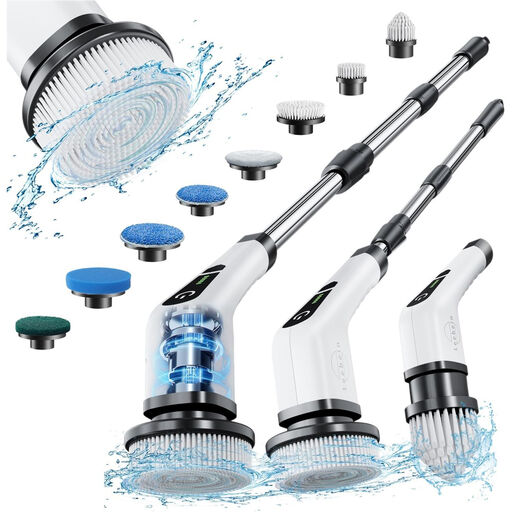
Consider the adjustable handle for tiled sections at different heights. The product name specifies eight interchangeable heads and two rotation speeds; check which heads suit your grout and tile finish.
Follow the model’s rinsing instructions rather than submerging the tool.
 No image available
The adjustable handle makes this a model to assess for higher and lower tiles. Its product name specifies a 137 cm handle and eight interchangeable heads; check the supplied head shapes before choosing it for grout or corners.
Read the exact model’s instructions for use around water.
 No image available
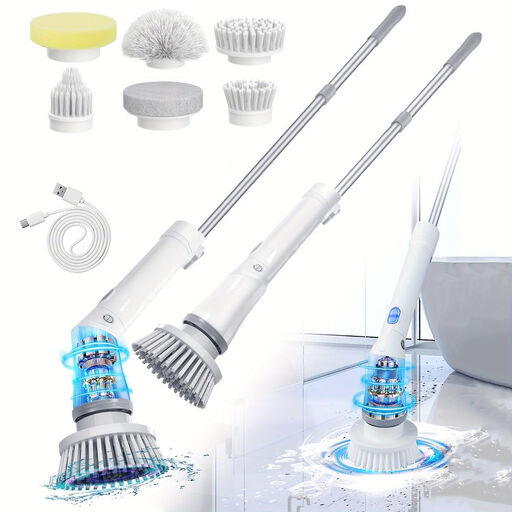
The extendable handle is relevant if the tiled wall includes sections that are awkward to reach. The product name specifies seven heads, two speeds and an IPX7 claim; confirm the head shapes and follow the model’s wet-use instructions.
 No image available
Consider this lightweight model for areas you can work on at close range. If high or low tiles are central to the job, confirm its handle reach before choosing it; also check the supplied heads and wet-use instructions.
Choose a telescopic model for substantial high or low wall sections; choose a handheld model when close control around fittings matters more. Ryobi specifies a 1.4 m pole and pivoting head for its R18TPS-0, while Lakeland lists extended reach for its Turbo Scrubber. A handheld tool will not remove the need to reach overhead tiles.
They may need different head shapes when the job combines broad tile faces with narrow joins or corners. Check that the exact kit supplies heads for both tasks and that its instructions allow their use on your tile and grout surfaces.
Use the combination only as directed by both the scrubber and cleaning-product manufacturers. The Health and Safety Executive warns that some cleaners can cause skin or eye harm; follow the label’s ventilation and protective-equipment instructions and take care to limit splashes.
A bare-tool listing may omit the battery and charger needed to operate the scrubber. Ryobi says its R18TPS-0 is supplied without either, so check whether you already have compatible 18V ONE+ equipment or need a package that includes it.
No general immersion rule applies to every electric scrubber. Bosch specifies IPX5 splash protection for the UniversalBrush, while Ryobi specifies IPX7 for the R18TPS-0; follow the wet-use instructions for the exact model rather than applying another tool’s rating to it.