Finding a gift that genuinely captures a child's or teenager's imagination can be a challenge. In a world full of screens, hands-on activities that are both entertaining and educational are more valuable than ever. Engineering toys offer a fantastic solution, providing a gateway to understanding how the world works while developing critical thinking and problem-solving skills.
As a Joybuy Product Recommendation Officer, my role is to help you navigate the options. This guide is designed to provide practical advice and highlight some standout choices, helping you find a project that will inspire a future innovator or provide a satisfying challenge for a hobbyist.
How to Choose the Right Engineering Toy
Before diving into specific products, considering a few key factors can help you make a more informed decision.
1. Match the Project to Their Passion: Electronics or Mechanics?
Engineering is a broad field. A great first step is to identify what sparks their curiosity.
- For the future electrician: If they are fascinated by gadgets, lights and how remote controls work, an electronics kit for kids is an ideal starting point. These kits focus on circuits, power and components like resistors and diodes in a safe, controlled way.
- For the aspiring mechanic: If they are more interested in gears, pistons and moving parts, mechanical toys are the way to go. A build your own engine kit, for example, provides a tangible and rewarding insight into how vehicles and machinery function.
2. Balance Challenge with Age-Appropriateness
The goal is to challenge, not frustrate. Always check the manufacturer's recommended age range, but also consider the individual's patience and experience. A kit with over 250 small parts might be overwhelming for a 10-year-old new to model building, but perfect for a focused teenager or adult. The best educational building toys grow with the user, allowing them to build confidence before moving on to more complex science toys for teenagers.
3. Prioritise Clear Instructions and Safety
A well-designed engineering toy should come with a clear, step-by-step instruction manual. Diagrams are often more helpful than text alone. For UK buyers, ensure the product adheres to safety standards, especially concerning small parts and any electrical components. Kits that require no glue or soldering are often a great, mess-free choice for younger builders.
Top Engineering Toy Recommendations
Based on their design, educational value and user experience, here are a few recommendations that cater to different interests and skill levels.
Science Mad SM37 Electrical Circuit Lab
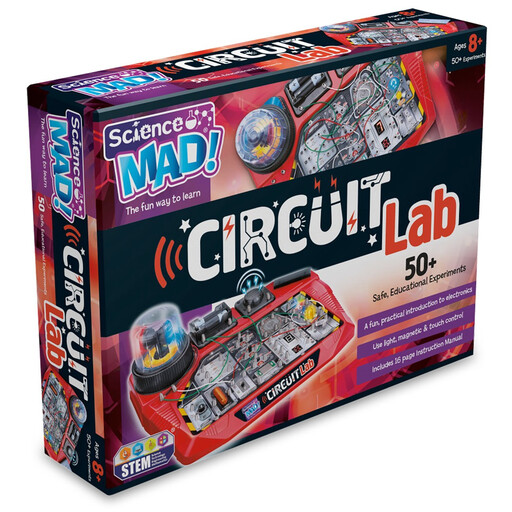
- Why It Stands Out: This kit is an excellent introduction to the world of electronics. With 50 different experiments, it offers a huge amount of variety, taking a user from simple light-up circuits to more complex projects like a security alarm. The solder-free design, featuring easy-to-use spring connectors, makes it safe and accessible for younger enthusiasts.
- Pros:
- Solder-free assembly with pre-cut wires for safety and convenience.
- Teaches the function of core components like resistors, transistors and diodes.
- Includes interactive controls, including light, magnetic and touch-sensitive switches.
- Comes with a comprehensive 16-page instruction manual with clear diagrams.
- Who is it for: Children aged 8 and up who are curious about electricity and how everyday gadgets function. It’s a foundational STEM kit that builds confidence and technical vocabulary.
Machine Works Build Your Own 4-Cylinder Engine
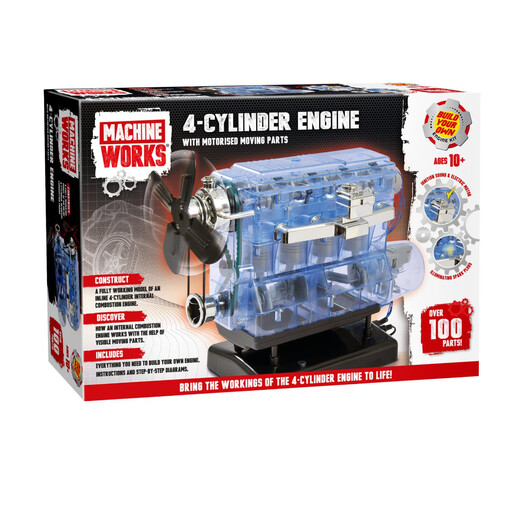
- Why It Stands Out: This kit demystifies one of the most common types of internal combustion engines. The transparent casing is its key feature, allowing builders to see exactly how the pistons, crankshaft and valves work together. The addition of realistic engine sounds and illuminating spark plugs makes the finished model both an educational tool and an impressive display piece.
- Pros:
- Construct a fully functional 1:4 scale replica of a petrol engine.
- Includes over 100 precision parts for an authentic building experience.
- Features an electronic sound module and light-up spark plugs.
- Comes with a step-by-step manual endorsed by Haynes.
- Who is it for: Aspiring mechanics and car enthusiasts aged 10 and over. It’s one of the most popular model engine kits for those who want a hands-on understanding of automotive engineering without the grease and heavy lifting.
Machine Works Build Your Own V8 Engine
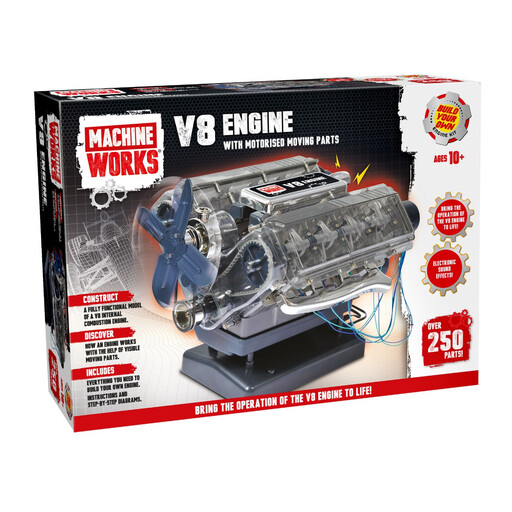
- Why It Stands Out: For those seeking a more significant challenge, the V8 engine kit is a fantastic step up. With over 250 parts, this project is considerably more complex and offers a deeper dive into advanced engine mechanics, including a dual overhead cam design. The finished, motorised model is a truly rewarding achievement for any serious hobbyist.
- Pros:
- A detailed and complex build with over 250 components.
- Transparent casing reveals the intricate movements of a V8 engine.
- Includes realistic engine sounds and synchronised light-up spark plugs.
- The Haynes-endorsed manual provides clear, expert-guided instructions.
- Who is it for: Teenagers and adult hobbyists looking for an immersive and substantial project. This is an excellent choice for someone who has already completed simpler mechanical toys and is ready for a more demanding and impressive build.
Looking for More Options?
While these three kits represent great choices in the electronics and mechanics categories, the world of educational toys is vast. If you're searching for a different type of project, from robotics to coding kits, we invite you to explore our full collection of STEM toys.
Frequently Asked Questions about Engineering Toys
What skills do engineering toys teach?
These toys are designed to develop a wide range of valuable skills. Key among them are logical thinking, problem-solving, fine motor skills and patience. They also provide a practical understanding of STEM (Science, Technology, Engineering, and Mathematics) principles, such as cause-and-effect, electrical theory and mechanical physics.
Are engineering toys just for boys?
Absolutely not. Curiosity and a passion for understanding how things work are universal. STEM kits and engineering toys are for any child, teenager or adult, regardless of gender. The skills they foster are beneficial for everyone in an increasingly technology-driven world.
What is a good age to start with engineering toys?
While simpler educational building toys can be introduced at a younger age, the more complex engineering toys involving small parts or detailed instructions are typically best for ages 8 and up. For intricate kits like the model engines, an age of 10+ is recommended, often with the option of adult supervision to help guide the process and share in the experience.


