For airflow around one hobby-room chair, start with a compact desk air circulator if you have a stable surface nearby: adjustable tilt or oscillation can help direct the breeze away from your face and loose materials. Check noise at the speed you would use, along with the base and cable position. A height-adjustable pedestal fan makes more sense if the seating position changes; a tower fan is worth considering when surface space is scarce.
Who is this for?
People with quiet, focused hobbies
If you read, paint, sew or work on detailed projects beside your chair, noise at the speed you actually use may matter as much as the strength of the breeze. Consider whether illuminated controls would distract you, too.
People who need directed airflow
If the aim is to move air around one seat rather than across the whole room, check whether the fan can point past your face and away from paper or lightweight materials on the work surface.
People with changing room layouts
If you move between a chair and a worktable, a portable fan or one with adjustable height may be easier to position. Check where its base and cable will go in each position.
What matters when choosing?
Desk air circulator
Choose it when: A stable nearby surface lets you direct airflow around one chair.
Allow for: The base takes up surface space, and the available aiming range depends on the model.
Adjustable pedestal fan
Choose it when: You need to change the airflow height as you move between the chair and a worktable.
Allow for: Its floor-standing base needs a clear, stable position.
Tower fan
Choose it when: Surface space is limited and a narrow floor-standing format fits beside the chair.
Allow for: Check whether its airflow can reach the height and direction you need around your work.
| Concern |
What to check |
Who this matters to |
| Directed airflow |
Check the available tilt and horizontal or vertical oscillation; confirm the base fits the intended position. |
If paper or small components sit beside my chair, I need air to pass the seat without blowing across my work. Around 36% of consumers put directed chair-side airflow first. |
| Noise while concentrating |
Identify the speed or mode behind any stated sound figure, and check the controls you would use during a session. |
For reading or detailed work, I want a usable breeze that does not draw my attention to the fan. Noise during focused use comes first for around 29% of consumers. |
| Space and placement |
Measure the available surface or floor space and plan the cable route; consider adjustable height if the fan must move between positions. |
When I shift between the chair and worktable, I need a fan I can place securely without blocking either area. Around 21% of consumers put flexible placement first. |
| Safety and upkeep |
Check that the fan can stand securely, that its cable can avoid chair and walking routes, and that cleaning instructions are available. |
With tools and cables near my seat, I want a stable fan I can maintain without putting it in the chair's path. Safe placement and upkeep are the primary concern for around 14% of consumers. |
Mistakes to avoid
-
Choosing by the minimum noise figure alone
A minimum figure does not tell you how the fan will sound at a setting that delivers enough airflow to your chair. Manufacturers may state figures for different modes, making the setting important to any comparison.
Check which speed or mode each sound figure describes, then consider the airflow adjustment and aiming range you need.
-
Overlooking the direction of the breeze
A fixed stream of air can disturb loose paper and lightweight hobby materials even when it feels comfortable at the chair.
Look for suitable tilt or oscillation and plan a position that moves air past the seat rather than directly across the work surface.
-
Leaving placement until after purchase
A desk fan needs a secure surface, while a floor-standing model needs room for its base. Electrical Safety First warns against placing a fan where it could be knocked over.
Measure the intended spot and keep the cable clear of the chair and walking route; do not balance the fan on an edge.
-
Assuming a listing settles suitability and safety
A product listing alone does not answer how its power arrangement, instructions or seller support will work for your setup. Electrical Safety First advises buying from a reputable retailer or directly from a known manufacturer.
Check the seller, supplied power arrangement, product instructions and recall-registration information before buying.
Brands to consider for these fan formats
Meaco
Meaco's Sefte range includes table and pedestal air circulators relevant to directed chair-side airflow.
- Meaco states that its Sefte 10-inch table model has 12 speeds, horizontal and vertical oscillation, and a minimum sound level of 25 dB.
- Those figures describe a named model, not every Meaco fan. Check the sound level at the setting you expect to use and whether the base fits your space.
Duux
The Duux Whisper Flex 2 is relevant when you want to switch between table-height and standing use.
- Duux states that Whisper Flex 2 has 30 speeds, adjustable horizontal and vertical oscillation, and table and standing heights of 54 cm and 92 cm.
- Check the power arrangement and terms for the particular version offered to you; the stated minimum sound level does not describe every speed.
Dyson
Dyson's AM07 illustrates the narrow, floor-standing tower format for rooms without a suitable nearby surface.
- Dyson lists 10 airflow settings for the AM07 and states sound levels of 38 dBA in quiet mode and 56 dBA at maximum.
- Check whether a tower's airflow reaches your seated position without blowing across your hobby materials; the AM07 specifications do not describe other Dyson models.
Joybuy product choices
These compact chair-side choices cover a desk fan and a portable tower fan. Compare their placement and airflow controls against your hobby setup, particularly if precise aiming or quiet use is decisive.
 No image available
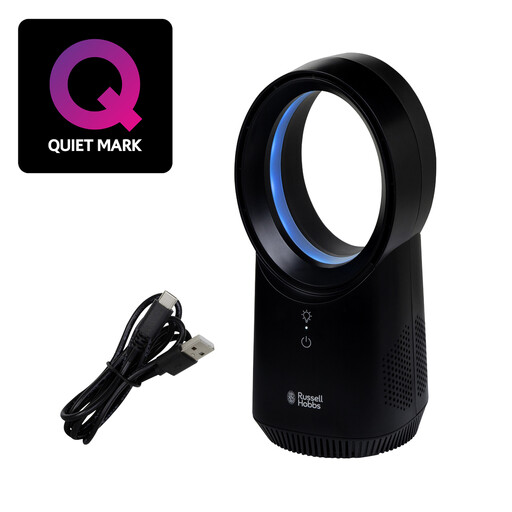
Russell Hobbs RHBLDLUSB25B Compact Wireless Bladeless Desk Fan, Black
Consider this desk format if you have a stable surface beside your chair and want to vary the breeze during a hobby session.
The product name specifies three speeds and USB charging. Before choosing it for detailed work, check how its airflow can be aimed and whether the noise at your preferred speed suits the room. Confirm the power arrangement needed for your setup.
View on Joybuy
 No image available
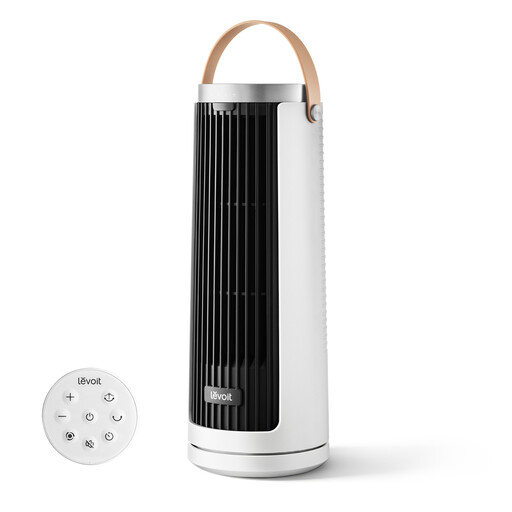
Levoit Windi Mini Plus Tower Fan
Consider this portable tower format if you need to reposition a fan around a small chair-side area.
The product name specifies multiple airflow modes and USB Type-C recharging. Check whether its airflow reaches the height and direction you need, and assess noise at the mode you would use for concentrated work. Confirm the charging arrangement for your setup.
View on Joybuy
Frequently asked questions
Should I put a desk fan or a pedestal fan beside my hobby chair?
Choose a desk fan if you have a secure nearby surface and mainly need airflow around one seat. An adjustable pedestal fan is more useful if you need to change the airflow height between the chair and a worktable, provided its base can stand clear of your walking route.
Will a fan with a low stated decibel figure be quiet at every speed?
No: check which setting the figure describes before judging whether the fan will suit concentrated work. For instance, Meaco states a minimum of 25 dB for its Sefte table model, while Dyson gives separate quiet-mode and maximum figures for the AM07; neither figure alone tells you how another setting will sound.
Where can I place a fan safely beside a hobby chair?
Put it on a stable surface or level floor where the chair cannot knock it over, and route its cable away from feet and moving furniture. Electrical Safety First advises care with fan placement; also follow the manufacturer's instructions for use and cleaning, and do not use a damaged unit or cable.


