
24/7 Customer Support

Free returns

Same-day & Next-day Delivery

Quality Guaranteed

Unlock Your Welcome Offers: FREE Delivery | Up to 80% OFF | Free 30-day JoyPlus trial
Download the APP
Packing for a family camping trip, a weekend festival or even just a day at the beach can feel like a logistical challenge. The journey from the car park to your perfect spot often involves multiple trips, juggling coolers, tents, chairs and bags. A reliable folding camping trolley can transform this experience, turning a strenuous haul into a single, manageable trip.
As the Joybuy Product Recommendation Officer, my role is to help you navigate the options. This guide is designed to provide practical advice on what to look for in a collapsible wagon and to highlight a few models that stand out for their features and utility, helping you make an informed choice without the marketing jargon.
Before looking at specific models, it helps to understand the key features that determine a trolley's performance. Focusing on these aspects will ensure you find a cart that meets your specific needs, whether it's for hauling gardening supplies or festival gear.
It's important to distinguish between these two measurements. Load capacity, measured in kilograms (kg), tells you the maximum weight the trolley can safely handle. A heavy duty garden cart might prioritise a high load capacity for soil and tools. Storage volume, measured in litres (L), refers to the amount of space inside the trolley. A large capacity camping cart is essential for bulky but lighter items like sleeping bags and pillows. Consider what you'll be carrying most often to find the right balance.
The wheels are arguably the most critical feature. Standard wheels are fine for smooth paths and pavements, but for the varied British landscape, you may need something more robust.
The frame provides the trolley's strength. Most are made from steel tubes, which offer a good combination of durability and weight. Check for a powder-coated or spray-painted finish, as this helps protect against rust from damp grass or sea spray. Equally important is how the collapsible wagon folds down. A good design will be intuitive to collapse and result in a compact shape that fits easily into a car boot or shed.
Based on a review of their specifications and features, here are a few notable options available on Joybuy.
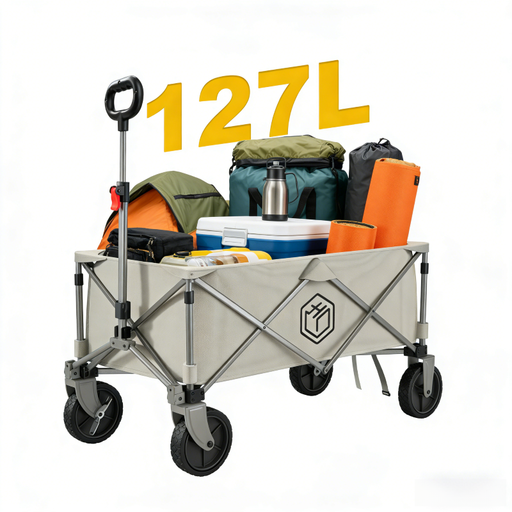
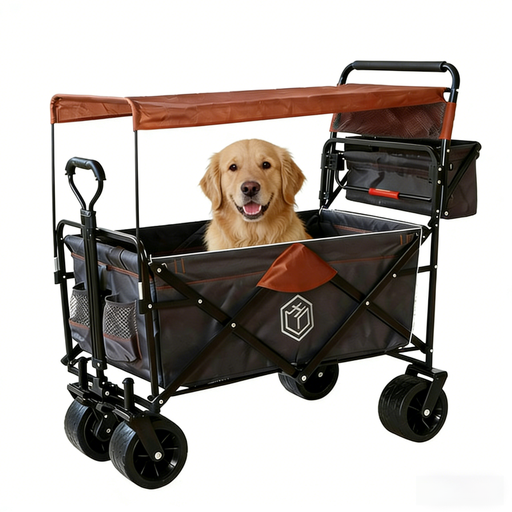
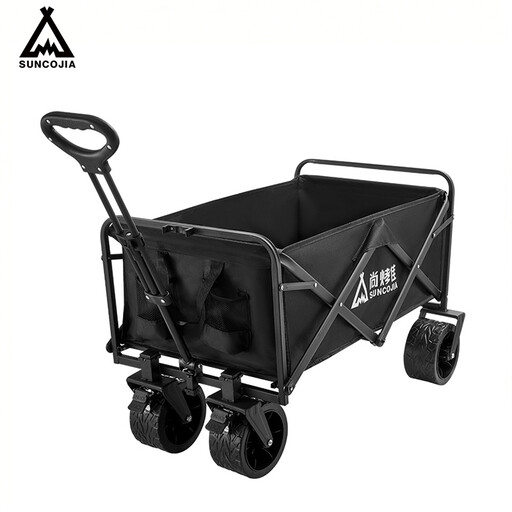
The models highlighted here cover a range of common needs, from heavy-duty hauling to all-terrain performance. However, if you have different requirements or are looking for alternative designs, there are many other styles to consider.
To see a wider selection of carts with different capacities, frame materials and features, you can explore our full range of Metallic Trolleys.
For a typical family of four on a weekend camping trip, a trolley with a load capacity of 80-100 kg and a volume of 90-150 litres is usually sufficient. This provides enough strength and space for a tent, sleeping bags, a cooler and other essentials. If you carry particularly heavy items like large water containers or cast-iron cookware, consider a model with a capacity of 150 kg or more.
Yes, but with a condition: the wheels must be suitable. A standard festival trolley with narrow wheels will likely dig into the sand and be very difficult to pull. To use a trolley on the beach, you need one with wide, 'off-road' style wheels that distribute the weight over a larger surface area, allowing it to glide over the sand more easily.
Maintenance is straightforward. After use, wipe down the fabric bin with a damp cloth to remove dirt or sand. For the frame, wipe it dry, especially if it has been exposed to rain or sea air, to prevent rust. Before storing, ensure the trolley is completely dry. Periodically check that all bolts on the wheels and frame are tight and lubricate the wheel axles if they begin to squeak.