
24/7 Customer Support

Free returns

Same-day & Next-day Delivery

Quality Guaranteed

Unlock Your Welcome Offers: FREE Delivery | Up to 80% OFF | Free 30-day JoyPlus trial
Download the APP
Choosing a new food processor can feel overwhelming. The market is filled with models promising to do everything from chopping vegetables to kneading dough, but many fall short of expectations. As a Joybuy Product Recommendation Officer, my role is to help you see past the marketing hype and focus on what truly matters for your kitchen. Before you invest, it’s crucial to understand the common traps that lead to buyer's remorse.
Navigating the options for a new kitchen appliance can be tricky. Here are three frequent issues UK shoppers encounter that can lead to a disappointing purchase.
Many shoppers are drawn to a food processor and blender combo that promises to replace multiple gadgets. While convenient in theory, these units can be a compromise. Often, the motor is optimised for one function over the other, leaving you with a weak blender that can't handle ice or a food processor that struggles with dense dough. The result is an appliance that does two jobs poorly instead of one job well.
Brands often highlight high wattage (e.g., 1200W) as the main indicator of performance. However, a powerful motor is only half the story. An inefficiently designed blade system or a poorly constructed drive shaft can mean that a 1000W machine struggles more than a well-engineered 750W model. True performance comes from the combination of motor torque, blade design and overall build quality, not just a single number on the box.
A box filled with a dozen attachments for slicing, dicing and shredding looks like great value. In reality, most home cooks use only two or three core tools: the main chopping blade, a slicing disc and perhaps a grating disc. The rest often end up collecting dust in a cupboard, and many are made from flimsy plastic that can crack or warp after a few uses, making them more of a liability than a benefit.
To make a smart choice, focus on the fundamental specifications that determine how the appliance will perform in your home.
A reliable food processor needs a balance of power and precision. For general use, a motor between 750W and 1000W is typically sufficient for tasks like chopping firm vegetables, mixing batters and making sauces. However, pay equal attention to the blades. Look for stainless steel blades and a sturdy drive system. This combination ensures the motor's power is transferred efficiently to chop, blend or mix ingredients smoothly, whether you're using a full-sized unit or a compact food chopper.
Consider your household size and kitchen space. A large 3-litre bowl is ideal for batch cooking or large families, but it will take up significant counter space. For smaller households, couples or those with limited storage, a mini food processor with a capacity of around 1 to 1.5 litres is often more practical. For simple tasks like making soups or sauces directly in the pot, a space-saving hand blender (also known as an immersion blender) is an excellent alternative.
Be realistic about your cooking habits.
smoothie maker or a powerful blender jug attachment is essential.baby food maker offers convenience, a high-quality mini food processor can achieve the same smooth purees and offers more versatility as your child grows.Based on these practical considerations, here are a few options tailored to different types of home cooks.
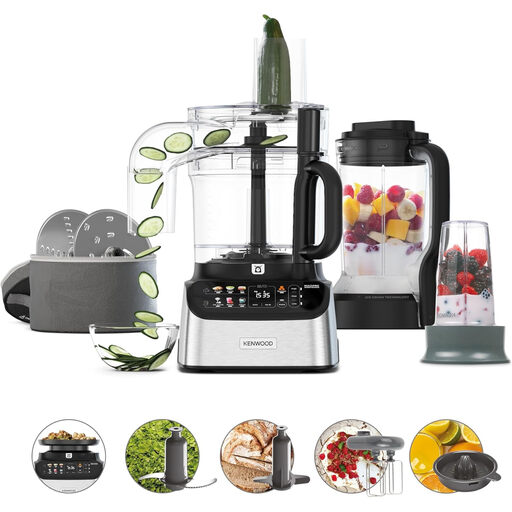
Why This Fits Their Persona: This model is built for efficiency in a busy family kitchen. The large 3L processor bowl handles big batches of ingredients for meal prepping, while the integrated digital scale saves time and reduces washing up by allowing you to weigh directly into the bowl.
It sidesteps the "all-in-one" pitfall by using a powerful 1000W motor that effectively drives both the processor and the separate 1.5L blender jug, ensuring neither function is compromised. The 13 accessories are practical and designed for core tasks.
The integrated EasyWeigh scale is a standout feature for precise baking and cooking. OneTouch preset programs simplify common tasks like ice crushing and dishwasher-safe parts make cleanup straightforward.
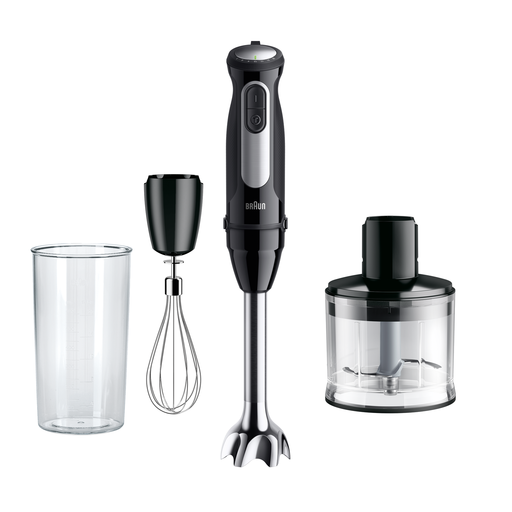
Why This Fits Their Persona: For those with limited counter or cupboard space, this immersion blender set is ideal. It performs the core tasks of a food processor—chopping herbs, blending soups, whipping cream—without the large footprint. It's perfect for quick, everyday meal prep.
This set avoids accessory overload by providing only the essentials: a blending shaft, a chopper, a whisk and a beaker. Each attachment is robust and serves a distinct, useful purpose. The 1000W motor is more than capable for its intended tasks.
The Anti-Splash design allows you to blend directly in a hot pot of soup with minimal mess. Its ergonomic grip and intelligent speed control make it comfortable and precise to use, even for longer tasks.
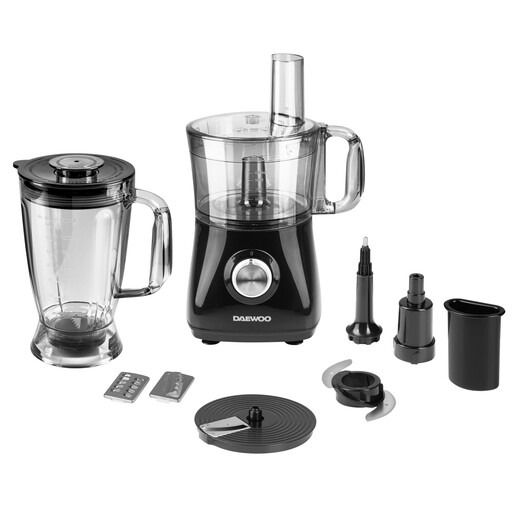
Why This Fits Their Persona: This appliance provides the core functionality of both a food processor and a blender at an accessible price point. With a 2L processor bowl and 1.8L blender jug, it's well-sized for everyday family meals without the premium cost of more complex models.
By focusing on the essentials, it delivers solid performance where it counts. The 750W motor is well-matched to the stainless steel blades for chopping and blending, proving that you don't need the highest wattage for good results in everyday tasks.
Its simplicity is its strength. With two speeds and a pulse function, it's straightforward to operate. The detachable jugs and blades make for easy cleaning and its compact design doesn't demand excessive counter space.
We have compiled a complete, real-time list of products that fully satisfy these strict selection criteria and UK safety regulations.
For most UK households, a food processor with a motor between 750 and 1000 watts is perfectly adequate for everyday tasks like chopping vegetables, making dips and mixing light batters. If you plan to frequently knead heavy dough or crush large amounts of ice, a model with 1000W or more might be beneficial, but always consider it in conjunction with blade quality and overall design.
Most modern food processors come with dishwasher-safe bowls, lids and attachments. However, it is essential to check the manufacturer's instructions. Blades should often be hand-washed to maintain their sharpness and the motor base should never be submerged in water. Always place plastic parts on the top rack of the dishwasher to prevent warping from the heat.
A blender is primarily designed for liquids. Its tall, narrow jug and vortex-creating blade action are perfect for making smoothies, soups and sauces. A food processor is more versatile for preparation tasks. Its wide bowl and interchangeable blades or discs are designed for chopping, slicing, shredding, grating and mixing solid or semi-solid foods. While some overlap exists, each is optimised for its specific function.