
24/7 Customer Support

Free returns

Same-day & Next-day Delivery

Quality Guaranteed
Download the APP
Categories
If you are searching for a new gaming mechanical keyboard, you have likely grown tired of the mushy, unresponsive feel of a standard membrane model. Whether you are a competitive gamer seeking faster response times, a programmer wanting a more satisfying typing experience or a tech enthusiast who appreciates premium hardware, the world of mechanical keyboards offers a significant upgrade.
However, the market is filled with technical jargon and a vast array of options, which can make choosing the right one a challenge. As a Joybuy Product Recommendation Officer, my role is to help you navigate these choices. This guide will break down the key features to consider and present a selection of keyboards that cater to different needs and budgets, helping you find the perfect fit for your setup.
Before diving into specific models, let's cover a few essential features. Understanding these will help you make a more informed decision.
The heart of any mechanical keyboard is its switches. These are the mechanisms beneath each keycap that register a keystroke. They largely determine how a keyboard feels and sounds. While there are many variations, they generally fall into three categories:
For those who enjoy customisation, a hot-swappable keyboard is a fantastic feature. It allows you to change the switches easily without any soldering, giving you the freedom to experiment with different switch types to create your ideal typing feel.
Keyboards come in various sizes, and the right one for you depends on your desk space and needs.
Connectivity is another key consideration. A traditional wired connection offers a reliable, zero-latency link, which is critical for competitive gaming. However, a wireless mechanical keyboard provides a cleaner, cable-free desk. Many modern boards are a tri-mode keyboard, offering the best of all worlds: low-latency 2.4GHz wireless for gaming, Bluetooth for connecting to multiple devices and a detachable USB-C cable for wired use and charging.
Here are a few recommendations that stand out for their features, performance and value across different price points.
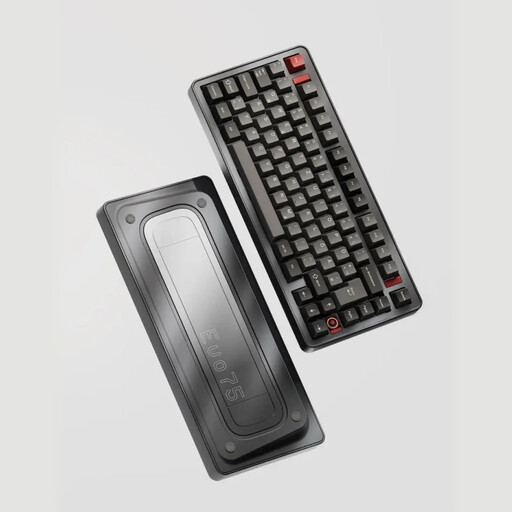
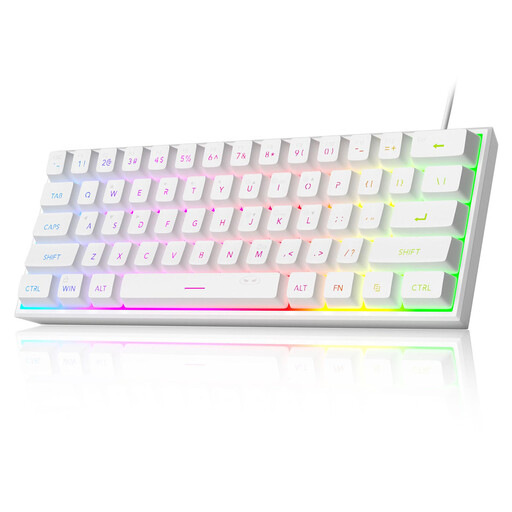
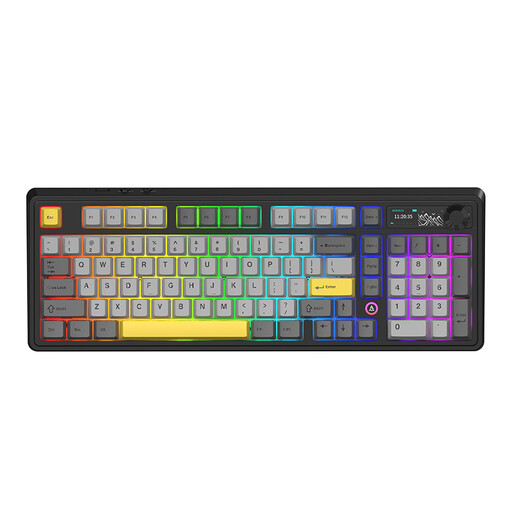
While these three models cover a wide range of needs, the world of mechanical keyboards is vast and personal. If you are looking for different layouts, unique aesthetics or specific lighting effects, there are many other options to discover.
If you're particularly interested in vibrant lighting, browse our full collection of RGB keyboards to find your perfect match.
1. Are mechanical keyboards actually better for gaming? Many gamers prefer mechanical keyboards for several objective reasons. The switches often have a lower actuation point and faster reset time, which can translate to quicker in-game actions. They are also typically more durable, with switches rated for tens of millions of keystrokes. Finally, features like N-key rollover ensure that every single keypress is registered, even when multiple keys are pressed simultaneously.
2. What is a hot-swappable keyboard? A hot-swappable keyboard has a printed circuit board (PCB) with special sockets that allow you to pull out and replace the mechanical switches without any soldering. This makes it incredibly easy to try different switch types (linear, tactile, clicky) to customise the keyboard's feel or to replace a faulty switch. It is a highly sought-after feature for keyboard enthusiasts.
3. How much should I spend on a gaming mechanical keyboard? The cost can vary significantly. Entry-level models provide a tangible upgrade over standard keyboards for a modest investment. Mid-range options, often in the £70-£150 range, typically introduce features like better build materials, hot-swappable sockets and wireless mechanical keyboard functionality. High-end and custom models can cost several hundred pounds, offering premium materials like aluminium, advanced mounting styles and near-limitless customisation. The right budget depends on the features that are most important to you.