
24/7 Customer Support

Free returns

Same-day & Next-day Delivery

Quality Guaranteed

Unlock Your Welcome Offers: FREE Delivery | Up to 80% OFF | Free 30-day JoyPlus trial
Download the APP
Driving on poorly lit roads, especially during the UK's darker months, can be a challenge with standard halogen headlights. Their dim, yellowish light often provides limited visibility, making it harder to spot hazards. If you're looking for a straightforward car headlight upgrade, switching to a modern H4 LED headlight bulb can significantly improve clarity and safety during night-time driving.
This guide is designed to help you navigate the options. We'll cover the key features to look for when choosing a bulb and present some of our top recommendations for 2026, helping you find a reliable and effective lighting solution for your vehicle.
Before purchasing, it's useful to understand a few key technical aspects. This will ensure you select a bulb that is compatible with your vehicle and meets your performance expectations.
While high lumen ratings indicate a bright LED headlight, the quality of the beam pattern is far more critical. A well-designed bulb will mimic the focussed pattern of your original halogen, illuminating the road ahead without creating dark spots or, crucially, dazzling oncoming drivers. Look for bulbs that specify a 1:1 beam pattern or a design that prevents glare. The most common colour temperature is 6000K cool white, which provides a crisp, modern light that is close to natural daylight.
Many modern vehicles use a Controller Area Network (CANbus) system to monitor the car's functions, including the headlights. Since LED bulbs draw less power than halogens, the system can sometimes mistakenly register this as a fault, leading to a dashboard warning light or flickering. To prevent this, it is advisable to choose a CANbus ready LED bulb. These have built-in drivers or resistors that communicate correctly with the vehicle's computer system, ensuring smooth, error-free operation.
For most DIY enthusiasts, ease of installation is a priority. Many LED upgrades are designed as direct plug and play headlights, meaning they can be fitted without any complex wiring or modifications. It is essential to confirm your vehicle's specific bulb type. While this article focuses on the H4 LED headlight bulb (which typically combines high and low beams in a single unit), other common single-beam fitments include the H7 LED bulb, H11 LED bulb and 9005 HB3 headlight. Always check your vehicle's manual or the existing bulb to confirm the correct fitment.
Here are a few noteworthy H4 LED headlight bulb options that offer a compelling combination of performance, longevity and ease of use.
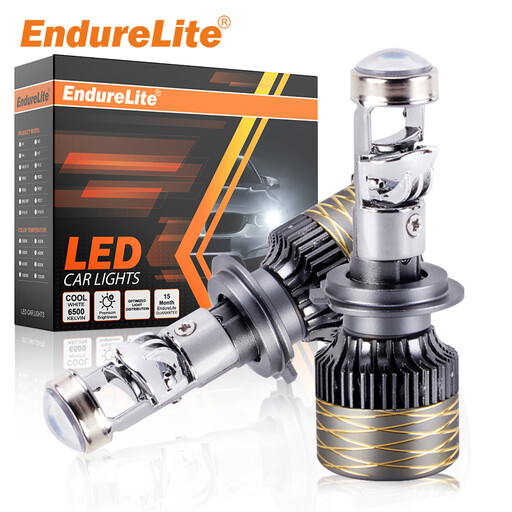
Why It Stands Out: The ENdureLite bulbs feature an integrated projector lens, which helps to create a highly focussed and sharp cut-off line for the beam. This design is excellent for maximising road illumination while minimising glare for other road users.
According to the manufacturer, these bulbs provide illumination that is 300% brighter than stock halogens. They are built with an aluminium alloy shell and feature a powerful 10,000 RPM fan to manage heat, contributing to a stated lifespan of over 50,000 hours. The plug-and-play design and CANbus-ready driver make them a convenient upgrade for a wide range of vehicles.
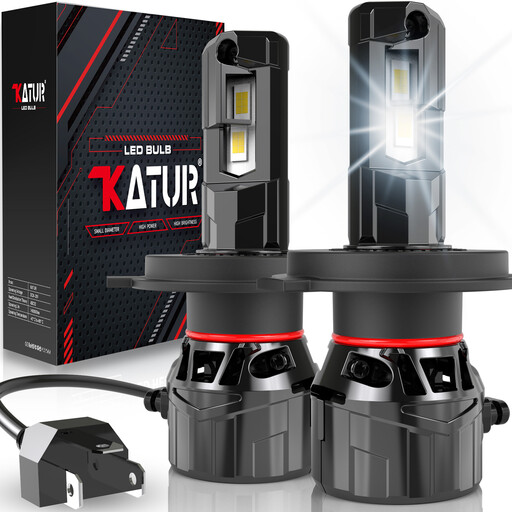
Why It Stands Out: The KATUR H4 bulbs are notable for their compact, 1:1 mini size, which is identical to a standard halogen bulb. This makes installation exceptionally straightforward, as they fit directly into the factory housing without needing modifications or concerns about dust covers.
These bulbs are rated at 120W and 30,000LM per pair, delivering a powerful 6000K xenon white light. The cooling system is also robust, featuring a high-speed 16,000 RPM turbo fan and a hollow-carved heat sink to dissipate heat effectively. The manufacturer states a lifespan of up to 60,000 hours and compatibility with 99% of vehicles thanks to an upgraded CANbus decoding system.

Why It Stands Out: Sold as a single unit, the Bullvision H4 bulb is a practical choice for motorcycles or for drivers who only need to replace one bulb. It shares many of the strong features seen in other recommendations, including a design that matches the size and beam pattern of stock bulbs.
The manufacturer claims a brightness increase of 300% and a lifespan of 50,000 hours, supported by an IP68 waterproof rating and an integrated 10,000 RPM cooling fan. It is also designed to be CANbus ready, reducing the likelihood of flicker or error warnings on compatible vehicles.
If our recommendations don't quite fit your vehicle's requirements, or if you're searching for a different type of lighting solution, there are many other models to consider.
Explore our wider collection of automotive lighting to find the perfect match for your car. Browse our full range of Projector Lamps here
As of 2026, regulations require that any headlight conversion maintains the original beam pattern to pass an MOT test and avoid dazzling other drivers. While fitting an LED bulb into a housing designed for a halogen is a modification, high-quality LED bulbs that accurately replicate the halogen beam pattern are less likely to cause issues. However, it is always recommended to check the latest DVSA guidelines and ensure your headlights are correctly aligned after installation.
The main difference is their function. An H4 bulb is a dual-filament bulb, meaning it contains both the high beam and low beam in a single unit. An H7 bulb is a single-filament bulb, so a vehicle will use two separate H7 bulbs per headlight—one for the low beam and one for the high beam.
If your car was manufactured after the mid-2000s, it likely has a CANbus system. For these vehicles, a CANbus ready LED bulb is highly recommended to avoid dashboard error messages or flickering lights. For older vehicles without a CANbus system, this feature is not a necessity, but it causes no harm to use one.