
24/7 Customer Support

Free returns

Same-day & Next-day Delivery

Quality Guaranteed

Unlock Your Welcome Offers: FREE Delivery | Up to 80% OFF | Free 30-day JoyPlus trial
Download the APP
Struggling with dim, yellow headlights on dark British roads? You're not alone. Standard halogen bulbs can often feel inadequate, especially during winter or on unlit country lanes. An H7 LED headlight bulb upgrade is a popular and effective way to improve visibility, enhance safety and give your vehicle a more modern look.
However, the market is filled with technical jargon and ambitious claims. This guide cuts through the clutter, explaining the key features to look for and providing a few carefully selected recommendations to help you make a confident choice.
Before you buy, understanding a few key specifications will ensure you get the performance and compatibility you need.
The two most important metrics here are lumens (lm) and Kelvin (K).
The goal for most car owners is a straightforward upgrade without cutting wires or modifying the headlight housing. Look for terms like:
Modern vehicles, particularly European models, use a Controller Area Network (CANBUS) system to monitor the car's electronics. Since LED bulbs draw less power than halogens, the system can mistakenly think a bulb has failed, leading to a dashboard warning light or flickering. A CANBUS H7 LED bulb has built-in circuitry to prevent these errors, ensuring seamless integration with your vehicle's computer.
Here are a few options that stand out for their features, performance specifications and user-friendly design.
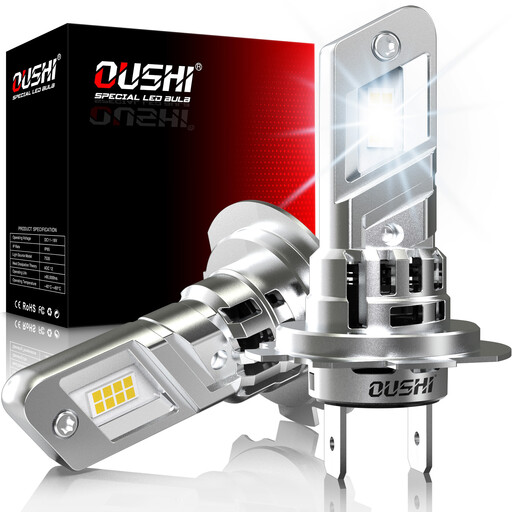
Why It Stands Out: This OUSHI H7 LED bulb combines high-intensity light output with a design focused on simple installation. The 6500K colour temperature provides a very crisp, cool white light for excellent clarity on the road.
Pros:
Who is it for? Drivers seeking a significant upgrade in brightness and a modern aesthetic, who prioritise a hassle-free, direct-fit installation.
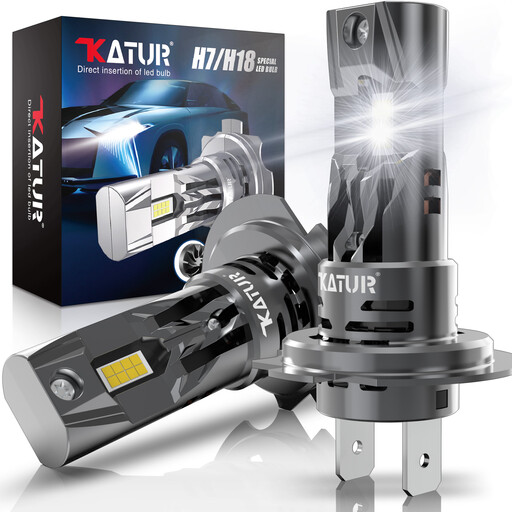
Why It Stands Out: This KATUR model uses an external driver, which can help with heat management and longevity. Its powerful fan and automotive-grade chips are geared towards sustained high performance.
Pros:
Who is it for? Car owners who want a high-power H7 LED bulb and appreciate the design of an external driver, which can help ensure stable performance in vehicles with complex electrical systems.
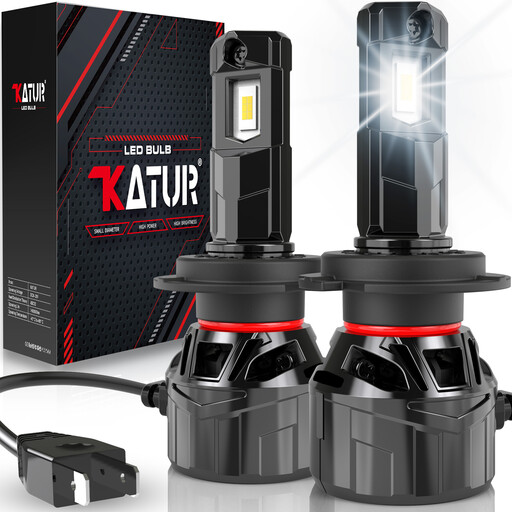
Why It Stands Out: This bulb offers a very high power rating of 120W per pair while maintaining a compact, all-in-one 1:1 mini size. This makes it a powerful yet incredibly simple H7 halogen replacement.
Pros:
Who is it for? DIY enthusiasts looking for a top-tier power output in a compact, easy-to-install package that requires no modifications.
These recommendations cover some of the most popular features, but every car and driver is different. If you're looking for different specifications or bulb types, it's worth exploring a wider selection.
Browse our full collection of xenon headlight bulbs to find the perfect fit for your vehicle.
1. Are H7 LED bulbs a direct replacement for halogen? Yes, many are specifically designed as a direct H7 halogen replacement. Models advertised with a 1:1 mini size and plug and play functionality are intended to fit directly into your factory socket without any modifications, just like a standard bulb.
2. Will I get an error on my dashboard if I install H7 LED bulbs? This can happen with some vehicles, as their computer systems may not recognise the lower power draw of LEDs. To avoid this, it is highly recommended to choose a CANBUS H7 LED bulb. These are built to communicate correctly with your car's computer and prevent dashboard errors or flickering. On some highly sensitive models, an additional decoder may still be required.
3. How much brighter are H7 LED bulbs than halogen bulbs? The difference is significant. A standard H7 halogen bulb produces around 1,500 lumens. A high-performance H7 LED bulb, such as one rated for 30000LM per pair, can be several times brighter. This provides a much wider and farther field of vision, greatly improving night-time driving safety.