
24/7 Customer Support

Free returns

Same-day & Next-day Delivery

Quality Guaranteed

Unlock Your Welcome Offers: FREE Delivery | Up to 80% OFF | Free 30-day JoyPlus trial
Download the APP
Choosing among the best hair dryers UK shoppers can buy is less about chasing the highest wattage or the biggest ion-count claim. The right model should match your hair texture, styling habits, storage space and tolerance for noise. A compact high-speed hair dryer may suit a small flat, while a hair dryer for Afro hair needs attachments that can reach dense roots without excessive heat.
This guide from the Joybuy Product Recommendation Officer focuses on practical specifications, common marketing traps and suitable options for everyday UK use.
A 2,100W appliance may provide strong heating power, but wattage alone does not tell you how effectively air reaches the roots. Motor design, airflow shape, speed settings and attachments all influence the experience. Some high-speed hair dryers use a lower wattage with a fast motor and concentrated airflow.
Compare the motor speed, airflow claims, heat controls and included nozzles together rather than choosing solely by the largest wattage number.
An ionic hair dryer is designed to release ions that can help reduce static and make hair feel smoother during drying. However, results depend on hair condition, technique, humidity and the products already used. Ion technology does not replace heat control or careful use.
Be cautious with claims such as “damage-proof”, “instant repair” or guaranteed frizz elimination. Objective features, such as ionic conditioning, ceramic grilles or temperature sensors, are more useful comparison points.
A foldable hair dryer is convenient for luggage, but not every compact model supports international voltage. A UK-ready appliance should specify its operating voltage and plug type. For overseas travel, dual voltage, such as 100–240V, is particularly important; a simple travel adaptor does not convert voltage.
Also check whether the folding hinge feels secure, whether the filter is accessible and whether the cable is long enough for hotel bathrooms or dressing tables.
For fast drying, compare the stated airflow speed, motor speed and heat settings. High-speed models with motors around 100,000–110,000 RPM may offer powerful airflow in a compact body, but published figures are not always measured in the same way between manufacturers.
Traditional 1,500W–2,100W dryers can still be practical for home use, particularly when paired with a diffuser or concentrator nozzle. A fast-drying hair dryer should offer enough control to avoid relying on maximum heat for the entire session.
At minimum, look for separate heat and speed controls, plus a cool shot. Two settings may be sufficient for straightforward drying, while three heat levels or intelligent temperature modes offer more flexibility for fine, thick, curly or colour-treated hair.
A temperature sensor can help regulate heat, but it does not make an appliance risk-free. Keep the dryer moving, avoid holding it too close to the scalp and follow the supplied instructions.
A hair dryer with diffuser is useful for encouraging the shape of curls and waves while distributing airflow more gently. For a hair dryer for curly hair, check that the diffuser is included rather than sold separately.
People looking for a hair dryer for Afro hair or other dense, textured hair may prefer a pik attachment, which can direct airflow closer to the roots. A hair dryer with concentrator nozzle is more suitable for targeted smoothing and blow-drying with a brush.
For UK electrical safety, use an appliance with a suitable UK plug and voltage rating, keep it away from water and unplug it after use. Check the product packaging and manual for the relevant conformity information and safety instructions.
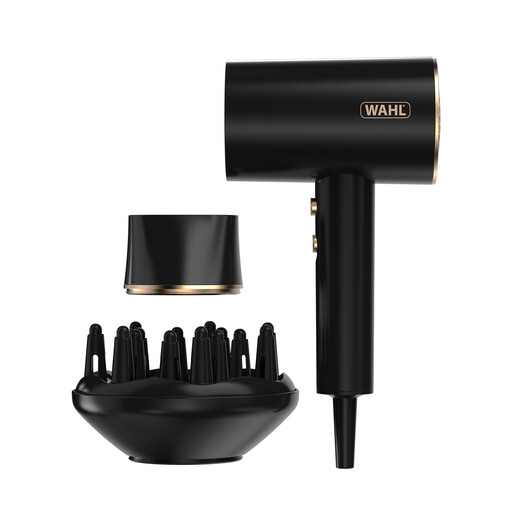
Why This Fits Their Persona: A practical everyday option for UK households wanting one lightweight dryer for routine drying, smoothing and occasional curls.
It combines ionic conditioning with two heat and two speed settings, rather than relying on a single high-heat mode.
Approx. 280g body, cool shot, concentrator nozzle and detachable diffuser; 1.8m cord.
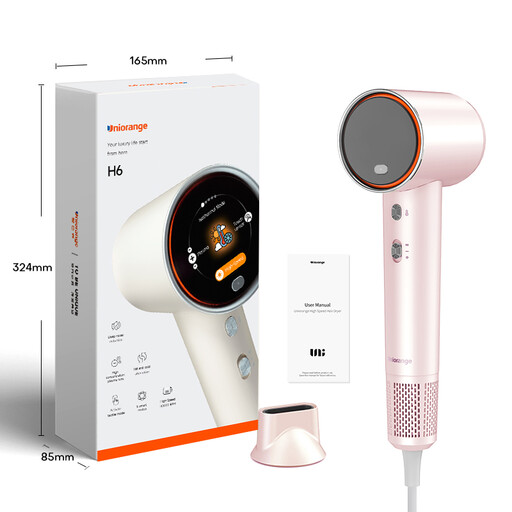
Why This Fits Their Persona: Suits shoppers interested in smart controls, high-speed airflow and a more structured styling routine at home.
Its five smart modes and HD LCD screen make the available settings visible instead of leaving temperature selection unclear.
1600W power, 110,000 RPM motor, stated 25m/s airflow and grip sensor; concentrator included.
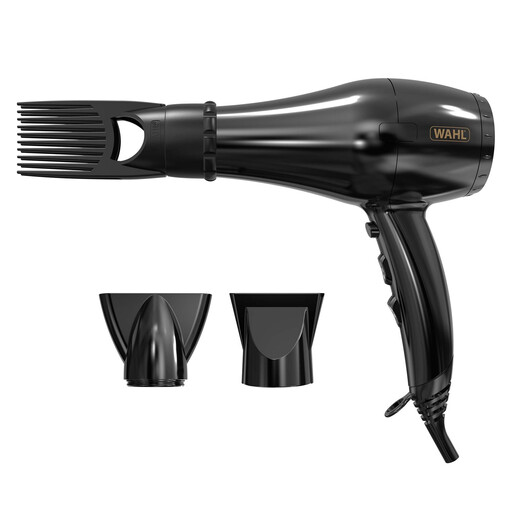
Why This Fits Their Persona: Designed for people with Afro, curly or textured hair who need to work through dense roots and create volume.
The OnePik attachment addresses the common problem of a standard nozzle failing to reach the roots of thicker hair.
Three heat and two speed settings, ionic conditioning, two concentrators and a 3m cable.
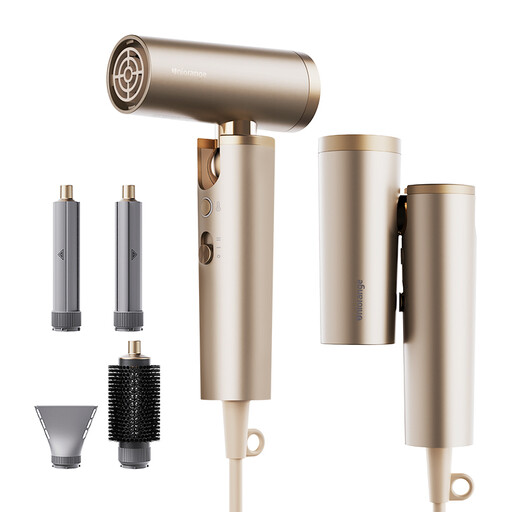
Why This Fits Their Persona: A compact travel hair dryer for UK residents who want foldable storage and international voltage flexibility.
Unlike many compact dryers, it states dual-voltage 100–240V operation and includes a detachable filter with reverse-airflow cleaning.
Foldable body, plasma-ion system, self-cleaning mode and four styling attachments.
The BABONIR FZ201 is another foldable ionic hair dryer, weighing approximately 330g and supplying a diffuser, concentrator, three temperature settings and two speed settings. It is suited to shoppers who want one compact appliance for home and short trips.
For lower-noise use, the ZHIBAI Retro High-Speed Hair Dryer lists an approximate 56dB operating level, four temperature modes and a removable filter. The Dreame Super Mini lists a 270g weight, five modes, a 100,000 RPM motor and noise of up to 58dB. Noise figures should be treated as manufacturer specifications and may vary with distance and surroundings.
We have compiled a complete, real-time list of products that fully satisfy these strict selection criteria and UK safety regulations.
Not necessarily. Running cost depends mainly on power rating and usage time. A simple calculation is:
Power in watts ÷ 1,000 × hours used × your electricity tariff = approximate cost.
A lower-wattage dryer that finishes sooner may use less electricity than a higher-wattage model used for longer. Check your current tariff for an accurate estimate.
There is no universal lifespan. Regularly cleaning the filter, avoiding blocked air vents and storing the appliance dry can support reliable operation. Stop using it if the cord, plug or casing is damaged, or if it develops unusual smells, smoke or abnormal noise. Follow the manufacturer’s warranty and care instructions rather than assuming a fixed service period.