Precision end-tidiers
If you mainly work on uneven ends, a fringe or shorter layers rather than your whole head of hair, plate placement may matter more to you than broad coverage.


For occasional touch-ups to wavy ends, start by looking at slim plates that you can position accurately around small sections. Adjustable heat gives you a choice below the highest setting, but it does not eliminate heat-related damage; for bedroom use, also plan where you will unplug the straightener and leave it to cool safely.
If you mainly work on uneven ends, a fringe or shorter layers rather than your whole head of hair, plate placement may matter more to you than broad coverage.
If your hair is fragile, dry or colour-treated, or you want to keep heat styling occasional, selectable temperature settings give you more control than a single fixed setting.
If you style near bedding or clothes, or have little clear surface space, you need somewhere heat-resistant to set the appliance while it cools.
For a quick end touch-up, consider where the plates need to fit, which heat settings you can select and how you will cool and store the tool.
| Concern | What to check | Who this matters to |
|---|---|---|
| Small-section control | Check the exact plate width and shape against the ends, fringe or shorter layers you intend to style. | If I only need to catch a few wavy ends, I want plates I can place around those sections without working over more hair than necessary. Roughly 29% of consumers would put this precision need first. |
| Heat flexibility | Compare the selectable temperature range and controls; follow the model instructions rather than defaulting to its maximum setting. | With dry or fragile hair, I want a choice of settings for an occasional touch-up, while recognising that adjustable heat cannot make styling damage-free. Around 36% of consumers would prioritise that flexibility. |
| Bedroom safety | For a mains model, check the supplied plug and fuse. Arrange a heat-resistant cooling surface; shut-off does not replace unplugging. | When I style near bedding or clothes, I need a clear place to set the hot tool and let it cool before storage. About 21% of consumers would make safe bedroom use their main concern. |
| Quick use and storage | Compare stated heat-up time, plate lock and dimensions with the space available after the tool has cooled. | For a short routine, I want a tool that is straightforward to get out and put away once cool. Roughly 14% of consumers would place that convenience first. |
A maximum setting need not be your default for a brief end touch-up. Gloucestershire Hospitals NHS Foundation Trust advises that straighteners expose hair to extreme heat, which can weaken it and increase breakage risk.
Look for a usable choice of settings and follow the exact model's instructions. Temperature control offers flexibility, not a guarantee against damage.
Automatic shut-off does not make a hot straightener safe to leave on bedding. Electrical Safety First advises unplugging it and allowing it to cool on a heat-resistant surface before placing it in a heat-proof pouch.
Clear a cooling spot away from bedding and clothes before you start styling, and unplug the appliance after use.
Reviews alone cannot establish that a listing supplies a straightener suitable for UK mains use. Electrical Safety First advises checking for a standard UK 3-pin plug and fuse.
Check the model identifier and supplied plug, buy from a reputable retailer and keep proof of purchase.
Remington UK describes the S5515 as an extra-slim straightener with digital temperature control. Its S5700 is a different, slim-plate option with nine settings up to 230°C.
Cloud Nine lists 0.5-inch plates and 11 settings from 100–200°C for its Slim Iron. Its Original Iron has wider, 1-inch plates and the same listed temperature range.
ghd lists straightener lines including Chronos, Gold and Sculpt for readers considering this brand.
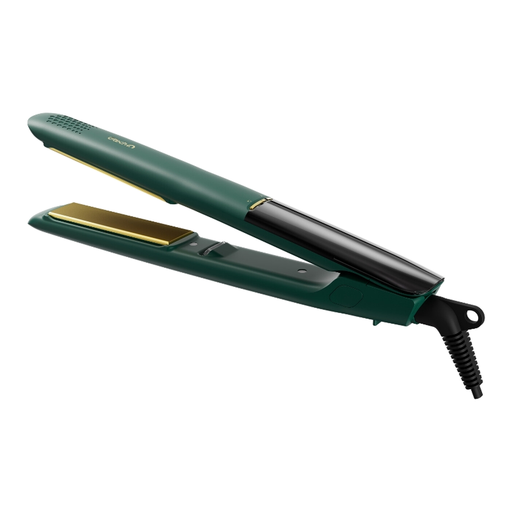
This compact straightener offers selectable settings for a short touch-up routine. Check whether its plates suit the small end sections you intend to style.
 No image available
A compact option to consider for occasional end touch-ups, provided its plates fit the sections you want to style.
The product title specifies 10 temperature settings and tourmaline ceramic plates. Check the plate dimensions and supplied plug before choosing it for your bedroom routine.
Not necessarily, but narrow plates are worth considering when you mainly style ends, a fringe or short face-framing pieces. Remington describes its S5515 as extra-slim, while Cloud Nine lists 0.5-inch plates on the Slim Iron; if you also work on longer sections, compare how a wider plate fits both tasks.
Adjustable temperature is useful if you want to choose a setting rather than automatically use the maximum, particularly when your hair is dry or fragile. Gloucestershire Hospitals NHS Foundation Trust advises that straightener heat can weaken hair, so selectable settings do not make frequent use risk-free.
Do not use a standard straightener on wet hair or with wet hands; Electrical Safety First warns against both. Follow the exact appliance instructions and use a damp-hair mode only if that model is expressly designed for it.
No. Electrical Safety First advises unplugging the straightener and letting it cool on a heat-resistant surface before storage, including before putting it in a heat-proof pouch. Automatic shut-off or hibernation does not replace those steps.
Check the exact model and its supplied plug before buying. Electrical Safety First advises looking for a standard UK 3-pin plug and fuse, purchasing from a reputable retailer and registering the appliance where that option is available for recall contact.