
24/7 Customer Support

Free returns

Same-day & Next-day Delivery

Quality Guaranteed

Unlock Your Welcome Offers: FREE Delivery | Up to 80% OFF | Free 30-day JoyPlus trial
Download the APP
Staring at a solid brick wall with a picture hook in one hand and a standard drill in the other is a common moment of DIY doubt. While a regular drill driver is perfect for wood, metal and plasterboard, masonry requires a different kind of power. This is where the hammer drill comes in, but choosing the right one can be confusing. Do you need a cordless model, a heavy-duty electric drill or something called an SDS drill?
As the Joybuy Product Recommendation Officer, my role is to help you find the right tool for the job without the marketing jargon. This guide will walk you through the key differences and provide clear recommendations to help you tackle your next project with confidence, whether you're assembling a flat-pack wardrobe or mounting a shelf on a stubborn brick wall.
Before you choose, it’s helpful to understand a few key features. Getting this right ensures you have a tool that meets your needs without overspending on functions you won't use.
The first major decision is how your drill is powered.
These terms are often used interchangeably, but they describe two different mechanisms for different jobs.
We've selected a few standout options that cater to different needs, from light household tasks to more demanding construction work.
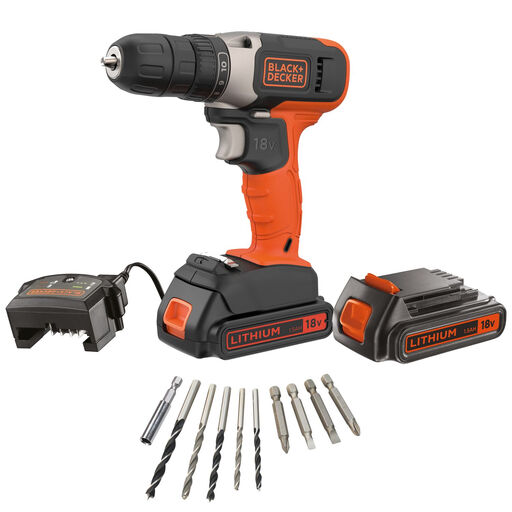
Why It Stands Out: This drill is a fantastic starting point for any home toolkit. Its lightweight design and precise clutch control make it ideal for tasks where finesse is more important than force, such as building furniture or drilling into wood and plasterboard without damaging the material. The battery is part of the 18V POWERCONNECT system, meaning it can be shared with other Black + Decker garden and home tools.
Pros:
Who is it for? New homeowners, renters and DIYers who need a reliable tool for general household tasks like assembling furniture, hanging pictures on internal walls and other light-duty projects. Note: This is a drill driver, not a hammer drill, so it is not intended for masonry.

Why It Stands Out: This is the ultimate DIY drill kit. It combines a versatile cordless hammer drill with a comprehensive 104-piece accessory set, all neatly organised in a sturdy toolbox. With the flick of a switch, you can engage the hammer action to drill into brick and light concrete, making it a true all-in-one solution for almost any job around the house.
Pros:
Who is it for? Homeowners and DIY enthusiasts who want a single, comprehensive kit that prepares them for any project, from building a deck to hanging a heavy mirror on a brick wall.
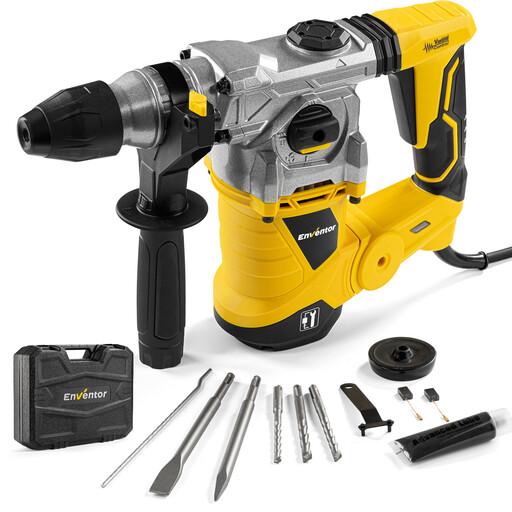
Why It Stands Out: When you need serious power, this heavy duty drill delivers. As a corded rotary hammer drill, it’s built to handle the toughest materials. Its 1500W motor and 6 joules of impact energy make quick work of drilling into dense concrete and stone. The four-function switch also allows for chiselling, making it a valuable tool for tasks like removing tiles or channelling walls.
Pros:
Who is it for? Tradespeople and serious DIYers undertaking major renovation projects that involve working with concrete, stone and heavy masonry.
If these recommendations aren't quite what you're looking for, or if you'd like to compare a wider range of models, there are many other tools available. Explore our full collection to find the perfect fit for your project and budget.
Explore All Drill Machines on Joybuy UK
Yes. Virtually all hammer drills have a switch that allows you to turn the hammer function off. In this mode, it operates as a standard drill driver, suitable for drilling into wood, metal or plastic. This versatility is one of their main advantages.
While you might manage to make a hole in soft brick with a standard drill and a masonry bit, it will be slow, difficult and can burn out your drill's motor. A hammer drill makes the process significantly faster and easier by pulverising the material as it drills. For anything harder than plasterboard, a hammer drill is the recommended tool.
A standard hammer drill creates its impact with two ribbed discs, which is effective for brick and blockwork. An SDS drill (a type of rotary hammer) uses a more powerful piston mechanism, delivering much stronger blows. This makes it the superior choice for drilling into hard concrete or for light chiselling tasks. The SDS chuck also grips the specialised bits without slipping, which is essential for handling the higher forces involved.