
24/7 Customer Support

Free returns

Same-day & Next-day Delivery

Quality Guaranteed

Unlock Your Welcome Offers: FREE Delivery | Up to 80% OFF | Free 30-day JoyPlus trial
Download the APP
A hand blender can save time when preparing soup, sauces, smoothies, baby food and batters. However, attractive wattage figures and long attachment lists do not always translate into convenient daily use. The right choice depends on how the motor, controls, blade guard, accessories and cleaning requirements match your kitchen routine.
This guide highlights common buying traps, explains the specifications that matter and compares suitable options for different UK households.
A 1000W hand blender may offer more power for dense mixtures, but wattage alone does not tell you how efficiently the blade system transfers power to the food. A motor also needs appropriate speed control, a stable blending foot and sensible operating intervals.
Some products list a maximum power figure rather than their rated power. For example, the ROUNY model lists 1000W rated power and 1200W maximum power. This distinction is worth checking before comparing it with another appliance advertised only by its peak figure.
A 4-in-1 hand blender can include a blending shaft, beaker, chopper and whisk, but extra accessories are useful only if they suit your recipes and are easy to assemble. Check the capacities carefully: a 500ml chopper is suitable for smaller quantities, while a larger beaker may be more convenient for family portions.
Also check whether the set includes a hand blender with whisk, a masher, slicing discs or an ice-crushing blade. Do not assume that every attachment shown in a product family is included with every model.
A detachable shaft and dishwasher-safe accessories can make a substantial difference after cooking. Yet the motor body should generally be wiped rather than immersed, and dishwasher instructions may apply only to specific removable parts.
Continuous operating time is another easily missed detail. Several models in this guide specify a maximum cycle of around one minute, followed by a rest period. Ignoring this instruction can increase heat build-up and place unnecessary strain on the motor.
For occasional smoothies, sauces and soft vegetables, a lower-powered model may be adequate. A 450W hand blender such as the Braun MultiQuick 1 is designed around simple, one-speed operation.
For thicker soups, cooked root vegetables, hummus-style mixtures and regular food preparation, consider a variable speed hand blender. A dial, pressure-sensitive control or separate turbo button allows you to start gently and increase speed as needed, which can help reduce splashing.
A model with 1000W rated power is a practical option for households that regularly blend larger or denser mixtures. Remember to follow the stated duty cycle rather than assuming a higher wattage permits uninterrupted use.
A stainless steel hand blender shaft is easy to wipe and is designed for regular contact with food. Stainless steel blades are also common on models intended for everyday soups, sauces and smoothies.
Look for a bell-shaped guard or anti-splash design around the blade. This does not remove the need to submerge the blending head before switching on, but it can help contain splashes. If you use non-stick pans, keep the guard from being pressed forcefully against the cookware, even where pan protection is advertised.
For hot food, use a deep saucepan or suitable heat-resistant container, keep the blender upright and take care around steam. Check the instruction manual for temperature and container restrictions; some accessories are not intended for hot liquids.
A 600ml beaker is convenient for individual portions, while an 800ml beaker may suit larger smoothies or sauces. A chopper bowl is more appropriate for herbs, onions and other solid ingredients, but it should not be overfilled.
Check whether removable parts are dishwasher-safe and whether there are exclusions for gearboxes, lids or adapters. For example, the ROUNY description specifies dishwasher-safe accessories below 60°C, while the motor body must remain out of water.

Why This Fits Their Persona: A straightforward option for students, smaller households and occasional cooks making smoothies, sauces or desserts without needing multiple attachments.
Its one-speed design avoids paying for controls or accessories that may not be needed. The 600ml beaker and detachable shaft keep the setup simple.
450W motor, stainless steel blades, one-touch operation and dishwasher-safe removable parts.
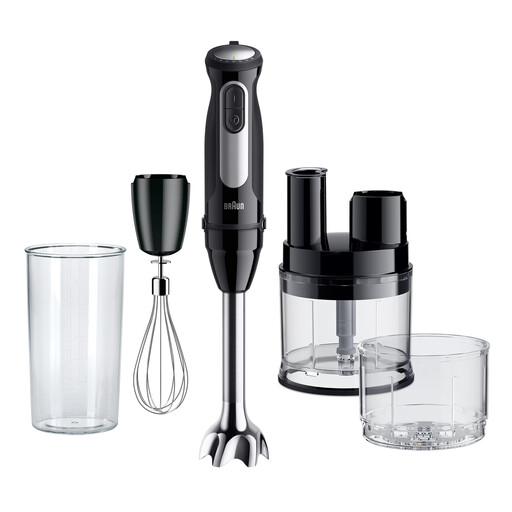
Why This Fits Their Persona: Suitable for home cooks who want one system for blending, baking preparation, chopping and selected food-processing tasks.
The 25-speed wheel and Turbo function offer more control than a single-speed appliance, while Splash Control addresses mess during blending.
1000W motor, mini food processor, whisk, metal blending shaft and 500ml BPA-free beaker.
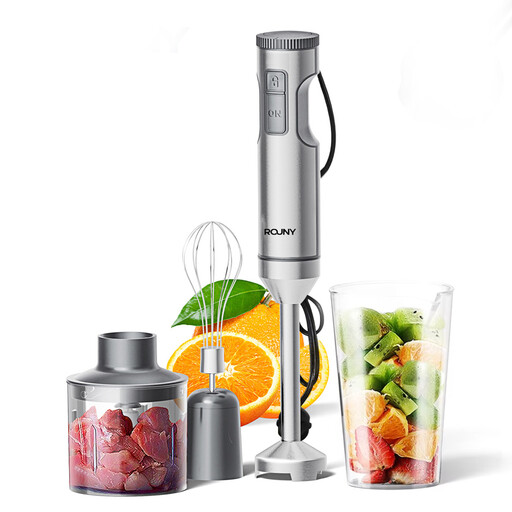
Why This Fits Their Persona: A practical match for families preparing soups, sauces, smoothies, chopped ingredients and whisked mixtures with one corded appliance.
The product details separate rated and maximum power, list the 1-minute operating limit and specify cleaning conditions for dishwasher-safe accessories.
1200W maximum power, 15,000rpm listed speed, stepless control, stainless steel shaft, 700ml beaker and 500ml chopper.
We have compiled a complete, real-time list of products that fully satisfy these strict selection criteria and UK safety regulations.
An immersion blender can be convenient for soup because it avoids transferring liquid to a separate jug. Use a deep, suitable pan, keep the blending head below the surface and follow the manufacturer’s temperature guidance. Take particular care with steam and splashes, and never lift the running blade above the liquid.
Lifespan depends on frequency of use, ingredients, cleaning and adherence to the operating cycle. Avoid hard foods outside the manual’s permitted uses, do not force the blade into thick mixtures and allow the motor to rest between cycles. Detachable parts should be dried thoroughly before storage.
A higher wattage indicates potential electrical input when the appliance is operating, but actual cost also depends on usage time and your electricity tariff. Short blending cycles generally use less energy than prolonged operation. Choose sufficient power for your recipes rather than selecting a maximum figure without considering how often you will use it.