People who want a repeatable routine
If you regularly make firm hard-boiled eggs, a model with a water guide or timer and a clear end-of-cycle signal may suit you. Check for automatic shut-off separately rather than assuming every cooker has it.


An electric egg cooker is worth considering if you make hard-boiled eggs often enough to value a water guide, timer or completion alert over using a saucepan you already own. Choose a capacity that fits your usual batch, then check the exact model’s hard-boiled instructions, controls, dimensions and cleaning requirements; for occasional eggs, a saucepan may be the simpler choice.
If you regularly make firm hard-boiled eggs, a model with a water guide or timer and a clear end-of-cycle signal may suit you. Check for automatic shut-off separately rather than assuming every cooker has it.
For breakfasts, salads or packed lunches, compare the stated boiled-egg capacity with the number you usually make. Salter and Tower list models holding six, seven or eight eggs.
If cupboard or worktop space is tight, check the cooker’s dimensions and where its accessories will go. Poaching trays are worth considering only if you expect to use them.
Start with your usual batch size, then check how the cooker handles a hard-boiled cycle and whether you have room to store and clean it.
| Concern | What to check | Who this matters to |
|---|---|---|
| Consistent results with less monitoring | Check the hard-boiled water guide or timer and how the cycle ends. Confirm automatic shut-off on the exact model if you want it. | If I want firm eggs without watching a pan, I need a clear way to repeat the cooking cycle. Around 40% of consumers would put consistency and less monitoring first. |
| Enough eggs per cycle | Compare the stated boiled-egg capacity with your normal batch, not just the appliance’s general description. | When I prepare eggs for several lunches or a household breakfast, avoiding a second cycle matters more than extra cooking modes. Roughly 30% of consumers would prioritise batch capacity. |
| Storage and upkeep | Check the dimensions, accessory storage and which removable parts the instructions permit you to put in a dishwasher. | In a small kitchen, I want a cooker I can put away and clean without fuss; I would use extra trays only occasionally. Around 30% of consumers would put compact storage and practical extras first. |
The documented Salter and Tower models hold between six and eight boiled eggs, while automatic shut-off is explicitly listed for Tower’s T19023. A category description cannot tell you which controls a particular cooker has.
Check the exact model’s boiled-egg capacity and end-of-cycle controls before choosing it.
Poaching and omelette accessories do not increase a cooker’s stated boiled-egg capacity. They may also add parts to store and clean.
Prioritise hard-boiled capacity and controls; consider additional trays only if they fit the way you cook.
Egg cookers heat water and produce steam, but cleaning instructions differ between the removable parts and the electrical base.
Unplug the cooker and let it cool before cleaning. Follow its manual for removable parts, and do not immerse the electrical base.
Steam needs space to escape, and water near the plug or cable creates an electrical risk.
Use a flat, heat-resistant surface with clearance from cupboards and shelves, keep the cable and socket dry, and follow the model’s water-fill instructions.
Salter lists compact electric cookers for boiling eggs, with poaching accessories on the documented models.
Tower describes its T19023 as a seven-egg cooker with boiling, poaching, omelette and scrambled-egg functions.
Lakeland’s own-brand six-egg cooker included boiling, poaching and omelette options.
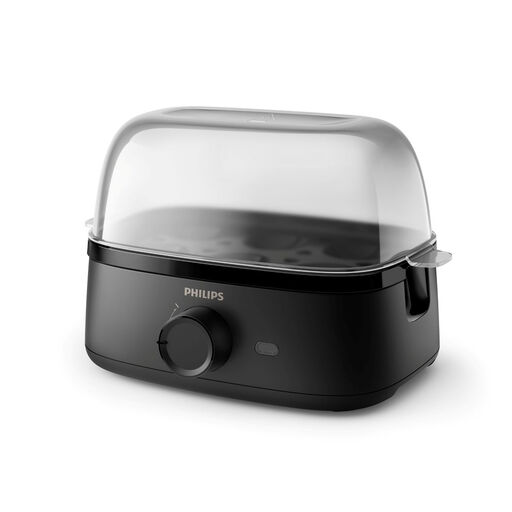
This compact egg-cooker choice is relevant if you usually prepare a small batch of hard-boiled eggs and want a dedicated appliance.
 No image available
Consider this model if you mainly make small batches of hard-boiled eggs and prefer a dedicated cooker to monitoring a saucepan.
If you regularly need more than six eggs at once, compare larger-capacity models. Before ordering, check that its hard-boiled water guide and completion controls suit your routine, and confirm the plug and fuse for your kitchen.
Choose a capacity that covers the number you normally cook in one batch. Salter specifies six boiled eggs for the EK2783 and eight for the EK6213, while Tower specifies seven for the T19023; a larger batch than your chosen cooker holds will need another cycle.
No: check automatic shut-off on the exact model rather than treating it as a standard feature. Tower lists thermal-sensor automatic shut-off for the T19023; a timer or completion alert on another cooker does not, by itself, establish that it switches off automatically.
Only put parts in the dishwasher when the model’s instructions identify them as dishwasher-safe. Tower describes parts of the T19023 as dishwasher-safe, but the electrical base must not be immersed; unplug the cooker and let it cool before cleaning.
Follow your model’s manual for descaling and cleaning the water-heating area. One Salter egg-cooker manual recommends descaling at least monthly, but use the instructions for the cooker you own rather than applying that schedule to every model.
Confirm the cooker’s plug and fuse details before ordering, then read its operating and cleaning instructions. Electrical Safety First advises checking for a standard UK three-pin plug and fuse on kitchen appliances; keep the plug and cable dry during use.