
24/7 Customer Support

Free returns

Same-day & Next-day Delivery

Quality Guaranteed

Unlock Your Welcome Offers: FREE Delivery | Up to 80% OFF | Free 30-day JoyPlus trial
Download the APP
As we spend more time indoors, the quality of the air we breathe at home has become a significant consideration for many of us in the UK. From seasonal pollen and urban pollutants to household dust and pet dander, various airborne particles can affect our comfort and well-being. A HEPA air purifier for home use can be a practical addition to your living space, helping to filter out these microscopic irritants.
This guide is designed to help you understand the key features to look for, so you can choose a model that suits your specific needs, whether it's for a quiet bedroom, a living room with pets or an office space prone to dust.
Navigating the technical specifications of air purifiers can feel overwhelming. Here are a few key points to focus on to simplify your decision.
One of the most important specifications is the CADR (Clean Air Delivery Rate). Measured in cubic metres per hour (m?/h), this rating tells you how quickly the purifier can clean the air in a room of a certain size. For effective performance, ensure the purifier's recommended coverage area (in square metres, m?) matches or slightly exceeds the dimensions of your room. A higher CADR means faster air circulation and purification.
The filter is the core of any air purifier. A True HEPA filter is a standard for capturing at least 99.97% of airborne particles as small as 0.3 microns. This includes common irritants like dust mites, pollen, mould spores and pet dander, making it a key feature for an air purifier for dust and allergies. Many models use an H13 HEPA filter, which is a highly effective grade of HEPA filtration. For tackling household smells, a model with an activated carbon layer is also beneficial, making it a capable air purifier for smoke and odours.
If you plan to use the purifier in a bedroom or office, its noise level is a crucial factor. Look for a quiet air purifier for bedroom use that offers a dedicated sleep mode, often operating below 30 decibels (dB), which is comparable to a whisper. Additionally, modern conveniences can enhance usability. Features like timers, automatic modes that adjust fan speed based on air quality and Wi-Fi connectivity for a smart air purifier UK model allow for greater control and efficiency.
Here are a few air purifiers that offer a compelling combination of features, performance and practicality for different home environments.
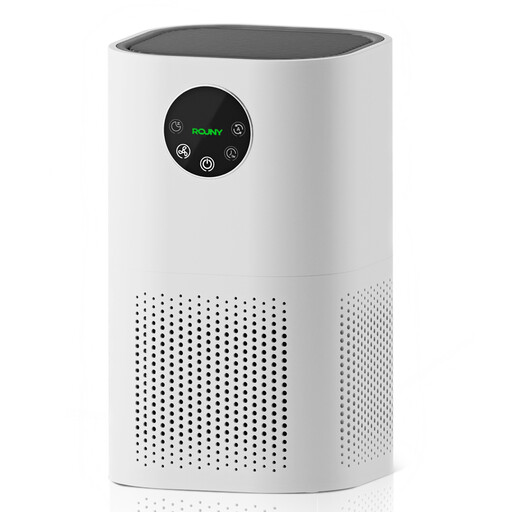
Why It Stands Out: The ROUNY air purifier is a well-rounded option designed for quiet efficiency. Its sleep mode operates at a very low ≤25dB, making it an excellent companion for light sleepers. The real-time air quality display provides instant visual feedback, shifting between green, yellow and red to indicate the current air purity.
Pros:
Who is it for? This model is a great fit for those seeking a quiet, straightforward HEPA filter air cleaner for bedrooms, home offices or other personal spaces where low noise is a priority.
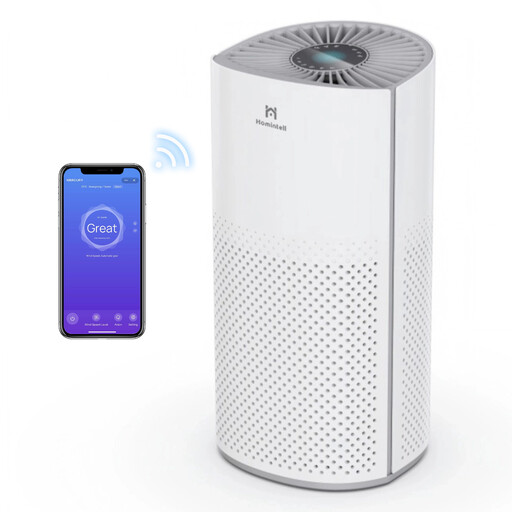
Why It Stands Out: For those who appreciate modern technology, the Homintell Smart Air Purifier offers Wi-Fi connectivity, allowing you to control all its functions from your smartphone. Its three-stage filtration system combines a pre-filter, an H13 HEPA filter and an activated carbon filter to tackle particles and odours. It also includes a UV sterilisation function.
Pros:
Who is it for? This is an excellent choice for the tech-savvy user who wants the convenience of a smart air purifier UK model to manage air quality in a medium-sized room, such as a living room or study.
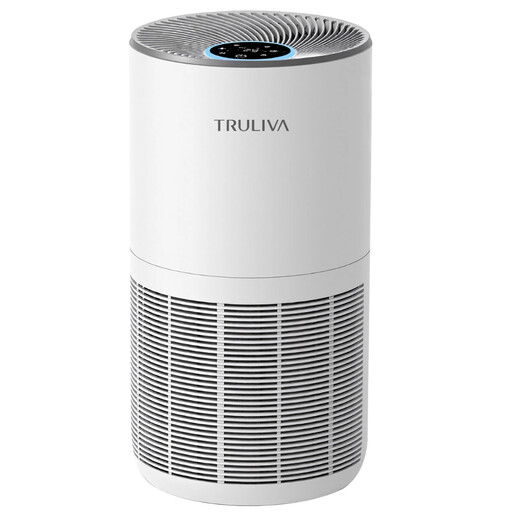
Why It Stands Out: With a powerful CADR of 450m?/h, the TRULIVA air purifier is built for large, open-plan spaces. Its 360° air intake system draws in air from all directions, ensuring efficient and thorough purification. This high capacity makes it a strong contender as an air purifier for pets, as it can quickly circulate air to capture dander and reduce odours in bigger rooms.
Pros:
Who is it for? This purifier is ideal for households with large living areas, open-plan layouts or multiple pets, where high-powered air cleaning is needed to maintain a fresh environment.
The right air purifier depends entirely on your room size, specific concerns and desired features. If the recommendations above aren't quite what you're looking for, or if you need a model specifically for a smaller space, you can explore our full range of bedroom air purifiers to find other models that may better suit your needs.
Most manufacturers recommend replacing the HEPA filter every 6 to 12 months. However, this can vary based on how often you use the purifier and the level of pollutants in your home. Many modern units come with a filter replacement indicator to let you know when it's time for a change.
Yes, particularly models that include an activated carbon filter in addition to a HEPA filter. The HEPA filter traps physical particles like pet dander, while the activated carbon is highly effective at absorbing and neutralising odours from pets, cooking and smoke.
For optimal performance, place your air purifier in the room where you spend the most time. It should be positioned on a flat surface with at least a foot of clear space around it to allow for unobstructed air intake and outflow. Avoid placing it in tight corners or directly against a wall.