
24/7 Customer Support

Free returns

Same-day & Next-day Delivery

Quality Guaranteed

Unlock Your Welcome Offers: FREE Delivery | Up to 80% OFF | Free 30-day JoyPlus trial
Download the APP
For any professional on a construction site, in a workshop or on a factory floor, a reliable marker is a non-negotiable part of the toolkit. A standard office marker simply will not suffice when you need a mark to remain clear on dusty concrete, oily steel or a surface exposed to the British weather. The frustration of a faded or smudged line can lead to costly mistakes and delays.
This guide is designed to help you navigate the options and find the right industrial markers for your specific tasks. We will look at the key features to consider and highlight a few dependable choices that are built for demanding environments.
Selecting the correct marker goes beyond just picking a colour. To ensure your marks are clear, durable and fit for purpose, consider these factors.
The biggest distinction in this category is between ink-based markers and paint markers.
Your working environment dictates the resilience required from your marker. If you are working outdoors or in damp conditions, a waterproof marker is essential. For marking on cold pipes or materials stored outside in winter, look for markers specifically formulated for low temperatures. The durability of the mark against UV light, chemicals and abrasion is also a critical consideration for long-term identification.
The tip of the marker determines the kind of line you can produce.
Here are our recommendations for markers that deliver on durability and performance in professional settings.
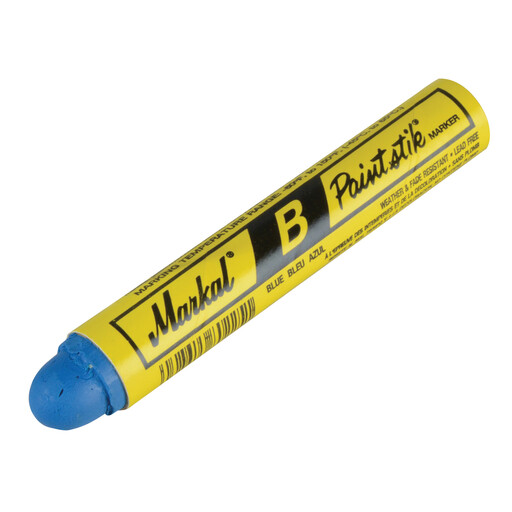
Why It Stands Out: As a solid paint marker, the Markal Paintstik excels where liquid ink fails. Its solid form means no drips and no mess, and it is specifically formulated to write on a vast range of materials, including cold, wet or oily surfaces. The bright blue paint provides excellent visibility on dark materials.
Pros:
Who is it for? This is an excellent tool for steel fabricators, scaffolders, surveyors and any trade professional who needs to make durable marks on non-porous or challenging surfaces in any weather.
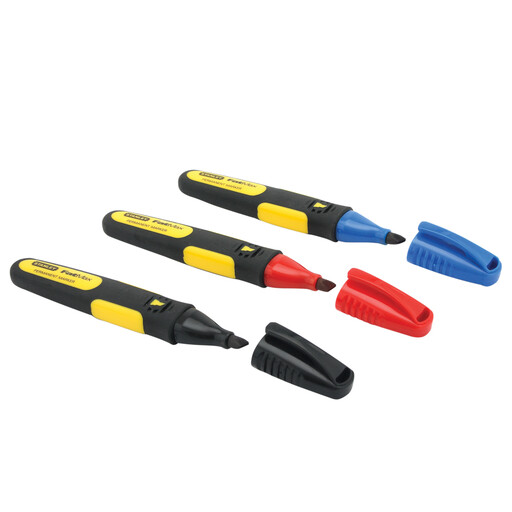
Why It Stands Out: The Stanley FatMax markers are designed with the rigours of a construction site in mind. The robust barrel can withstand being knocked about in a tool bag, and the versatile chisel tip allows for both marking out large areas and writing finer details. This pack includes three essential colours for colour-coding work.
Pros:
Who is it for? A great all-rounder for joiners, electricians, plumbers and general builders. Its versatility makes it a dependable staple for any professional toolkit.
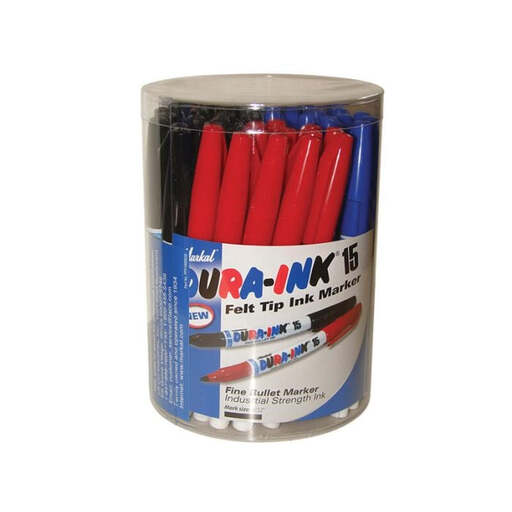
Why It Stands Out: When precision is paramount, the DURA-INK 15 delivers. Its fine tip is designed for accurate, detailed marking on smaller components, labels or inspection tags. The ink is quick-drying to prevent smudging, and this large 48-pack offers excellent value for teams or high-volume industrial use.
Pros:
Who is it for? Ideal for quality control inspectors, mechanics, manufacturing staff and anyone who needs to make clear, permanent and precise marks on a variety of materials.
While these heavy duty marker pens cover many industrial needs, your project might require a different type of specialised tool. For other marking and application solutions, including precision adhesive pens for intricate assembly work, feel free to explore our wider collection.
Q: What is the difference between a paint marker and a permanent marker?
A: The main difference lies in the marking substance. Permanent markers use a dye-based ink that soaks into porous surfaces like paper and wood. Paint markers use opaque, pigmented paint that sits on top of a surface, forming a durable layer. This makes them far more effective on non-porous and dark surfaces like metal, plastic and glass.
Q: Are industrial markers truly permanent?
A: In the context of marking tools, "permanent" typically means the mark is water-resistant and fade-resistant under normal use and environmental exposure. They are designed to last for the duration of a project. However, most industrial marks can be removed with specific chemical solvents or significant physical abrasion.
Q: Can I use a construction marker on oily or wet surfaces?
A: This depends on the marker. Standard ink-based markers will not work effectively on oily or wet surfaces. However, specialised solid paint markers, such as the Markal Paintstik, are formulated to displace surface contaminants like water and light oils, allowing them to leave a clear, lasting mark. Always check the product's specifications to ensure it is suitable for your application.