Weekly uniform pressers
Parents and carers pressing school trousers for the week may value a steam boost for difficult creases and a tip that reaches around seams. John Lewis & Partners identifies a steam boost as useful for sharp trouser creases.


For one or a few pairs of school trousers each week, a standard steam iron with controllable temperature and a steam boost is generally the proportionate choice. Check the trousers’ care label first; consider a steam generator if you also regularly iron a larger household load and have room for its separate base.
Parents and carers pressing school trousers for the week may value a steam boost for difficult creases and a tip that reaches around seams. John Lewis & Partners identifies a steam boost as useful for sharp trouser creases.
Anyone handling easy-care or blended trousers needs to match the heat setting to the garment. School Bells advises following the temperature on the sewn-in care label rather than judging it by how creased the fabric looks.
Households ironing only a small amount of uniform laundry may prefer a conventional iron they can put away easily instead of finding space for a steam generator’s separate base.
Start with the trousers’ care label, then weigh crease control against the amount of ironing you do across the whole household.
| Concern | What to check | Who this matters to |
|---|---|---|
| Neat creases | Compare continuous steam, a separate steam boost and access around seams; use steam only if the care label permits it. | If I press several pairs before the school week, I want defined leg creases without repeatedly working the same area. Around 43% of consumers would put quick smoothing and crease definition first. |
| Fabric care | Read the trouser label and look for temperature and steam controls suited to its instructions. | With easy-care trousers, I do not want a stubborn crease to tempt me into using unsuitable heat. Roughly 29% of consumers would prioritise fabric-appropriate heat and steam. |
| Storage and upkeep | Choose between a conventional iron and a separate-base generator; consider tank size and the maker’s cleaning instructions. | When uniform trousers make up most of my ironing, I would rather not store a separate base for occasional use. Around 28% of consumers would put manageable storage and upkeep first. |
A separate base takes up space even if you usually press only one or two pairs of trousers.
Judge the iron against your total weekly laundry load. Consider a generator when substantial ironing is routine and you have somewhere to store it.
The appropriate setting depends on the trousers’ fabric and finish, not on how creased they appear. School Bells notes that some easy-care uniform garments do not need ironing.
Read the sewn-in care label before starting and use a steam boost only when its instructions permit steam.
Tefal lists a 140 g/min boost for the Virtuo 30 FV2C64G0, while a Joybuy listing for that model states 130 g/min. That difference matters if the boost figure is part of your decision.
Compare the full model number and the specifications on the current listing with the manufacturer’s information before ordering.
Limescale care is part of using a steam iron, while a damaged cable or plug needs attention regardless of the iron’s features.
Follow the maker’s water and cleaning instructions. Electrical Safety First advises checking the cable and plug regularly and stopping use if the appliance is damaged.
Tefal’s UK range includes the compact Virtuo 30 FV2C64G0 and the higher-output Ultimate Pure FV9853G0, giving shoppers two conventional-iron formats to compare for different workloads.
Philips offers conventional irons with automatic-temperature features as well as separate-base steam generators.
The Powersteam Ultra Pro 28630 is a conventional steam iron for shoppers considering steam controls and maintenance features without a generator base.
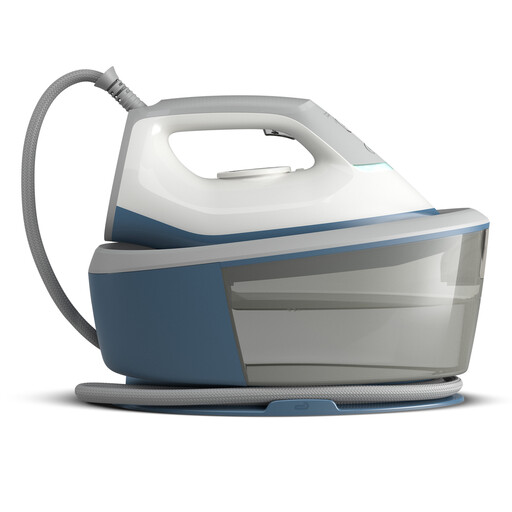
This steam generator is worth considering if school trousers are part of a larger, regular household ironing load. For occasional trouser pressing, weigh the separate base against the simpler storage of a conventional iron.
 No image available
Consider this format if you routinely iron a substantial household load as well as school trousers and have space for its base.
Listed power: 2400 W. Follow the trousers’ care label when choosing heat and whether to use steam.
No. School Bells says many easy-care uniform garments do not need ironing. Check the sewn-in care label before deciding whether and how to press a pair.
John Lewis & Partners gives 20 g/min continuous steam as a general benchmark for fast results and identifies a separate boost as useful for difficult or sharp trouser creases. Use steam only where the trousers’ care label permits it.
A standard steam iron is generally more proportionate if school trousers are your main ironing task. Consider a generator if you regularly tackle a larger household load and can accommodate the separate base.
Electrical Safety First advises checking for a standard UK three-pin plug and fuse, reading the maker’s instructions, inspecting the cable and plug, and unplugging the iron when it is not in use. Stop using an iron if it is damaged.