
24/7 Customer Support

Free returns

Same-day & Next-day Delivery

Quality Guaranteed

Unlock Your Welcome Offers: FREE Delivery | Up to 80% OFF | Free 30-day JoyPlus trial
Download the APP
Finding an activity that genuinely engages everyone, from young children to adults, can be a challenge. For a successful family game night or lively party, you need something that is easy to understand but remains exciting play after play. This is where the simple genius of Jenga shines.
As a Joybuy Product Recommendation Officer, my role is to help you navigate your shopping choices. This guide is designed to provide clear, practical information on the classic wooden block stacking game, helping you decide which version is the right fit for your home without any marketing fluff. We will look at the key differences between popular models and offer straightforward advice for your next get-together.
Before adding a Jenga set to your basket, a few considerations can help ensure you pick the perfect match for your game nights.
The first decision point is often between the original game and its modern variations. Classic Jenga is centred on suspense and physical skill. The quiet tension of sliding a block out from a teetering tower is a universal thrill. In contrast, newer versions like Jenga Maker transform the game into a fast-paced, creative challenge. Instead of deconstruction, it focuses on construction, pitting teams against each other in a race to build specific shapes. Consider whether your group prefers a game of steady hands or one of frantic, collaborative energy.
While most Jenga games are versatile, they are designed with different groups in mind. The classic version is suitable for players aged 6 and up and can be enjoyed by a solo player just as much as by a group. This makes it an excellent choice for families with younger children or for a quiet afternoon challenge. Jenga Maker, however, is built for teams and is recommended for ages 8 and up due to its more complex, communication-based gameplay. It’s one of the more engaging party games for larger groups.
The beauty of the original Jenga rules lies in their simplicity: use one hand to remove a block from anywhere below the highest completed level and place it on top of the tower. The game ends when the tower falls. This simplicity makes it accessible to everyone instantly. Variations introduce new rule sets. Jenga Maker, for example, uses instruction cards that one teammate must describe to another, adding a layer of communication and interpretation to the challenge.
Based on their distinct gameplay styles and suitability for different occasions, here are our recommendations.
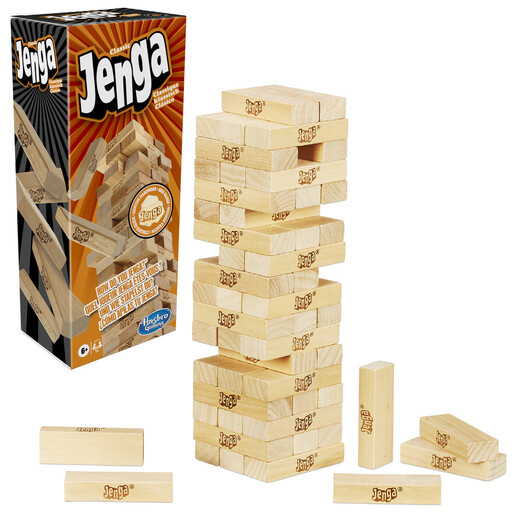
Why It Stands Out This is the quintessential wooden block stacking game that has been a staple of family game night ideas for decades. Its appeal lies in its purity. There are no cards, no teams, just a tower and the mounting tension with every block removed. The game is built on a foundation of suspense, skill and a little bit of luck, creating memorable moments when the tower finally tumbles.
Pros
Who is it for? This is for the purists. It’s ideal for families seeking a straightforward, universally loved game, individuals who enjoy a calming yet tense challenge and anyone needing a reliable ice-breaker for a social gathering.
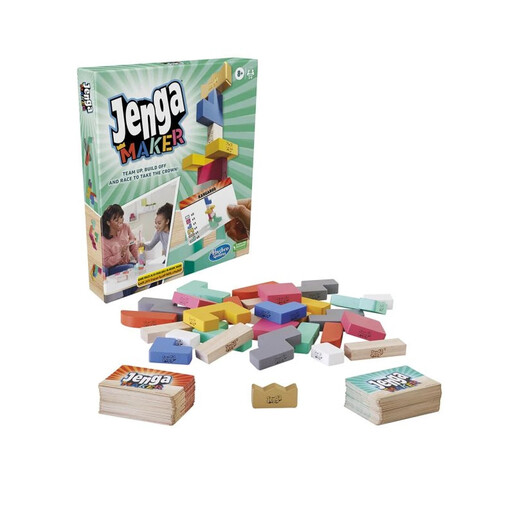
Why It Stands Out Jenga Maker flips the classic concept on its head. Instead of careful deconstruction, it’s a frantic race to build. Teams work together where one player—the "Director"—describes a structure from a card, and the other—the "Maker"—races to build it. This twist emphasises communication, speed and teamwork over silent, steady hands.
Pros
Who is it for? This is an excellent choice for established groups, families with slightly older children (8+) and anyone looking for dynamic party games. If your game nights thrive on energy, laughter and friendly competition, Jenga Maker is a fantastic option.
While Jenga offers a brilliant balance of simplicity and suspense, it is just one of many options for creating a memorable game night. If you are looking to expand your collection with different types of challenges, from strategic thinking to hilarious party fun, there is a wide world of games to discover.
Explore our full collection of board games for more family fun and party entertainment.
1. What are the official rules for Classic Jenga? The official Jenga rules are straightforward. After setting up the tower, players take turns removing one block from any level below the highest completed one. Using only one hand, they must then place that block on the top of the tower to create a new level. The game continues until a player causes the tower to fall. That player loses the game.
2. Can you play Jenga with only two players? Absolutely. Jenga is an excellent game for two players, offering a tense head-to-head battle of nerves. The classic version can also be played solo as a personal challenge to see how high you can build the tower. Jenga Maker requires a minimum of two players to form opposing teams (one player per team).
3. What is the main difference between Classic Jenga and Jenga Maker? The core difference is the objective. Classic Jenga is a game of suspenseful deconstruction, where players carefully remove blocks from a pre-built tower. Jenga Maker is a game of creative construction, where teams race to build specific objects shown on cards. The former tests physical steadiness, while the latter tests communication and speed.