
24/7 Customer Support

Free returns

Same-day & Next-day Delivery

Quality Guaranteed

Unlock Your Welcome Offers: FREE Delivery | Up to 80% OFF | Free 30-day JoyPlus trial
Download the APP
A flat battery or a soft tyre can turn a routine journey into a roadside headache. While breakdown cover is essential, waiting for assistance isn't always practical. This is where a multi-function jump starter with air compressor comes in, combining two critical emergency tools into one portable unit.
However, the market is flooded with devices making bold claims. Many UK drivers end up with a gadget that fails when they need it most. Before you buy, be aware of these common purchasing pitfalls:
To ensure your emergency car kit is reliable, focus on the practical specifications that matter for UK road conditions.
The power you need is directly related to your vehicle's engine. A higher peak amperage provides more power to turn over a cold or stubborn engine.
Nearly every portable air compressor for car tyres will claim a maximum pressure of 150 PSI. This is more than enough for any road vehicle. The more important, but often unlisted, specification is the airflow rate, measured in litres per minute (L/Min). A higher airflow rate means the device can inflate your tyres much faster. Also, look for models with an auto-stop function. This allows you to pre-set your desired tyre pressure and the inflator will automatically switch off when it's reached, preventing dangerous over-inflation.
A good car starter power bank should do more than just start your car. Consider its other functions:
We've filtered the options to match different UK driver profiles, focusing on models that offer a reliable balance of power, functionality and build quality.
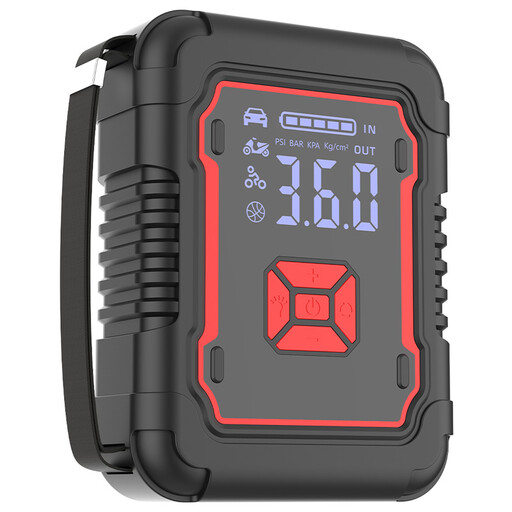
Why This Fits Their Persona: This is a solid all-rounder for the typical UK household. It has enough power for most petrol and diesel cars, vans and SUVs, providing peace of mind for the school run, daily commute or family holidays. It's compact enough to live in the boot without taking up too much space.
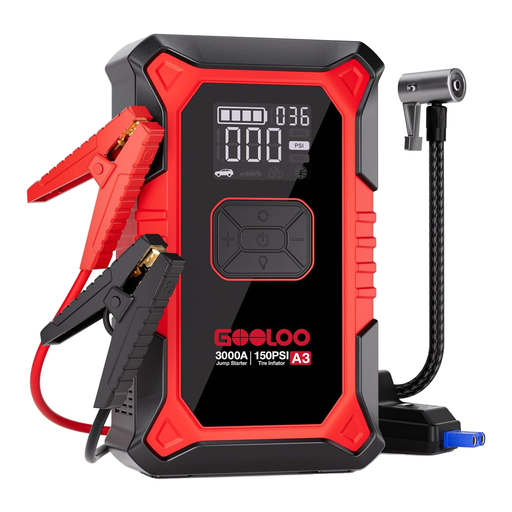
The 3000A peak current is backed by clear compatibility for a wide range of vehicles. Its air compressor includes an auto-stop function, which directly counters the risk of inaccurate inflation common in cheaper models.
A balanced combination of high jump-starting power and a smart tyre inflator. The QC3.0 18W USB output provides useful fast charging for phones and other devices.
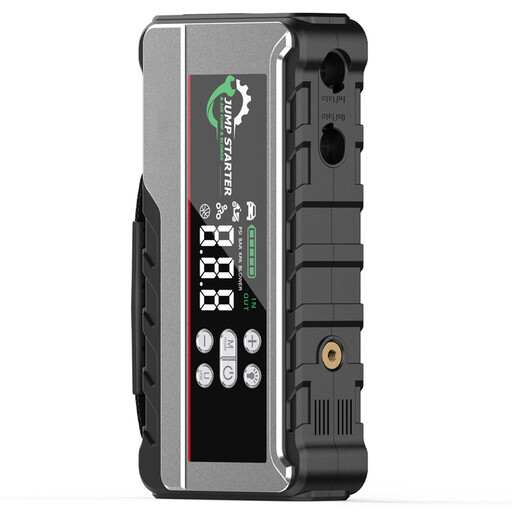
Why This Fits Their Persona: For those who drive larger vehicles or need a true mobile power station. This unit is ideal for van owners, SUV drivers or anyone who needs to charge a power-hungry laptop (like a MacBook) on the road, thanks to its high-wattage output.
It addresses the vague battery claims by offering a genuinely useful, high-power PD65W fast charging output. This isn't just a phone charger; it's a functional laptop power bank, justifying its larger battery capacity.
The 65W Power Delivery is a standout feature for professionals and tech users. It also includes an air blower function for inflatables, adding extra utility for camping or leisure activities.
Why This Fits Their Persona: This unit is built for versatility beyond the car. With specific inflation modes for bikes and balls, and a rugged design specified for a wide temperature range, it's a great companion for camping trips, cycling holidays and general outdoor use where you need a reliable jump starter for petrol diesel vehicles and more.
It tackles the "afterthought compressor" problem by offering multiple inflation modes and nozzles, showing a clear design focus on its tyre-inflating capabilities. The brand also provides a specific performance metric (inflating a tyre from 30 to 36 PSI in one minute).
The smart digital screen and multiple inflation modes make it very user-friendly. It also features a "BOOST" button for starting vehicles with extremely low battery voltage, a feature that provides extra reassurance in a tough situation.
We have compiled a complete, real-time list of products that fully satisfy these strict selection criteria and UK safety regulations.
Most modern lithium-ion based jump starters have a low self-discharge rate. You can typically expect them to retain a significant amount of charge for 3 to 6 months. However, it is good practice to check and top up the charge every 3 months to ensure it's ready for an emergency. Some newer models with different battery chemistries, like sodium-ion, claim much longer standby times, but for most units, a quarterly check is a sensible routine.
Yes, but with caution. Most manufacturers specify an operating temperature range, often between -20°C and 60°C. While a UK winter rarely drops below the lower limit, extreme cold can temporarily reduce the battery's efficiency and power output. The device will still work, but it may not deliver its maximum peak amps. It is always wise to check the product's specifications for its recommended storage and operating temperatures.
It depends on the engine size. A 1500A peak current may be sufficient for smaller diesel engines (under 2.0L) in mild weather. However, diesel engines require much more power to crank than their petrol counterparts. For reliable starting of most UK diesel cars, especially in colder months, a portable jump starter with a peak current of 2000A or higher is a much safer and more reliable choice.