Start with a compact keyboard that leaves room for your mouse and notes without making the commands you use to navigate dialogue branches awkward. A mini layout suits space-first writing; a 75% board is worth considering if you regularly use navigation keys, remapped shortcuts or macros. If typing comfort takes priority over desk space, review the whole workstation and consider a wider split keyboard instead.
Who this setup suits
Small-desk dialogue writers
If you outline and revise branching conversations with a mouse, notebook or reference device beside the keyboard, its footprint matters. A smaller layout frees desk space but may put some keys behind combinations, as Logitech notes in its keyboard guidance.
Shortcut and macro workflow builders
If you repeatedly navigate nodes, apply tags or run editor commands, check whether the keyboard can accommodate those actions. Keychron says its 75% K3 Max supports key remapping and macros through VIA.
Long-session shared-space typists
If you write for extended periods near other people, switch sound and the wider desk setup may matter as much as keyboard size. Logitech offers different switch options on its MX Mechanical Mini; check the selected option rather than judging noise by the model name alone.
What to check before choosing
Space-saving mini keyboard
Choose it when: Desk width is scarce and sustained writing matters more than having every navigation key immediately available.
Accept: You may need key combinations for commands that have dedicated keys on a larger layout.
Programmable 75% keyboard
Choose it when: Repeated dialogue-editor commands make remapping or macros useful; Keychron documents both on the K3 Max.
Accept: You will need to check the exact key arrangement and switch variant before settling on a compact mechanical board.
Split ergonomic keyboard
Choose it when: Your preferred typing position matters more than preserving the maximum surface beside the keyboard.
Accept: A full-width design such as Logitech’s ERGO K860 takes more room than a mini board and does not replace a suitable workstation setup.
For dialogue-tree work, check the commands you use most, then decide how much desk space, customisation and quiet typing matter to you.
| Concern |
What to check |
Who this matters to |
| Desk space and navigation |
Check the keyboard’s footprint and whether your usual arrow, function and editor commands need key combinations. |
If I keep a mouse and notes beside my dialogue tree, I need space without making branch navigation cumbersome; around 42% of consumers put this balance first. |
| Shortcuts and device workflow |
Check remapping or macro support if you will use it, and confirm the connection modes you need. |
When I repeat tagging or testing commands, I want a setup I can adapt to that workflow; roughly 33% of consumers prioritise this flexibility. |
| Typing comfort and noise |
Check the selected switch option and available desk space for a comfortable setup; do not assume a keyboard alone resolves workstation issues. |
For long writing sessions in a shared room, I want a typing feel I can live with without distracting others; about 25% of consumers put comfort or quiet first. |
Buying pitfalls
-
Choosing the smallest layout before checking your commands
Compact layouts save room by sacrificing some keys. If your dialogue editor relies on arrows, function keys or frequent shortcuts, extra key combinations may interrupt your workflow.
List the commands you use most, then compare their positions on mini, 75% and larger layouts.
-
Assuming every switch option sounds alike
Logitech offers tactile quiet, clicky and linear versions of the MX Mechanical Mini and describes differences in their feedback and sound. A model name alone does not identify the switch you will receive.
Confirm the named switch on the selected variant and check its sound if you share the room.
-
Taking the retailer’s location as proof of keyboard layout
Keychron’s UK listings show that layout and switch selections can vary within a keyboard family. A UK-facing page does not, by itself, tell you which physical arrangement is selected.
Check the exact variant’s layout, legends, switches and operating-system key labels before ordering.
-
Expecting a keyboard purchase to fix the whole workstation
Keyboard choice is only one part of a long writing session. Screen position, chair, available desk space and breaks also affect how the workstation is used.
Arrange the desk so you can use the keyboard comfortably, and seek a workplace display-screen-equipment assessment if your employer’s duties apply to your work.
Brands to consider for these keyboard types
Logitech
Logitech offers several distinct approaches here: the space-saving MX Keys Mini, the MX Mechanical Mini with switch options, and the wider split ERGO K860.
- Logitech describes programmable keys on the MX Keys Mini and offers tactile quiet, clicky and linear options for the MX Mechanical Mini.
- The full-width ERGO K860 addresses a different space trade-off from the mini models; confirm that its shape fits your desk.
Keychron
Keychron’s K3 Max is a 75% route for writers who intend to configure repeated commands.
- Keychron states that the K3 Max supports VIA remapping and macros, hot-swappable low-profile switches, and 2.4 GHz, Bluetooth and wired connections.
- Check the exact UK-ISO layout and switch selection rather than relying on the keyboard-family name.
Razer
Razer’s BlackWidow V4 Pro 75% is another compact mechanical option for buyers interested in changing switches.
- Razer identifies the BlackWidow V4 Pro 75% as a hot-swappable keyboard.
- Check which of its controls you would actually use for writing, as well as the selected layout and the room it leaves on your desk.
Joybuy keyboards for compact desks
These 75% and 80% keyboards are options to check if you want more room for a mouse or notes while building dialogue trees. Compare their stated layouts with the keys you use: several specify US QWERTY, which may not suit someone seeking UK-ISO.
 No image available
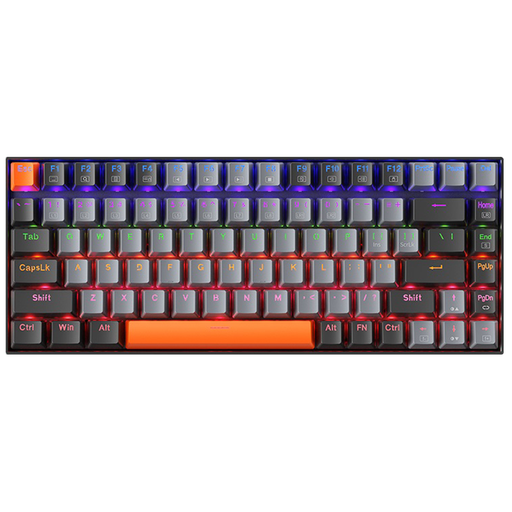
MACHENIKE K500A-B84 75% wired keyboard, US QWERTY, red switches
Consider this compact wired option if you use arrow keys and a function row while navigating dialogue branches.
The listing describes an 84-key 75% layout with those keys retained; the selected variant has red switches and LED backlighting. Its US QWERTY arrangement is not UK-ISO, and the USB cable needs a place on your desk.
View on Joybuy
 No image available
AULA F75 75% keyboard, US QWERTY, tri-mode
Consider the 75% layout if you want a compact writing setup and a choice of connections.
The title specifies wired, Bluetooth and 2.4G modes, PBT keycaps and RGB backlighting. It also specifies US QWERTY, so check the physical arrangement against your typing needs and confirm the keys used by your editor.
View on Joybuy
 No image available
AULA S75 Pro 75% tri-mode keyboard, Star Vektor switches
Consider this compact mechanical option if changing switch feel later matters to you.
The title identifies hot-swappable Star Vektor switches, a TFT display and a knob. Confirm the selected key layout and the commands you need before buying; the 75% label alone does not establish UK-ISO suitability.
View on Joybuy
 No image available
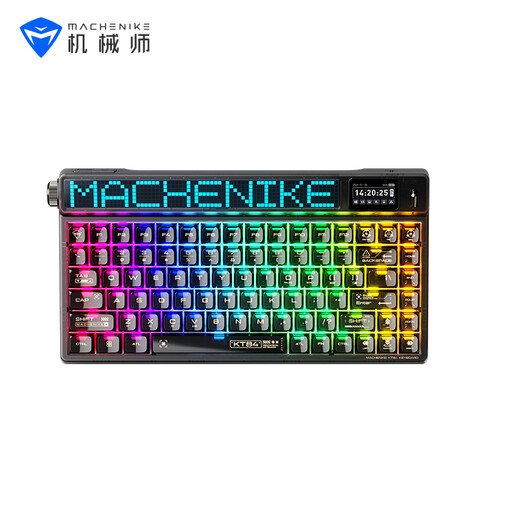
MACHENIKE KT84-B84W 75% tri-mode keyboard, Gateron White switches
Consider this 75% option if you want to switch between connection modes while keeping the keyboard compact.
The selected title specifies Gateron White switches and a US QWERTY layout. Check that arrangement and the keys needed for dialogue-tree navigation; do not assume a switch name establishes how quiet typing will be in your room.
View on Joybuy
 No image available
MACHENIKE KG87 80% tri-mode keyboard, Latte Switch-Pink
Consider the 80% layout if you can give the keyboard more room than a 75% board while retaining space for your mouse or notes.
The title identifies a gasket mount and US QWERTY layout. Check its physical dimensions, key arrangement and actual typing sound against your desk and shared-room needs.
View on Joybuy
Common questions
Should I choose a 75% keyboard over a smaller mini layout?
Choose a 75% keyboard if its key arrangement makes your regular dialogue-editor navigation and shortcuts easier while still leaving enough desk space. Smaller layouts sacrifice some keys, as Logitech notes; map your own commands before deciding whether the extra space saved by a mini board is worth those key combinations.
Which mechanical switches should I consider for a shared room?
Start by checking the exact switch variant rather than assuming all versions of a keyboard sound alike. Logitech describes linear switches as quieter than clicky options and tactile options as offering feedback with less noise than clicky switches; check how the selected board sounds if noise is decisive.
Do I need a UK-ISO keyboard for dialogue-tree writing?
Choose UK-ISO if you want its physical key arrangement and legends for your typing setup; it is not a requirement of dialogue-tree work itself. Check the selected variant rather than the retailer’s location: Keychron’s UK listings identify layout and switch selections separately.
Does a more ergonomic keyboard replace a workplace setup check?
No: keyboard shape is only one part of the workstation. The Health and Safety Executive says display-screen-equipment rules apply to employers whose workers regularly use it as a significant part of normal work; if that describes your work, ask your employer about the applicable workstation assessment rather than relying on a keyboard purchase alone.


