
24/7 Customer Support

Free returns

Same-day & Next-day Delivery

Quality Guaranteed

Unlock Your Welcome Offers: FREE Delivery | Up to 80% OFF | Free 30-day JoyPlus trial
Download the APP
Choosing a significant toy like a kids play kitchen can feel like a big decision. You want something that will capture your child's imagination, stand up to enthusiastic play and offer more than a few minutes of entertainment. A good children's kitchen playset is more than just a toy; it's a stage for creativity, a tool for learning social skills and a fun way to mimic the grown-up world.
As the Joybuy Product Recommendation Officer, my role is to help you navigate the options. This guide is designed to provide practical advice and highlight a few standout choices, helping you find a role play kitchen that fits your space, budget and your child's interests.
Before diving into specific models, here are a few key points to keep in mind. Thinking about these factors can help you narrow down the wide array of choices.
The choice between a wooden play kitchen and a plastic one often comes down to personal preference. Wooden models are known for their sturdy construction and classic aesthetic, often blending well with home furniture. They can be very durable, making them a long-lasting investment. Plastic kitchens, on the other hand, are typically lighter, easier to clean and can come in a wider variety of bright colours. They also frequently incorporate more electronic features.
Consider the level of interactivity you're looking for. Some children are happiest with a simple setup that allows them to fill in the blanks with their imagination. Others are captivated by a pretend kitchen with lights and sounds, turning knobs that click and taps that make water noises. Features like running water functions, ice dispensers and included accessory sets can make the experience more immersive. A toddler kitchen with accessories included from the start means your little one can begin playing straight away.
Play kitchens come in all shapes and sizes, from large, multi-unit setups to compact, single-unit designs. Before you buy, it's always a good idea to measure the space you have available in your playroom or living area. Corner kitchens are a clever solution for maximising play area in a smaller room, while more compact or mobile options are great for homes where space is at a premium.
Here are a few different types of play kitchens that cater to various needs and play styles.
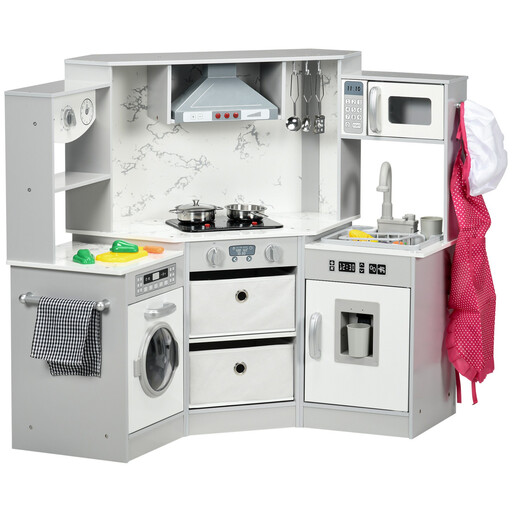
Why It Stands Out: This model is a comprehensive play station designed to be the centrepiece of a playroom. Its corner layout is a smart use of space, and it is packed with realistic features that encourage extended, imaginative play.
Pros:
Who is it for? This is a great option for families looking for a feature-rich toy kitchen that can keep children aged 3-6 engaged for hours. Its size and multiple features make it ideal for siblings or friends to play together.
View the AIYAPLAY Corner Kitchen

Why It Stands Out: With its compact footprint and clean Miele branding, this mini kitchen offers a simple, focused play experience. It’s an excellent choice for smaller spaces or as a child's first introduction to kitchen role-play.
Pros:
Who is it for? Ideal for anyone seeking a simple and compact kitchen for a 3 year old. It’s a great starting point that won't overwhelm a younger child and fits easily into most homes.
View the Theo Klein Miele Mini Kitchen
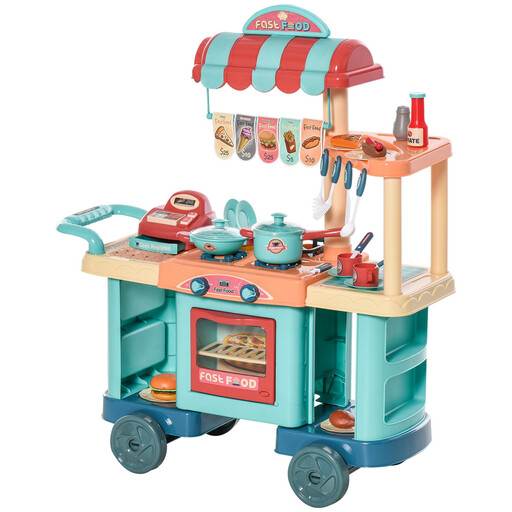
Why It Stands Out: This playset moves beyond the traditional home kitchen, offering a dynamic fast-food trolley experience. Its mobility and commercial theme open up a different world of role-play, from being a chef to a cashier.
Pros:
Who is it for? A fantastic choice for children who love playing "shop" as much as they love playing "kitchen." Its unique theme provides a fun alternative to a static children's kitchen playset.
View the HOMCOM Fast Food Trolley
The models above represent just a sample of the different styles available. If you're looking for a different size, material or feature set, there are many other choices to consider.
Explore Our Full Range of Kids Play Kitchens
1. What is a good age for a play kitchen? Most play kitchens are designed for children between the ages of 3 and 6. At this age, children are developing their imaginative and social skills, making it a perfect time for role-play toys. Always check the manufacturer's specific age recommendation, as some sets contain small parts that could be a choking hazard for children under 3.
2. Are wooden play kitchens better than plastic ones? One isn't necessarily better than the other; it depends on your priorities. A wooden play kitchen is often praised for its aesthetic appeal and sturdiness. Plastic models are generally lighter, may include more electronic features and can be easier to wipe clean. Consider what best suits your home and your child's play style.