
24/7 Customer Support

Free returns

Same-day & Next-day Delivery

Quality Guaranteed

Unlock Your Welcome Offers: FREE Delivery | Up to 80% OFF | Free 30-day JoyPlus trial
Download the APP
As a Joybuy Product Recommendation Officer, my role is to help you navigate the crowded market of pet supplies. Welcoming a kitten into your home is an exciting time, but the sheer volume of food options can be overwhelming. Marketing claims often add to the confusion, making it difficult to distinguish genuine nutritional value from clever packaging. This guide will help you understand the key factors in selecting the right kitten food, ensuring your new companion gets the best possible start in life.
Before we look at recommendations, let's address the most common pitfalls that new and even experienced owners encounter.
To make an informed choice, focus on these non-negotiable parameters. Understanding them will empower you to see past the marketing and assess the food's true suitability for your kitten.
This is the first thing you should look for on any packaging. The label must state that it is a "complete" food for kittens 2-12 months. This certification means it has been formulated to meet the specific, high-energy needs of a growing cat, including support for their immune system, bone development and overall vitality. This applies to both wet kitten food and dry kitten food. Pregnant or lactating queens also have higher nutritional demands and often benefit from these nutrient-dense kitten formulas.
Kittens grow at an astonishing rate, and this growth is fuelled primarily by protein and fat. As obligate carnivores, cats require a diet rich in animal-based protein.
There is no single correct answer here, as the choice depends on your kitten's preferences and your lifestyle.
Based on the criteria of providing complete nutrition and clear labelling, here are a few options suited to different needs and priorities.
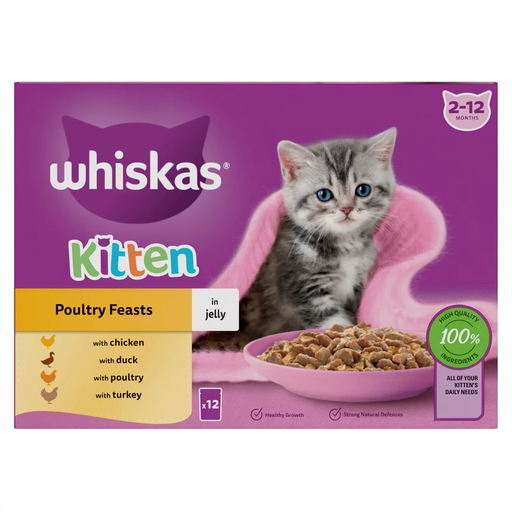
Why This Fits Their Persona: For new kitten owners who need a reliable, widely available and affordable option without compromising on core nutritional requirements. The multipack format is convenient and provides flavour variety to keep young kittens interested.
This is clearly labelled as a complete and balanced meal, removing the risk of accidentally under-nourishing your kitten with a complementary food. It's formulated specifically for kittens.
Fortified with calcium for bone development and taurine for heart and eye health. The high moisture content (84%) helps with hydration.

Why This Fits Their Persona: Ideal for owners who prioritise high, specified meat content and UK-sourced ingredients. This bulk pack is great for those who have settled on a quality food and want the convenience of a large supply.
This product directly counters the vague "meat" content trap by specifying high percentages of named meats, such as "UK Chicken Breast Slices 58.5%". This provides excellent transparency.
Features a very high protein content for wet food at 14.5%. It also includes 4% salmon oil, a great source of Omega fatty acids for skin, coat and brain development.
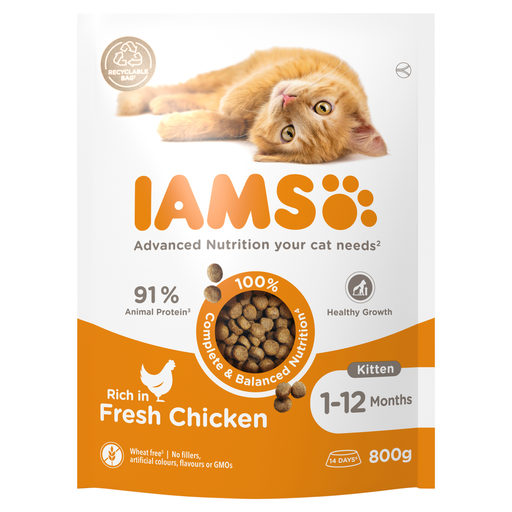
Why This Fits Their Persona: Perfect for owners who prefer the convenience, cost-effectiveness and dental benefits of a dry kibble diet, or for those who practice mixed feeding. This formula is packed with a high concentration of animal protein.
This food is wheat-free (though not fully grain-free) and avoids the "filler" trap by stating that 91% of its total protein is animal protein. It also specifies fresh chicken as a key ingredient.
An excellent high-protein dry food with 37% protein. It is enriched with DHA for brain development and has crunchy kibbles with tailored mineral levels to help reduce tartar build-up.
We have compiled a complete, real-time list of products that fully satisfy these strict selection criteria and UK safety regulations.
The correct amount depends on your kitten's age, weight and activity level, as well as whether you are feeding wet, dry or mixed food. Always check the feeding guide on the packaging, which provides a recommended daily amount. It's often best to divide this into several small meals throughout the day. Monitor your kitten's body condition and adjust portions as needed to ensure healthy growth without them becoming overweight.
No, you should avoid giving a kitten cow's milk. Most cats, including kittens, are lactose intolerant, and cow's milk can cause digestive upset, such as diarrhoea. If you wish to give a milk treat, choose a specially formulated kitten milk or cat milk product, like the Whiskas Kitten Cat Milk, which has had the lactose significantly reduced to make it safe for feline consumption. Remember, this is a complementary treat, not a meal replacement.
You should continue feeding your kitten a complete kitten formula until they are around 12 months old. At this point, they are considered an adult cat and their nutritional needs change. Their growth rate slows, so they no longer require the high levels of calories, protein and fat found in kitten food. Transition them to an adult cat food gradually over a period of 7-10 days by mixing the new food with the old, slowly increasing the proportion of the adult food to avoid any digestive issues.