
24/7 Customer Support

Free returns

Same-day & Next-day Delivery

Quality Guaranteed

Unlock Your Welcome Offers: FREE Delivery | Up to 80% OFF | Free 30-day JoyPlus trial
Download the APP
The dreaded low-battery warning on your laptop always seems to appear at the worst possible moment: halfway through a critical client presentation, during a lecture or on a long train journey with no access to a plug socket. In a world where we rely on our devices for work, study and staying connected, running out of power is more than just an inconvenience.
This guide is designed to help you navigate the technical specifications and marketing claims to find a reliable laptop power bank. We will focus on the key features that matter for charging high-power devices, ensuring you can keep your laptop, tablet and phone running, wherever you are.
Choosing the right power bank for a laptop is different from picking one for your phone. Laptops require significantly more power. Here are a few key considerations to keep in mind.
Capacity, measured in milliampere-hours (mAh), tells you how much energy a power bank can store. While a larger number is generally better, it's crucial to consider the flight approved power bank regulations. Most airlines, following international standards, limit batteries to 100Wh in carry-on luggage.
A typical 20000mAh power bank usually falls comfortably under this 100Wh limit, offering a good balance between charging potential and travel compliance. This capacity is often enough to provide a full charge for an ultra-portable laptop or multiple charges for a smartphone.
This is arguably the most important factor. A standard power bank won't charge a laptop. You need a high wattage power bank that supports Power Delivery (PD), a fast-charging standard that negotiates power needs between the charger and your device.
Look for models with a USB C power bank port that supports at least 45W output. For more demanding laptops, such as a power bank for MacBook Pro models, 65W, 100W or even 140W (using the latest PD3.1 standard) is preferable for efficient charging. A fast charging power bank with a high wattage output ensures your laptop charges at a reasonable speed, rather than just slowing the battery drain.
Consider how many devices you need to charge simultaneously. A good portable laptop charger will have multiple outputs, usually a mix of USB-C and USB-A ports. An all-metal casing, often aluminium, can offer better durability and heat dissipation compared to plastic alternatives, which helps maintain stable charging performance.
Here are a few models that stand out for their combination of power, capacity and features, suitable for a range of users from students to travelling professionals.
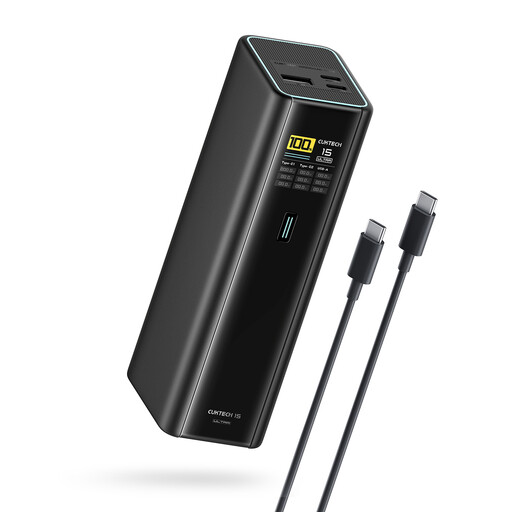
Why It Stands Out: This power bank is built for speed. Its main selling point is the single-port 140W output via the latest PD3.1 protocol, making it one of the faster options available for charging compatible devices like the latest MacBook Pro models.
Pros:
Who is it for? Tech enthusiasts and professionals with the latest PD3.1-compatible laptops who need the fastest possible charging speeds on the go.
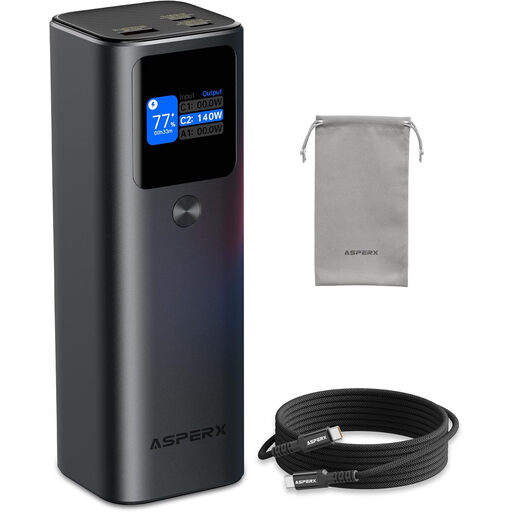
Why It Stands Out: This model maximises capacity right up to the legal flight limit. At 99.36Wh (derived from its 27,600mAh capacity), it offers the largest possible battery you can carry on a plane, perfect for long-haul travel or extended periods away from an outlet.
Pros:
Who is it for? Frequent travellers, digital nomads and anyone who needs to power multiple devices, including laptops, for a full day or more without access to mains power.
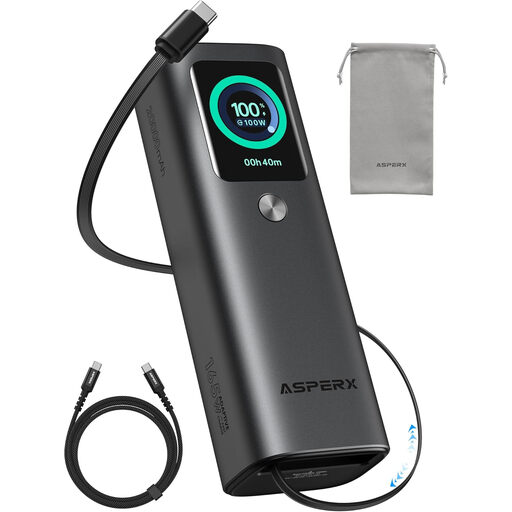
Why It Stands Out: This power bank prioritises convenience. Its standout feature is the built-in retractable USB-C cables, eliminating the need to carry or potentially forget separate charging cords. Just pull, plug and power up.
Pros:
Who is it for? The everyday commuter, student or professional who values convenience and an all-in-one solution, ensuring they never have to hunt for a cable again.
If the models above don't quite fit your specific needs, or if you'd like to explore different capacities and feature sets, there is a wide range of alternatives available.
No. Most standard power banks are designed for smartphones and have a low power output (typically 5W-18W). To charge a laptop, you need a portable laptop charger with a high-wattage USB-C Power Delivery (PD) port, usually providing 45W or more. Always check your laptop's power requirements before purchasing.
Yes, but with restrictions. Power banks must be carried in your hand luggage, not in checked baggage. The key limitation is capacity, which must not exceed 100Wh (Watt-hours). Most high-capacity power banks, including 20,000mAh and 27,600mAh models, are specifically designed to fall under this limit, making them flight-approved.
This depends on your laptop's battery size. A 20000mAh power bank will typically provide between 0.8 to 1.5 full charges for most modern ultra-portable laptops (like a MacBook Air or Dell XPS 13). For larger, more powerful laptops with bigger batteries, it may provide a 50-70% charge, which is still more than enough to get you through a critical meeting or help you finish your work.