
24/7 全天候客户支持

免费退货

当日/次日达

品质保障

开启新人专享福利: 全场免邮 | 低至 2 折 | 免费试用 30 天 JoyPlus 会员
下载 Joybuy
A dead laptop battery during a crucial meeting, a long train journey or just before a deadline is a modern-day nightmare. A reliable laptop power bank seems like the obvious solution, but the market is flooded with options that often fail to deliver on their promises. Many UK consumers find themselves with a portable charger that is either too weak, too bulky or worse, not even allowed on their flight.
Before you invest in a new portable power source, it's important to recognise the common pitfalls. Understanding these can save you from a frustrating and costly mistake.
To choose a portable charger for laptop use that genuinely meets your needs, focus on these three core specifications.
Wattage is the single most important factor for charging a laptop. It measures the speed at which power is delivered. While a phone might only need 15-20W, most modern laptops require at least 45W-65W to charge effectively. High-performance models, such as a MacBook Pro power bank, demand even more—often in the 100W to 140W range.
Look for a USB C portable charger that explicitly supports the Power Delivery (PD) standard. This technology allows the power bank to communicate with your laptop and deliver the optimal amount of power safely. The latest PD 3.1 fast charging protocol is designed for outputs up to 240W, making it the new benchmark for high-power devices.
While capacity is commonly listed in mAh, the crucial figure for travel and performance is Watt-hours (Wh). This is the universal metric used by airlines to determine if a battery is a flight approved power bank.
A capacity of 20000mAh to 27,600mAh (just under 100Wh) is the ideal range, providing enough power to fully charge most laptops at least once without falling foul of travel regulations.
A capable laptop power bank should have at least one high-wattage USB-C port that can handle the maximum output (e.g., 100W or 140W). Multiple ports are also highly practical, allowing you to charge your laptop, phone and tablet simultaneously. Check the specifications to understand how the power is distributed when multiple ports are in use, as the total wattage will be shared between them.
We have analysed the market to identify portable chargers that align with the needs of different UK users, ensuring they meet the critical specifications for performance and safety.
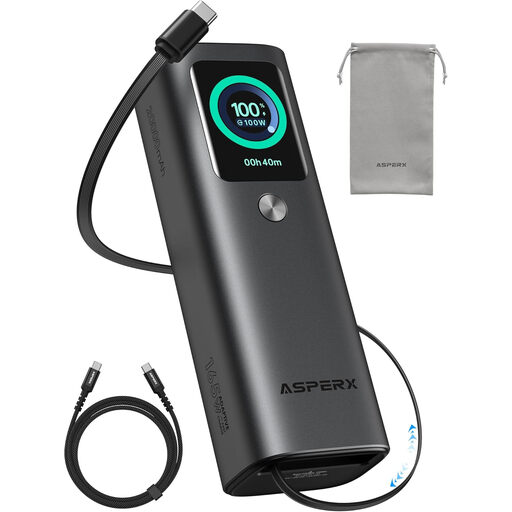
Why This Fits Their Persona: This model is ideal for those who value convenience. The built-in retractable cables mean you never have to remember to pack separate charging leads, making it perfect for tossing into a backpack for a day of lectures or commuting between offices.
It avoids the "fake fast-charging" trap with a powerful 100W single-port output, sufficient for most modern laptops. The 20,000mAh capacity is flight-approved and provides a substantial, realistic power boost.
Integrated Retractable Cables: Eliminates the need to carry extra cords.
High Total Output: 165W total power allows for charging multiple devices, including two laptops at once (e.g., 100W + 65W).
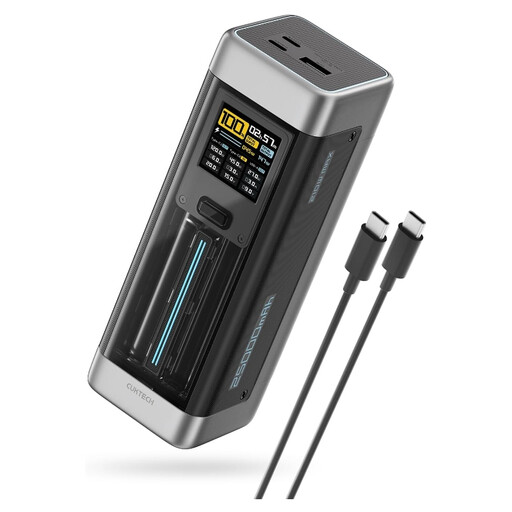
Why This Fits Their Persona: Built for those who depend on their tech while travelling. Its high capacity and power are perfect for long-haul flights, cross-country train journeys or working remotely from a café without access to a socket. It can keep a high-performance laptop like a MacBook Pro running through a full workday.
This unit directly counters the "airport security" gamble. At 25,000mAh (~90Wh), it offers high capacity while remaining comfortably under the 100Wh flight limit. The 140W PD 3.1 output ensures it can genuinely fast-charge demanding laptops.
140W PD 3.1 Output: Supports the latest fast-charging standard for top-tier laptops.
Informative Display: The colour screen shows real-time power input/output and remaining charge time, removing guesswork.
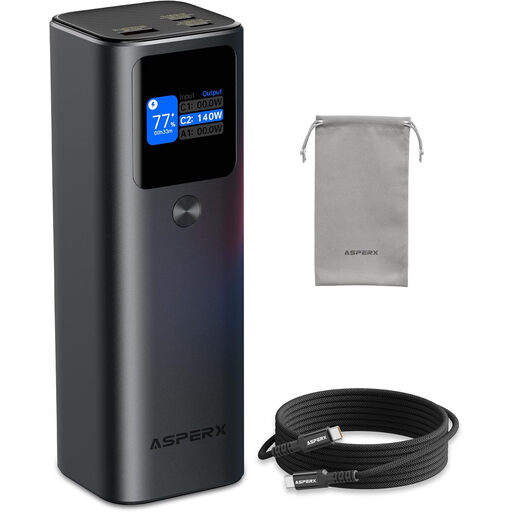
Why This Fits Their Persona: For the user who wants the maximum power and capacity allowed by regulations. This is for the tech enthusiast running multiple high-drain devices, who needs to charge a powerful laptop, tablet and phone simultaneously without compromising on speed. The premium aluminium casing also appeals to those who value build quality.
It masterfully navigates the capacity and flight-safety rules by offering 27,600mAh, which translates to 99.36Wh—the absolute maximum allowed in carry-on luggage. It also delivers a true 140W single-port output, satisfying the most power-hungry laptops.
Maximum Flight-Approved Capacity: At 99.36Wh, it provides the most power legally possible on a plane.
Premium Build: The aluminium unibody aids heat dissipation for more stable fast charging and offers superior durability.
We have compiled a complete, real-time list of products that fully satisfy these strict selection criteria and UK safety regulations.
This depends on your laptop's battery size and the power bank's true rated capacity. As a general guide, a typical 13-inch laptop (like a MacBook Air) has a battery of around 50Wh. A 20,000mAh power bank is about 72Wh. Factoring in energy loss, you can expect it to provide roughly one full charge for a smaller laptop or a significant 60-70% boost for a larger, more powerful model like a 16-inch MacBook Pro.
Modern, certified power banks from reputable brands are equipped with multiple safety features, including overcharge protection. This system automatically stops the charging process once the internal battery is full. However, for general safety, it is always good practice to charge electronic devices on a hard, non-flammable surface (like a desk, not a bed) and in a well-ventilated area.
The primary difference is wattage output. A standard power bank for phones typically provides 10-20W of power. A laptop power bank is specifically designed to deliver a much higher output, usually between 45W and 140W, through a USB-C Power Delivery (PD) port. Using a phone power bank on a laptop will either fail to charge it or charge it so slowly that the battery may still drain if the laptop is in use.