Who each setup suits

Listeners with room for floorstanders

If a pair of cabinets can stand clear of walkways and furniture, you can consider the larger floorstanding route for live albums. Q Acoustics positions its 5050 for bigger spaces; that positioning is a reason to investigate the route, not a prediction of its sound in your loft.

Listeners working around eaves and furniture

Standmount positions may give you more options when usable floor area is irregular. Check the cabinets and stands together: Wharfedale specifies its EVO4.2 at 455 mm high and 13.4 kg per speaker, so it is not a small-shelf solution.

Streamers who want fewer components

If music comes mainly from streaming services, a TV or a computer, an active system may simplify connections. KEF lists streaming, HDMI ARC and USB-C among the LSX II LT’s options; you still need to plan positions and power for the speakers.

What matters when choosing

Passive floorstanders

Consider when: The loft has clear space for two floorstanding cabinets and their positions will not obstruct the room.

Allow for: A suitable amplifier, speaker cables and enough freedom to position both cabinets.

Passive standmounts

Consider when: Separate speaker positions are possible, but eaves or furniture make floorstanders awkward.

Allow for: An amplifier, cables and stable stands; a substantial standmount can still take up considerable space.

Active stereo speakers

Consider when: Built-in amplification and direct connections for your music sources matter more than a separate-amplifier setup.

Allow for: Mains power and useful left/right separation; adding a subwoofer would introduce another component to place.

Calibrated active monitors

Consider when: You are prepared to set up a specialist system to address an awkward listening position.

Allow for: Compatible equipment and calibration work; room correction does not replace sensible placement.

Concern What to check Who this matters to
Concert scale and bass Check clear floor area and listening distance. If considering compact active speakers, assess whether their bass meets your needs before planning a subwoofer. I want the changes in level and low notes on live recordings to carry weight, and I can make room for the system that suits that aim. Around 33% of consumers put concert scale and bass first.
Room fit and placement Measure cabinet positions and, for standmounts, the stands’ footprint and height. Check cable routes around eaves and furniture. With limited clear space beside the listening area, I need speaker positions that do not block the room; room fit comes first for around 42% of consumers.
Connections and components List your actual sources and check the required inputs and power-socket positions. Passive speakers also need a suitable amplifier. I mainly use streaming, a TV or a computer and would rather avoid unnecessary separate boxes. Straightforward connection is the primary need for around 25% of consumers.

Buying pitfalls

  • Treating a large standmount as a shelf speaker

    Wharfedale specifies the EVO4.2 at 455 mm high and 13.4 kg per speaker. A narrow or shallow shelf may not provide a suitable position.

    Measure the proposed locations and plan stable supports before ordering.

    Stands and longer speaker cables may become part of the setup.

  • Buying passive speakers without the rest of the system

    KEF Q Concerto Meta and Wharfedale EVO4.2 are passive designs with stated amplifier-power requirements; neither is an all-in-one active system.

    Check amplifier suitability and how each music source will connect before choosing either pair.

    An amplifier, speaker cable and, where needed, stands or a separate source component add to the equipment required.

  • Assuming convenience guarantees concert-scale sound

    The compact KEF LSX II LT has a subwoofer output, but that connection does not establish whether its bass alone will meet your expectations.

    Audition the intended active setup if possible before deciding whether to add a subwoofer.

    A subwoofer would need its own position and connection.

  • Expecting calibration to fix every position

    Genelec says its GLM system can adjust level, delay and room response. Those controls do not make obstructed speaker positions or an impractical listening seat suitable.

    Choose viable speaker and seat positions first, then use compatible calibration equipment as part of the setup.

    The specialist hardware and calibration process require setup time.

Relevant brands to consider

KEF

KEF offers two distinct routes here: the passive Q Concerto Meta standmount and the compact active LSX II LT system.

  • KEF specifies a three-way bass-reflex design and 15–180 W amplifier requirements for Q Concerto Meta. LSX II LT provides streaming, HDMI ARC, USB-C and a subwoofer output.
  • The passive model needs external amplification. Do not assume the compact active model will deliver the presentation you want without checking it in a suitable room.

Wharfedale

The EVO4.2 is a substantial three-way passive standmount for a setup with suitable stands and amplification.

  • Wharfedale specifies 25–120 W recommended amplifier power, 87 dB sensitivity and 48 Hz bass extension at −6 dB for EVO4.2.
  • At 455 mm high and 13.4 kg per speaker, its cabinet and support need careful planning around eaves and furniture.

Q Acoustics

Q Acoustics positions the 5050 passive floorstander for larger spaces.

  • The company describes cabinet features intended to manage vibration and internal pressure; its larger-room positioning makes the 5050 relevant where floor space permits.
  • Those manufacturer descriptions do not establish its performance in a particular loft. Check placement and amplifier suitability, and audition where possible.

Genelec

Genelec is relevant to buyers considering a specialist active-monitor and calibration setup rather than a conventional passive hi-fi system.

  • Genelec says its compatible SAM and GLM equipment can adjust level, delay and room response.
  • This route calls for compatible source connections, a calibration workflow and sensible speaker placement.

Joybuy products for these setups

These products offer two different starting points: a passive bookshelf-speaker pair for an amplifier-based stereo system, and a single wireless tabletop speaker that needs another compatible unit for left/right stereo. Neither should be treated as a complete match for a larger floorstanding setup.

Pair of HiVi-Swans DIY3.1 passive bookshelf speakers

HiVi-Swans DIY3.1 Passive Bookshelf Speakers, 6.5-inch Pair

This passive stereo pair is worth considering if separate speaker positions fit the loft and you want to use an amplifier.

The product title identifies a 6.5-inch variant. Check the cabinet dimensions against your planned positions and confirm amplifier compatibility before buying.

View on Joybuy
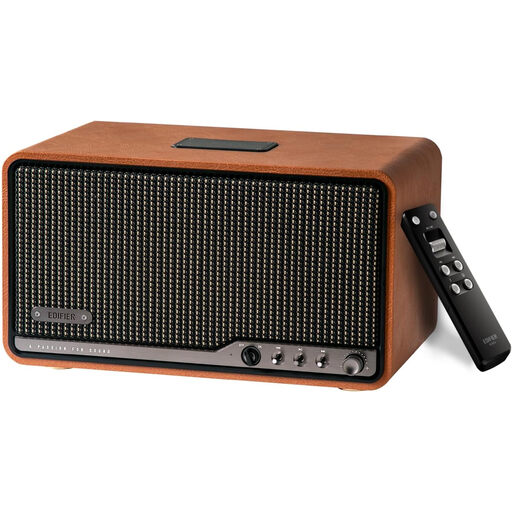
Edifier S300 wireless tabletop speaker in brown

Edifier S300 Wireless Multi-Room Tabletop Speaker, Brown

This single wireless tabletop speaker may suit a lower-clutter setup if you plan to obtain another compatible S300 for left/right stereo.

Confirm the quantity and pairing steps, check connections for your sources, and assess whether the resulting setup meets your bass and listening-distance needs.

View on Joybuy

Questions about loft speaker setups

Should I choose floorstanders or standmounts for a converted loft?

Consider floorstanders when you have clear positions for both cabinets and want to explore a larger-cabinet passive setup. Standmounts may be easier to position around eaves and furniture, but they still need suitable stands and an amplifier; a model as substantial as Wharfedale EVO4.2 should not be planned as a small shelf speaker.

Do active speakers make placement less important?

No. Built-in amplification can reduce the number of separate components, but an active stereo setup still needs useful left/right separation, mains power and workable cable routes. A subwoofer, if you decide you need one, adds another placement decision.

Can room calibration solve an awkward loft layout?

Calibration can help within a compatible system, but it cannot replace viable speaker and listening positions. Genelec says its SAM and GLM equipment can adjust level, delay and room response; using it also means choosing the compatible specialist setup and completing calibration.

What if the speaker setup needs new sockets or wiring?

Treat new fixed electrical work separately from buying and plugging in speakers. In England, GOV.UK’s Approved Document P gives guidance on electrical safety in dwellings, including notification, installation, inspection and testing. If the loft needs fixed sockets, circuits or wiring, check the applicable requirements with local building control or a qualified electrician; rules elsewhere in the UK should be checked for the relevant nation.