Quiet shared-desk editors
People revising programme copy beside colleagues who want less audible clicking without changing how they navigate documents.


For concert-programme work at a shared desk, start with quieter clicks and a connection your computer supports, then choose a shape that suits the length of your editing sessions. A slim mouse is easier to carry between desks, while a hand-fitting, contoured option deserves more attention for longer sessions; multi-device switching and advanced scrolling matter most if you will use them.
People revising programme copy beside colleagues who want less audible clicking without changing how they navigate documents.
People moving between layouts, lists and corrections for extended periods who need to consider hand fit alongside their desk setup.
People alternating between a laptop, tablet or another compatible device at different desks or venues who would use confirmed device-switching controls.
At a shared desk, consider click noise and hand fit before paying attention to extra controls. Connection options and portability become more important if you change devices or work locations.
| Concern | What to check | Who this matters to |
|---|---|---|
| Click noise | Check the exact model's quiet-click claim and consider wheel and desk-contact noise separately. | When I revise copy beside a colleague, I want clicking to be less distracting. Around 36% of consumers put quieter clicks first. |
| Hand fit | Choose a suitable size and handedness; the Health and Safety Executive advises keeping the mouse in line with the elbow. | For a long layout or proofreading session, I need a shape that fits my hand and space to position it comfortably. Hand fit comes first for around 29% of consumers. |
| Document and device control | Confirm compatible connections and the number of devices supported; decide whether extra scrolling controls would help. | If I move between a programme draft and another device, I want switching and navigation to fit that workflow. Around 21% of consumers prioritise document and device control. |
| Moving between desks | Consider carrying size and whether you work without a mouse mat or on a difficult surface. | Taking my mouse between desks makes a compact shape useful, while an unfamiliar surface may change what I need from tracking. Portability or surface flexibility is the main concern for around 14% of consumers. |
A quiet-click claim concerns the named mouse and does not establish that scrolling or contact with the desk will be inaudible.
Check which buttons the claim covers. If disturbance is decisive, assess the wheel and the mouse on the surface you normally use as well.
A slim mouse may be convenient to carry but is not automatically the right shape for prolonged editing. The Health and Safety Executive also treats mouse placement as part of the wider workstation setup.
Consider size and handedness, and leave room to position the mouse in line with your elbow. For regular work involving daily, continuous display-screen use of an hour or more, ask your employer about a workstation assessment.
Device switching and connection options depend on the exact model. Logitech says its MX Anywhere 3S connects to up to three devices by Bluetooth, but the Logi Bolt receiver is not included with that version.
Check each computer's Bluetooth capability, operating system and available ports, along with the mouse's supported connection methods and supplied accessories.
Using a receiver-based connection may also require a compatible receiver or an adaptor for your computer.
Its Pebble Mouse 2 M350s, Signature M650 and MX Anywhere 3S illustrate different ways to balance a compact shape, hand fit and device switching.
The Microsoft Bluetooth Mouse is a compact option to consider for a compatible Windows laptop when straightforward navigation is the priority.
The Pro Click Mini is relevant if compact size, device switching and scrolling controls all matter to your workflow.
These mice offer ways to approach quieter shared-desk work, from portable designs to receiver-based options. Compare each listing's connection and hand-fit details with your own computer and editing routine.
 No image available
Consider this for shared-desk editing if you want quieter clicks and expect to change between compatible devices. The named variant has adjustable DPI and uses one AA battery. Confirm which connection method each intended device can use; the quiet-click claim does not cover wheel or desk-contact noise.
 No image available
Consider this for programme work on a computer that can use its USB receiver. The named variant specifies 2.4GHz wireless connection, 1600 DPI and quiet clicks. Check that your computer has a suitable port; the click-noise wording does not establish how the wheel sounds.
 No image available
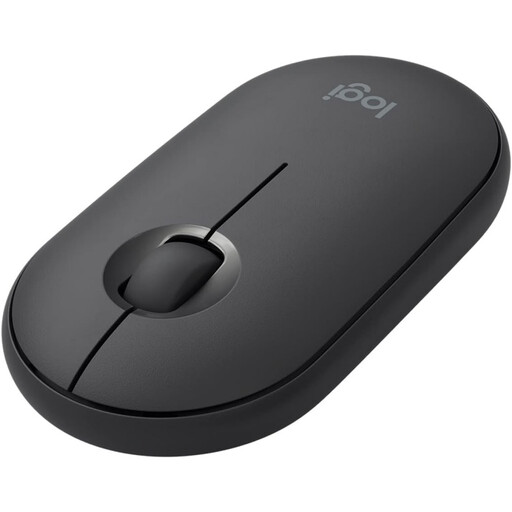
Its low-profile shape is worth considering if you carry a mouse between programme-editing locations. The listing describes quieter clicks, but confirm this SKU's exact connection method and whether a receiver is supplied before buying. Do not assume it has the features of the separately named Pebble Mouse 2 M350s.
 No image available
For a shared desk, the listing's quiet-click claim concerns the left and right buttons, not scrolling or desk contact. The named mouse has five adjustable DPI settings. Check its connection against your computer; the listing says its side buttons are unavailable on Mac.
The Health and Safety Executive does not specify one mouse type. For workers using display screen equipment daily for continuous periods of an hour or more, the UK rules require employers to assess the workstation and reduce risks, taking account of the equipment, the work and individual requirements. That wider assessment matters at a shared desk too.
No: a quiet-click claim does not establish that scrolling or desk contact makes no sound. Logitech's stated click-noise reductions for the named Pebble Mouse 2 M350s and Signature M650 models concern those models' click technology; check the exact mouse and, if practical, assess its noise where you work.
Not necessarily: Logitech describes Easy-Switch on compatible models as switching between paired devices when you press a button. Check that your exact mouse offers the feature and that both devices support its required connections.
Choose the power arrangement that fits where and how you work, rather than assuming either type will suit every editing session. Confirm the exact variant's power source and stated battery life, then consider whether charging access or keeping a replacement battery is easier across your work locations.