
24/7 Customer Support

Free returns

Same-day & Next-day Delivery

Quality Guaranteed

Unlock Your Welcome Offers: FREE Delivery | Up to 80% OFF | Free 30-day JoyPlus trial
Download the APP
As awareness grows around the materials used in our cookware, many home cooks in the UK are looking for healthier alternatives to traditional non-stick pans. If you've started questioning the coatings on your old frying pans, you're not alone. The search for a reliable, high-performing and non-toxic ceramic frying pan has become a priority for health-conscious households.
This guide is designed to help you navigate the options. We'll break down the essential features to look for when choosing a new pan and share a few of our top recommendations for 2026 that balance safety, performance and convenience.
Choosing the right pan goes beyond just its non-stick capabilities. Here are three key considerations to help you make an informed decision.
The main reason people seek out ceramic pans is to find a PFOA free frying pan. Modern ceramic non-stick coatings are typically made using a sol-gel process, which creates a hard, glassy surface from inorganic materials (like sand-derived silicon) without the use of Polytetrafluoroethylene (PTFE).
When shopping, look for clear labelling that confirms the pan is PFAS free cookware. This broader category includes thousands of chemicals, so a "PFAS-free" label offers greater peace of mind. Some advanced coatings are also reinforced with particles like diamond or titanium, which can enhance durability and prolong the life of the non-stick surface.
Not all pans work on all hobs. If you have a modern kitchen, finding a ceramic frying pan for induction is crucial. For a pan to work on an induction hob, its base must be made of a magnetic material, such as iron or certain grades of stainless steel. Always check the product details for "induction compatible" or an induction symbol.
Additionally, consider if you need an oven-safe frying pan. A pan that can go from the hob to the oven offers much more culinary flexibility, perfect for searing a steak and then finishing it in the oven. Pay attention to the maximum oven-safe temperature and ensure the handle is also made from an oven-proof material like stainless steel.
A key benefit of a healthy non-stick pan is effortless cleaning. A quality ceramic surface should release food easily, often requiring just a simple wipe or rinse. For added convenience, many people prefer a dishwasher-safe frying pan.
However, to maximise the lifespan of any non-stick coating, it's wise to follow a few simple rules. Use wooden or silicone utensils to avoid scratches, avoid using extreme high heat and let the pan cool down before placing it in water to prevent thermal shock.
Here are a few standout options that meet the criteria for safety, performance and modern convenience.
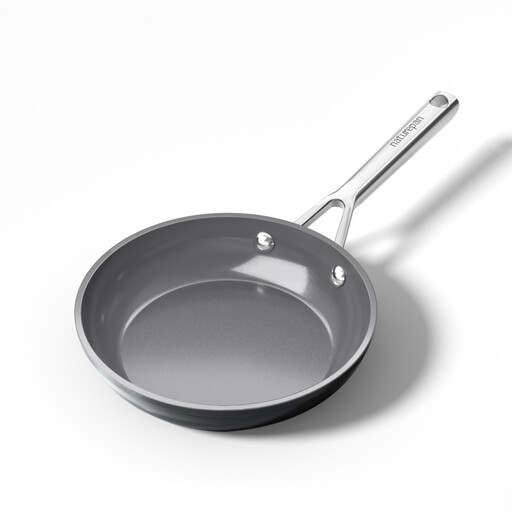
Why It Stands Out: This compact pan features a ceramic coating reinforced with diamond and titanium particles, offering a durable and reliable non-stick surface. Its encapsulated base ensures fast, even heating, which is ideal for delicate foods like eggs and pancakes that can easily burn on pans with hot spots.
Pros:
Who is it for?: Perfect for individuals, couples or anyone needing a smaller pan for daily breakfasts, omelettes or side dishes.
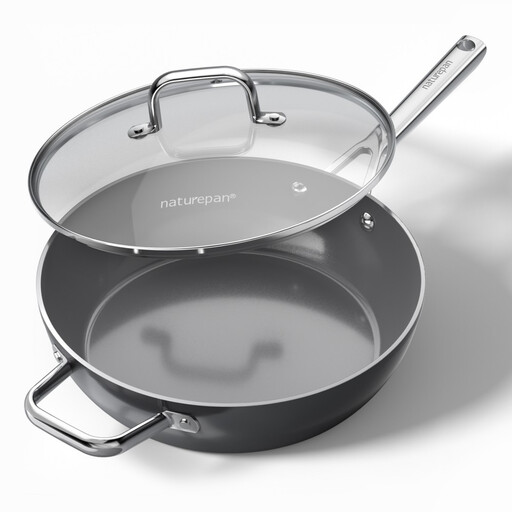
Why It Stands Out: This is more than just a frying pan. Its high sides and included lid transform it into a versatile piece of cookware suitable for simmering sauces, braising meat or making one-pan pasta dishes. The deep design minimises splatter, keeping your hob cleaner.
Pros:
Who is it for?: Ideal for families or home cooks who love making larger meals, stews and saucy dishes that require more volume and a lid.
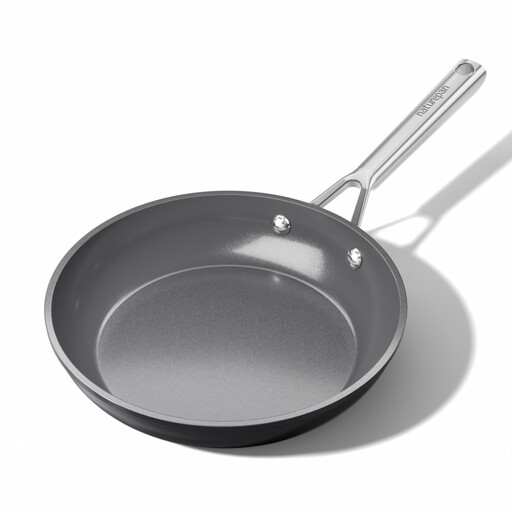
Why It Stands Out: The 24cm model is the quintessential all-rounder. It’s large enough to cook a meal for two or three people but remains lightweight and easy to handle. The diamond-titanium reinforced coating provides excellent food release, making it a reliable workhorse for everything from searing fish fillets to sautéing vegetables.
Pros:
Who is it for?: A great choice for anyone seeking a single, versatile pan without Teflon for a wide range of daily cooking tasks.
If these specific sizes don't quite fit your needs, there are many other styles available. Our curated selection of pure ceramic pan options offers a wider range of choices to suit every kitchen. Explore the full collection to find your perfect match.
Pans marketed as "ceramic" are typically metal pans (like aluminium or stainless steel) finished with a sol-gel coating. This coating is derived from inorganic minerals, primarily silicon and oxygen. It is celebrated for being made without PTFE (the material often used in Teflon-branded coatings) and PFOA (a chemical formerly used in the manufacturing process of PTFE). As such, they are a widely chosen option for consumers looking for PFAS free cookware.
To maintain the non-stick performance, it's best to use low to medium heat and avoid overheating the pan when empty. Always use silicone, nylon or wooden utensils to prevent scratching the surface. While many are dishwasher-safe, hand washing with a soft sponge is often recommended to prolong the life of the coating. Finally, allow the pan to cool completely before immersing it in water to prevent damage from thermal shock.
It depends entirely on the pan's construction. For a pan to be induction-compatible, its base must contain a magnetic (ferrous) layer. A pan made only of aluminium or pure ceramic will not work on an induction hob. Always check the product specifications or look for the induction symbol (a coil-like icon) on the packaging or the bottom of the pan to ensure it is a ceramic frying pan for induction.