
24/7 Customer Support

Free returns

Same-day & Next-day Delivery

Quality Guaranteed

Unlock Your Welcome Offers: FREE Delivery | Up to 80% OFF | Free 30-day JoyPlus trial
Download the APP
From lecture halls to boardrooms, the humble notebook remains an essential tool for capturing ideas, organising projects and planning our days. Yet, choosing the right one can be surprisingly difficult. The market is filled with options that look great on the shelf but fail to perform when put to the test. As a Joybuy Product Recommendation Officer, my role is to help you see past the marketing and focus on the features that truly matter. This guide will walk you through the common pitfalls to avoid and the key specifications to check, ensuring your next purchase is a practical and lasting one.
A poorly chosen notebook can be a source of daily frustration. Before you buy, be aware of these common issues that often lead to disappointment:
spiral notebook or glued options, fall apart with regular use. A wirebound pad can unravel, and a poorly glued spine on a hardcover journal can crack, scattering your important notes.To avoid these traps, focus on three core specifications. Getting these right is the key to finding a reliable notebook that fits your needs.
Paper weight is measured in Grams per Square Metre (GSM). This single number tells you a lot about the paper's thickness and quality.
office notepads and notebook multipack deals. It's perfectly suitable for ballpoint pens and pencils and offers a good balance of quality and value. Most lined notebook options for general use fall into this category.A5 notebook or journal.sketchbook for drawing, creative lettering or a high-end bullet journal where you might use markers, watercolours or heavy inks.The way a notebook is bound affects its durability and how you use it.
hardcover journal looks professional and stacks neatly on a shelf. The main consideration is that some may not lay perfectly flat, especially when new.Choosing the right size depends entirely on your intended use.
notebooks for students and professionals who need ample space. An A4 project book is perfect for detailed lecture notes, research and meeting minutes.Based on these practical criteria, here are a few recommendations matched to different user needs.
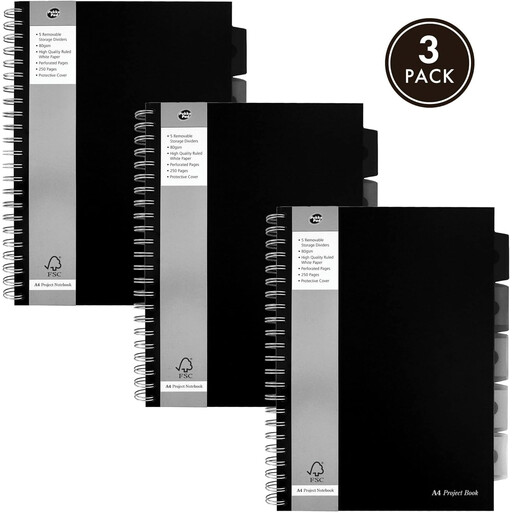
Why This Fits Their Persona: This is a workhorse for anyone juggling multiple subjects or projects. The A4 size provides ample room for notes, while the built-in dividers make organisation effortless. It's a staple for UK students and office workers for a reason.
The wipe-clean polypropylene cover directly counters the "non-durable cover" trap. Its sturdy wire binding holds up to heavy use, and the 80 gsm paper is a reliable standard for everyday pens, avoiding the worst of the bleed-through issue.
Five repositionable dividers with storage pockets allow for flexible organisation. Pages are perforated for clean removal.
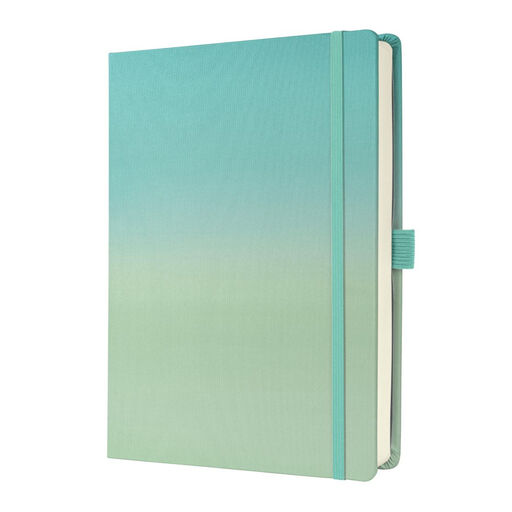
Why This Fits Their Persona: This journal is designed for creativity. It's ideal for anyone dedicated to bullet journaling, hand lettering or simply wants a high-quality writing experience with a touch of style.
Its premium 120 gsm paper completely solves the bleed-through problem. The innovative lay-flat binding is far superior to cheap glue, and the sturdy hardcover ensures it withstands daily use.
The 180° lay-flat design allows for comfortable writing across the entire page. The paper quality is excellent for creative penmanship.
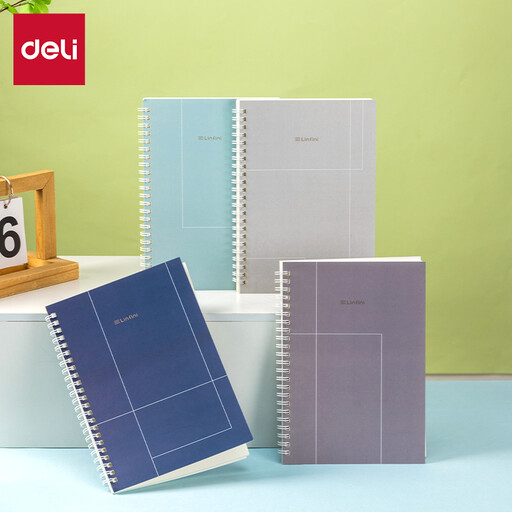
Why This Fits Their Persona: For students stocking up for a new term or offices needing a supply of reliable pads, this multipack offers excellent value. The A5 size is perfectly portable for lectures, meetings or quick notes.
The spiral binding is a reliable choice at this price point, avoiding the risk of a weak glued spine. While the 70 gsm paper is standard, it's fit for purpose with pencils and ballpoints, preventing you from overpaying for features you don't need.
This is a cost-effective solution for high-volume use. The 4-pack ensures you always have a fresh notebook on hand.
We have compiled a complete, real-time list of products that fully satisfy these strict selection criteria and UK safety regulations.
GSM stands for Grams per Square Metre and is a direct measure of paper density and thickness. For everyday writing with a ballpoint or pencil, 70-80 gsm is sufficient. If you use fountain pens, markers or heavy gel pens, look for 100 gsm or higher to prevent ink from bleeding or ghosting to the other side of the page.
This depends on your needs. A spiral notebook, like an A4 project book, is often preferred because it can lay completely flat, making it easier to write on any surface. Many also include perforated pages for handing in assignments. A hardcover journal offers superior durability for notes you need to keep for a long time and can feel more professional, but may be less flexible for quick note-taking.
The primary solution is to choose a notebook with a higher paper weight (GSM). Paper of 100 gsm or more provides a much better barrier against ink bleed. You can also choose your pens carefully. Archival-quality pigment inks (often found in fine-liners) tend to sit on top of the paper, while dye-based inks (common in many markers and fountain pens) are more likely to soak in and bleed.