
24/7 Customer Support

Free returns

Same-day & Next-day Delivery

Quality Guaranteed

Unlock Your Welcome Offers: FREE Delivery | Up to 80% OFF | Free 30-day JoyPlus trial
Download the APP
The oat milk aisle has exploded in recent years, moving from a niche dairy-free milk to a staple in many UK households. But with so much choice comes confusion. Flashy packaging and clever marketing can easily lead you to buy a product that doesn't suit your needs, whether it's a barista oat milk that splits in your coffee or a "healthy" option loaded with hidden sugars.
As the Joybuy Product Recommendation Officer, my role is to help you see past the hype. Before you add another carton to your basket, let's look at the common pitfalls and what you should really be checking on the label.
oat milk for coffee, but not all are created equal. The most common complaint is an oat drink curdling or splitting the moment it hits a hot cup of coffee. A true barista-style product is formulated to withstand heat and acidity, a feature that isn't guaranteed by the name alone.organic oat milk label appeals to those seeking minimal processing and fewer additives, it often comes with a trade-off. Many organic versions are not fortified with the vitamins and minerals—such as calcium, vitamin D and B12—that are standard in other plant-based milks. If you're using oat milk as a primary vegan milk alternative, this could leave a nutritional gap in your diet.To make a smart choice, focus on these three key parameters instead of just the front-of-pack claims.
The creaminess and performance of an oat drink are largely determined by its fat content and the presence of specific stabilisers.
barista oat milk, however, usually has a fat content closer to 3.0%. This higher fat level is essential for creating stable, velvety microfoam for lattes and cappuccinos.To avoid the sugar trap, ignore the front-of-pack slogans and turn straight to the nutritional table. Look for the "Carbohydrates" line, and directly underneath it, "of which sugars". This figure tells you the total sugar content per 100ml from all sources. For a truly sugar-free option, you need a product that lists 0g in this section, often labelled as a no sugar oat milk.
If oat milk is a regular part of your diet, check for fortification.
gluten-free oat milk.Based on these practical criteria, here are a few options from our catalogue, matched to different needs and lifestyles.

Why This Fits Their Persona: This is for the coffee enthusiast who wants reliable, café-quality results at home. The formula is specifically designed to create a smooth, lasting microfoam for latte art and won't curdle in hot drinks. The long-life multipack is convenient for daily coffee drinkers.
It sidesteps the "Barista Mirage" by containing the right formulation (including acidity regulators) to deliver consistent, foamable performance without splitting.
Excellent foaming capability and a neutral, oaty flavour that complements coffee rather than overpowering it. Fortified with vitamins B2 and D.
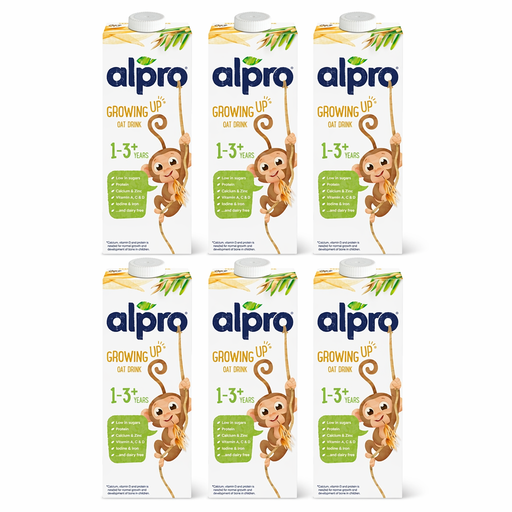
Why This Fits Their Persona: For parents seeking a plant-based drink for their toddlers. This is not just a standard oat milk; it's specifically formulated to support the nutritional needs of children aged 1-3, making it a considered choice for this crucial growth stage.
It directly counters the "Organic Trade-Off" by being heavily fortified with nutrients essential for young children, including iron for cognitive development, plus calcium and vitamin D for bone growth.
Tailored nutritional profile for toddlers, including added iron and iodine, which are not typically found in standard oat drinks.

Why This Fits Their Persona: Perfect for anyone actively managing their sugar intake or who simply prefers a clean, unsweetened taste. It's ideal for pouring over cereal, adding to tea, or drinking straight from the glass without any sugary aftertaste.
This product completely avoids the "Hidden Sugar" trap. Its nutritional information confirms 0g of sugar, distinguishing it from products that are merely "unsweetened" but still contain natural sugars.
Genuinely zero sugar content. It is also fortified with calcium, iodine and vitamins B2, B12 and D, making it a nutritionally sound choice.
We have compiled a complete, real-time list of products that fully satisfy these strict selection criteria and UK safety regulations.
This common issue, known as curdling or splitting, is usually caused by a reaction between the acidity of the coffee and the proteins in the oat milk, often accelerated by the temperature difference. Barista oat milk formulations prevent this by including a small amount of an acidity regulator (like dipotassium phosphate) to stabilise the drink when it's heated or mixed with acidic beverages.
Whether it's a "healthy" swap depends on the specific product and your dietary needs. Many oat milks are fortified with calcium and vitamin D to match the levels in cow's milk. However, they are typically lower in protein. It's also important to check the sugar content, as some can be surprisingly high. Always check the nutritional label to ensure it aligns with your health goals.
The main difference is the treatment process. Long life oat milk undergoes UHT (Ultra High Temperature) treatment, which sterilises the liquid so it can be stored in your pantry for months before opening. Chilled oat milk is pasteurised at a lower temperature and must be kept refrigerated at all times, with a much shorter shelf life. The UHT process does not significantly impact the core nutritional value.