Dark-scene immersion seekers
You mainly play single-player fantasy adventures in a dim room and want black depth, visible shadow detail and HDR presentation to guide your choice.


For fantasy adventures played in a dark room, OLED or QD-OLED is worth considering when deep blacks and contrast matter most, provided its care requirements suit your usage. Choose QHD to match a less demanding PC setup, 4K when fine detail and your hardware justify it, or ultrawide when your games and desk accommodate the wider format; check the intended input mode and exact-model warranty before buying.
You mainly play single-player fantasy adventures in a dim room and want black depth, visible shadow detail and HDR presentation to guide your choice.
You care about the clarity of maps, scenery and interface text, but need a resolution and refresh mode that your device can actually output.
You also spend time with static game interfaces or desktop applications, making panel-care settings and exact-model warranty terms part of the decision.
Consider it when: Your PC is better matched to QHD and you want a smaller screen for dark-room play.
Trade-off: Fine detail is less dense than on a comparable 4K screen.
Consider it when: Fine scenery and interface detail take priority and your device can supply the intended 4K mode.
Trade-off: 4K places a greater pixel load on a gaming PC than QHD; check viewing distance and desk depth for the chosen size.
Consider it when: A wider view appeals more than 4K pixel density and your preferred games support the format.
Trade-off: Some games, cut-scenes and console outputs may not fill a 21:9 screen as intended; the display also needs more desk space.
| Concern | What to check | Who this matters to |
|---|---|---|
| Dark-scene contrast and HDR | Compare the exact panel type, stated HDR specification and screen finish; consider reflections from nearby lights. | When caves and night scenes are central to play, I want dark areas and highlights to remain distinct. Around 36% of consumers put this picture-quality need first. |
| Resolution and device fit | Match screen size and the desired resolution and refresh mode to your PC output or console and the intended input. | If I spend time reading maps and examining scenery, detail matters only if my setup can use the chosen mode. For around 29% of consumers, resolution and device fit come first. |
| Motion and viewing format | Check refresh and variable-refresh support through your intended connection; for ultrawide, check game support and desk space. | During combat and camera movement, I value fluid motion, or I want a broader view where a game supports it. That is the primary concern for around 21% of consumers. |
| OLED care and after-sales terms | Read the exact model’s panel-care instructions and regional warranty; check the seller’s applicable returns terms. | If I leave HUDs or desktop windows visible for long periods, I need to be comfortable with OLED care and the warranty terms. Around 14% of consumers make those conditions their first priority. |
The displayed mode depends on the source, game and connection, not just the monitor’s maximum refresh rate. PlayStation states that PS5 supports 4K at 120 Hz output for games that support it.
Check the resolution, refresh rate and variable-refresh support for the specific input, device and cable you intend to use.
An HDR label alone does not establish how a particular monitor presents dark fantasy scenes. LG and BenQ list DisplayHDR True Black 400 for specific models, but that specification is not a measured result for every OLED screen.
Compare the exact model’s HDR specification and screen finish, and look for independent assessments of that model if picture quality will decide the purchase.
HUDs and paused screens can remain in place. ASUS says prolonged static, high-contrast images can cause image persistence or burn-in on OLED displays.
Follow the chosen model’s protection instructions and check its regional warranty, rather than assuming another OLED model has the same features or coverage.
GOV.UK’s product-marking guidance covers Great Britain and identifies different processes for Northern Ireland. Returns guidance also needs to be read for the applicable nation and type of purchase.
Check the seller’s terms and the guidance relevant to your delivery region, particularly for a marketplace purchase or direct import.
LG UK lists both a 27-inch QHD OLED route and a 34-inch 21:9 curved OLED route.
Dell UK lists the AW3225QF as a 31.6-inch curved 4K QD-OLED option.
Samsung UK lists the 32-inch Odyssey OLED G81SF as a 4K QD-OLED option with a Glare Free treatment.
BenQ UK lists the 26.5-inch EX271UZ for buyers considering 4K detail on a smaller QD-OLED screen.
ASUS ROG OLED models are relevant when panel-care features and exact-model warranty terms are central to the choice.
These Joybuy choices cover 16:9 QHD and 4K OLED monitors alongside wider OLED formats. Compare the format with your games and device before narrowing the choice to an individual model.
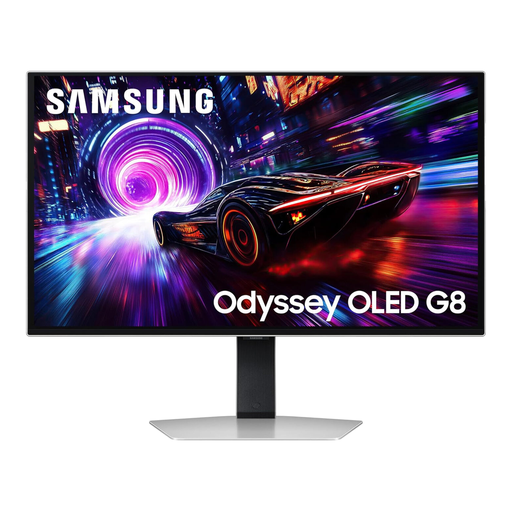 No image available
Consider this 4K QD-OLED format when fine detail in fantasy scenery matters and your device can use the intended output mode.
Check the input’s resolution and refresh support and the exact-model OLED warranty before choosing it.
 No image available
Consider this larger OLED screen if a wide view appeals to you and your preferred games and desk can accommodate it.
Check how those games handle the display format, along with the model’s panel-care instructions and warranty.
 No image available
Consider this ultrawide OLED format for fantasy games that support a wider view.
Check game and console display behaviour, desk fit, panel-care instructions and the exact-model warranty.
 No image available
This QHD OLED format is worth considering if you want a smaller screen and do not need 4K resolution.
The product name also states a 0.03 ms response time. If HDR is decisive, check the exact model’s HDR specification and OLED warranty.
 No image available
Consider this very wide format only if the fantasy games you play and your desk suit a 49-inch 32:9 screen.
Its product name lists Double Quad HD, a 1800R curve, 240 Hz and DisplayHDR 400 True Black. Check game support, panel-care instructions and the exact-model warranty.
No. OLED or QD-OLED is worth considering if dark-scene contrast is your leading priority, but resolution, game-format support and prolonged static-image use can change which monitor suits you. Check the full setup rather than choosing on panel type alone.
Check that the monitor’s intended HDMI input supports the output mode you want, then inspect the connected display information in the PS5’s Video Output settings. PlayStation states that PS5 supports HDMI 2.1 and 4K at 120 Hz output; a supporting game and the relevant console settings are also needed to use a 120 Hz mode.
Follow the protection instructions for your exact model, particularly when HUDs or desktop elements remain static for long periods. ASUS warns that prolonged static, high-contrast images can cause persistence or burn-in and describes pixel shifting, screen savers and pixel cleaning for its OLED monitors.
For an eligible distance purchase from a business in England, Citizens Advice describes a 14-day cooling-off period, subject to exceptions. Check the guidance for your nation and purchase circumstances, as well as the seller’s terms; change-of-mind returns are distinct from remedies for faulty, damaged or misdescribed goods.
No. GOV.UK’s product-marking guidance applies to England, Scotland and Wales and says the processes differ for Northern Ireland. If you are buying through a marketplace or importing a monitor directly, check the information applicable to your delivery region.