
24/7 Customer Support

Free returns

Same-day & Next-day Delivery

Quality Guaranteed

Unlock Your Welcome Offers: FREE Delivery | Up to 80% OFF | Free 30-day JoyPlus trial
Download the APP
As the seasons turn, many of us in the UK face a familiar problem: that one room that just won't stay warm. Whether it's a draughty home office, a chilly spare bedroom or a living area that needs a quick boost of warmth, relying on central heating for a single space can be inefficient and costly. A portable electric heater offers a flexible and targeted solution, providing comfort exactly where and when you need it.
However, the market is filled with options, from traditional oil-filled models to modern smart heaters. To help you make an informed choice, we've put together this practical guide. We'll break down the different types of heaters and highlight key features to look for, followed by our recommendations for 2026 that balance performance, efficiency and safety.
Before looking at specific models, understanding a few key factors will help you narrow down your search and find a heater that suits your needs and budget.
The two most common types of portable electric heaters are oil-filled radiators and convection heaters. Each has distinct advantages.
convection heater works by drawing in cool air, passing it over a heated element and then circulating the warmed air back into the room. Many models include a fan to speed up this process. They are very effective at heating an entire room quickly, making them ideal for living rooms or workshops that need a rapid temperature increase.With energy costs being a primary concern, look for features that help manage electricity consumption. A heater with thermostat is one of the most important. It allows you to set a desired temperature and the heater will automatically cycle on and off to maintain it, preventing it from running continuously and wasting power. This is a key characteristic of a low energy electric heater. Other useful features include multiple heat settings and programmable timers, which let you schedule operation to avoid heating an empty room.
Modern heaters offer more than just basic warmth. A smart heater with Wi-Fi connectivity allows you to control settings from your smartphone, which is perfect for pre-warming your office heater before you start your workday. For safety, always ensure the model has overheat protection, which automatically shuts the unit off if it gets too hot and a tip-over switch, which does the same if the heater is accidentally knocked over. A stable freestanding heater design is also crucial for peace of mind.
Based on features, user needs and overall value, here are our standout recommendations.
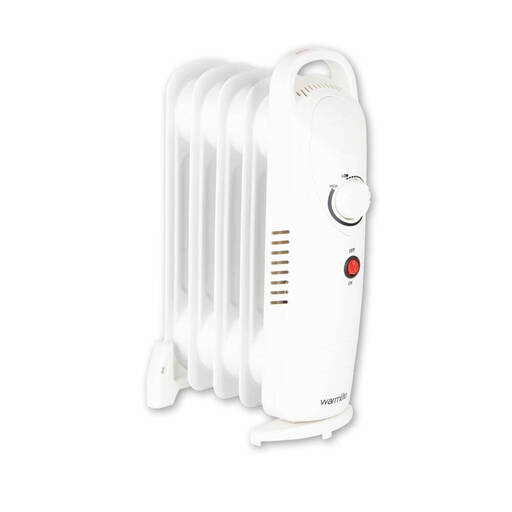
Why It Stands Out: This compact oil filled radiator is designed for efficient, low-energy background warmth in smaller spaces. Its 650W power output is modest, making it a cost-effective choice for taking the chill off a single room without significantly impacting your electricity bill. The adjustable thermostat ensures you can maintain a consistent temperature, while its lightweight design and integrated handle make it easy to move wherever it's needed most.
Pros:
Who is it for? This is a great option for those needing to heat a small, well-insulated space like a home office, a caravan or a box room. Its low wattage makes it suitable for providing supplementary warmth rather than being the primary heat source for a large area.
View the Warmlite 650W Oil Filled Radiator
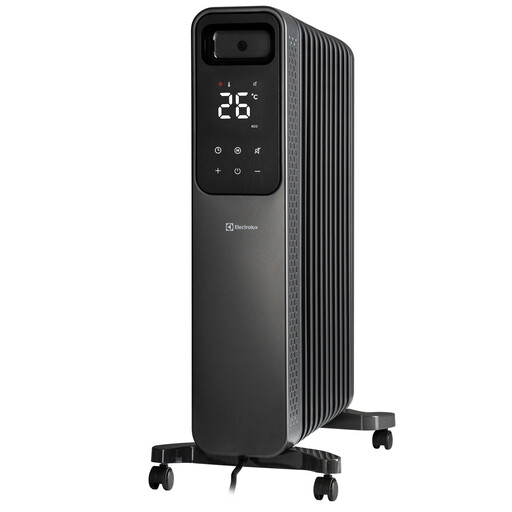
Why It Stands Out: For those needing to heat medium to large rooms, the Electrolux oil-filled radiator delivers substantial power. With a maximum output of 2400W and three heat settings, it offers the flexibility to tackle colder environments effectively. Despite its power, it maintains the silent operation characteristic of oil-filled models. Portability is handled by integrated castors and a carry handle, and it includes essential safety features like overheat protection and a tip-over switch.
Pros:
Who is it for? This heater is well-suited for users who need a powerful yet quiet heating solution for living rooms, master bedrooms or open-plan spaces. The adjustable settings make it adaptable for different levels of cold.
View the Electrolux 2400W Oil Filled Radiator

Why It Stands Out: This BLACK+DECKER model is a modern smart heater that combines the rapid heating of a convection heater with the convenience of app and voice control. Its 2.2kW output quickly warms small to medium rooms, and a turbo fan mode gives an extra boost when needed. The standout feature is its Wi-Fi connectivity, allowing you to adjust the temperature, set a 24-hour timer and switch modes via the BLACK+DECKER Home app or with Amazon Alexa and Google Home.
Pros:
Who is it for? This is the ideal choice for the tech-savvy user who values convenience and control. It's perfect for a home office, living room or bedroom where you want the ability to manage your heating remotely or on a set schedule.
View the BLACK+DECKER 2.2kW Smart Heater
If these models aren't quite what you're looking for or if you want to explore a wider variety of heaters with precise temperature management, we have a broad selection available.
Discover more models by exploring our full range of heaters with an Adjustable Temperature Thermostat.
1. Are portable electric heaters expensive to run? The running cost of a portable heater depends on its power rating (measured in kilowatts, or kW), your electricity tariff and how long you use it. To keep costs down, choose a model with a power output appropriate for your room size and use features like an adjustable thermostat and timer. A low energy electric heater with a lower wattage (like 650W) will be cheaper to run for small spaces than a 2400W model.
2. What size portable heater do I need for my room? A general guideline for well-insulated rooms is to allow for approximately 100 watts of heating power per square metre of floor space. For example, a 15-square-metre room would benefit from a 1500W (1.5kW) heater. However, this can vary based on ceiling height, insulation quality and window size, so always check the manufacturer's recommendation for room size suitability.
3. Is an oil-filled radiator better than a convection heater? Neither is inherently "better"; they are just suited for different purposes. An oil filled radiator is ideal for steady, silent, long-lasting heat in a bedroom or study. A convection heater is better for quickly heating up a larger, shared space like a living room. The right choice depends on your specific heating needs and preferences for noise and speed.