
24/7 Customer Support

Free returns

Same-day & Next-day Delivery

Quality Guaranteed

Unlock Your Welcome Offers: FREE Delivery | Up to 80% OFF | Free 30-day JoyPlus trial
Download the APP
As energy prices remain a key concern for UK households, finding a cost-effective way to stay warm is more important than ever. While central heating is essential, it can be inefficient and expensive to run just to heat a single room. A portable electric heater offers a flexible and targeted solution, perfect for taking the chill off a home office, warming up a bedroom before sleep or adding a comfort boost to your living area.
Navigating the market can be confusing, with various types and features to consider. This guide is designed to provide clear, practical advice to help you choose a suitable portable heater. We will break down the key differences between models and highlight some of our top recommendations based on their features, performance and user convenience.
Before looking at specific models, understanding a few key factors will help you make a more informed decision.
Different heaters warm a room in different ways. The three main types each have distinct advantages:
To manage running costs, look for an energy efficient electric heater with smart controls. Key features to consider include:
The power of a heater, measured in watts (W) or kilowatts (kW), determines its heating capability. As a general guide, you need approximately 100W of heating power for every square metre of room space. For example, a 2kW electric heater (2000W) is generally suitable for a room up to 20 square metres. For smaller personal spaces, a 1.5kW model is often sufficient.
Here are a few models that stand out for their practical features and reliable performance.
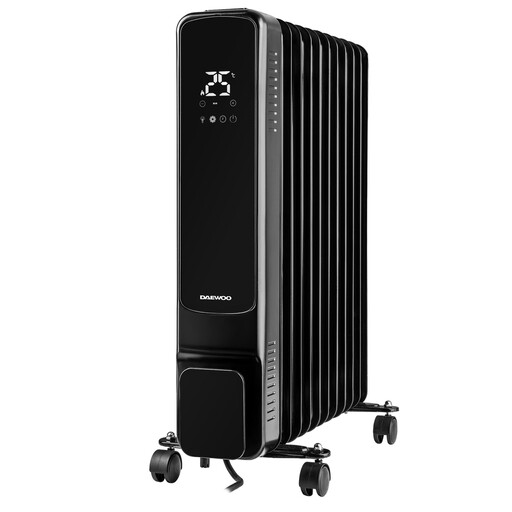
Why It Stands Out: This oil filled radiator from Daewoo is built for sustained, powerful heating. Its 2500W output and 11-fin design effectively distribute warmth across medium to large rooms. The oil-filled construction means it continues to radiate heat after being turned off, making it an efficient choice for maintaining a comfortable temperature over several hours. The digital controls, remote and 24-hour timer add a layer of modern convenience to a classic design.
Pros:
Who is it for? Anyone needing to heat a medium-to-large living room or bedroom consistently and quietly, who values the lasting warmth that oil-filled models provide.
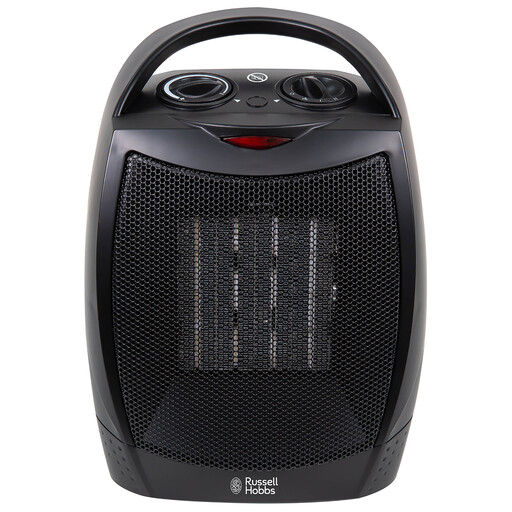
Why It Stands Out: The Russell Hobbs ceramic fan heater is designed for speed and portability. It delivers a focused stream of heat almost instantly, making it perfect for taking the chill off your personal space without waiting. Its compact, lightweight body and carry handle make it easy to move from your desk to your reading nook. Features like an adjustable thermostat and two heat settings provide control over comfort and energy use.
Pros:
Who is it for? Those working from home, students or anyone who needs a quick and effective heating solution for a small, personal area like a desk or a small box room.
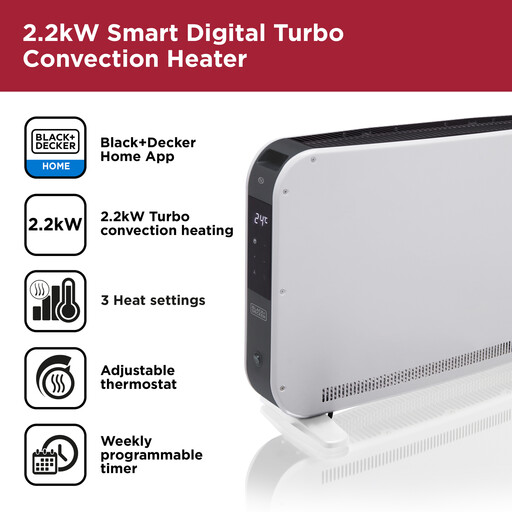
Why It Stands Out: This convection heater brings modern technology to home heating. As a smart heater with WiFi, it can be controlled from anywhere using the BLACK+DECKER Home app or via voice commands with Amazon Alexa and Google Home. The 2.2kW output effectively warms small to medium rooms, and a turbo fan can be activated to circulate heat faster. It combines the silent operation of a convection heater with the convenience of smart scheduling and remote control.
Pros:
Who is it for? Tech-savvy individuals who want the ultimate convenience of controlling their heating remotely, scheduling it around their routine and integrating it into their smart home ecosystem.
These recommendations cover a range of common needs, but your ideal heater might be different. If you're looking for a specific power level, design or feature set not mentioned here, you can find more choices in our full collection.
Explore our full collection of electric room heaters to find your perfect match.https://www.joybuy.co.uk/explore/best-electric-room-heater/QL4mMHYb
1. What is the most energy-efficient type of portable electric heater? All electric heaters convert nearly 100% of the electricity they use into heat. Therefore, true efficiency comes from how you use them. A model with an accurate thermostat and a timer will be more cost-effective because it only runs when needed. For heating a person quickly, a ceramic fan heater is effective as it doesn't waste energy heating the entire room. For maintaining warmth in a well-insulated room, an oil-filled radiator is a good choice due to its heat retention.
2. Are portable electric heaters safe to leave on overnight? It is generally not recommended to leave any portable heater running unattended, including overnight while you sleep. For safety, always choose a model with built-in protection, such as an automatic tip-over switch that cuts power if it's knocked over and overheat protection that shuts the unit off if it gets too hot. Always ensure the heater is placed on a flat, stable surface away from curtains, bedding and furniture.
3. How much does it cost to run a 2kW electric heater? The running cost depends on your electricity tariff. A 2kW heater uses 2 kilowatt-hours (kWh) of energy for every hour it runs on its maximum setting. To calculate the cost, multiply 2 by your provider's price per kWh. For example, if your electricity costs 25p per kWh, a 2kW heater would cost approximately 50p per hour to run at full power. Using a lower power setting or a thermostat will reduce this cost.