
24/7 Customer Support

Free returns

Same-day & Next-day Delivery

Quality Guaranteed

Unlock Your Welcome Offers: FREE Delivery | Up to 80% OFF | Free 30-day JoyPlus trial
Download the APP
As a Joybuy Product Recommendation Officer, I help sift through market information to offer practical shopping advice. For electric vehicle owners in the UK, a portable charger that uses a standard 3-pin socket offers incredible flexibility. It can serve as a primary electric car charger for home if you don't have a wall box, or as a reliable backup for travel. However, not all chargers are created equal, and choosing the wrong one can lead to frustration and safety concerns.
This guide cuts through the clutter to focus on what truly matters, helping you avoid common pitfalls and select a charger that is safe, efficient and suited to your needs.
Many EV owners are drawn to the convenience of a "plug-and-play" charger, but it's easy to overlook critical flaws that can make a device unreliable or even dangerous. Here are three common traps to avoid:
To ensure you get a reliable and safe 3 pin EV charger, focus on these essential specifications. They are far more important than flashy marketing claims.
A key feature to look for is an adjustable current EV charger. This allows you to manually lower the charging rate (e.g., from 10A down to 8A or 6A) to match the capacity of the socket you are using, preventing circuit overloads. This is particularly useful in older properties or when sharing a circuit with other appliances.
Furthermore, an EV charger with delay timer functionality is a significant advantage. This feature lets you plug in your vehicle when you get home but schedule the charging session to begin later, during off-peak hours. By utilising cheaper overnight electricity tariffs, you can significantly reduce your running costs. This makes it an effective slow charger for electric car owners looking to optimise their energy bills.
The Ingress Protection (IP) rating is a crucial indicator of a charger's resilience against environmental factors. The rating consists of two numbers: the first for dust protection and the second for water protection.
For a charger that you might use on your driveway or take on a travel EV charger trip, look for a rating of at least IP66.
An IP66 waterproof car charger provides confidence that it can handle rain and outdoor conditions common across the UK, ensuring longevity and safe operation.
The two main physical components to check are the cable and the vehicle connector. Most modern electric vehicles in the UK and Europe use a Type 2 connector, so a Type 2 portable charger is the most versatile option.
Cable length is also a practical consideration. A 5m EV charger cable generally provides enough reach from a domestic socket to your car's charging port without being overly cumbersome to store. This length offers a good balance between convenience and portability, making it suitable for various home and travel scenarios. These portable 3-pin units are often referred to as a granny charger UK drivers can rely on.
Based on these practical criteria, we've identified how a well-specified charger can meet the needs of different UK users.
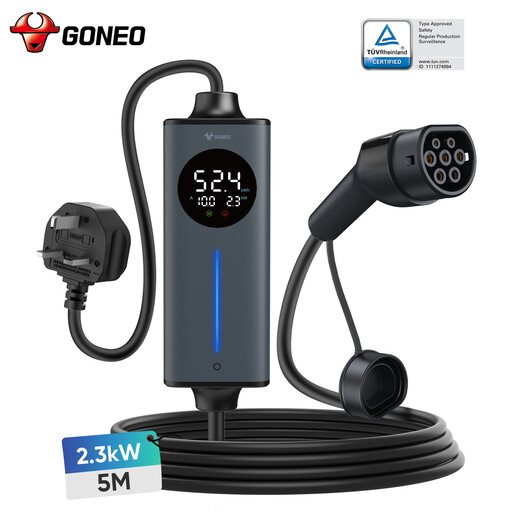
Why This Fits Their Persona: This user wants to charge their EV at home without the expense of a wall box installation. The ability to manage charging costs is their top priority.
Its adjustable current prevents tripping home circuits, and the delay timer allows for charging during cheaper off-peak electricity tariffs, directly countering the pitfalls of inflexible and inefficient charging.
Smart Controls: Adjustable 10A current and a delay charging function for energy savings.
Clear Display: An LED screen shows real-time voltage, current and temperature.
Why This Fits Their Persona: This user often visits friends, family or holiday lets where a dedicated EV charge point isn't available. They need a dependable charger they can pack in the boot and use anywhere with a standard UK socket.
The IP66 waterproof rating means it can be used safely in temporary outdoor settings, like a hotel car park or a relative's driveway, avoiding the risk of failure due to poor weatherproofing.
Plug & Play: The standard UK 3-pin plug and Type 2 connector offer wide compatibility.
Durable Build: The IP66 rating and flame-retardant housing make it a robust travel companion.
Why This Fits Their Persona: For this user, peace of mind is paramount. They are charging a family vehicle at a home with children and pets, and will not compromise on electrical safety.
It directly addresses the danger of unverified safety claims by incorporating multiple, verifiable protection systems, including crucial earth detection and dual temperature monitoring to prevent overheating.
Full Protection: Features dual leakage protection, earth detection and dual temperature monitoring.
Certified: Built with a flame-retardant housing and designed to meet international safety standards.
We have compiled a complete, real-time list of products that fully satisfy these strict selection criteria and UK safety regulations.
Yes, provided the charger is of high quality and has the necessary safety features. A charger with over-temperature protection will automatically reduce power or shut down if it detects overheating in the plug or control box. Always ensure the plug socket is in good condition and not overloaded.
The cost depends on your electricity tariff and the size of your car's battery. A 3-pin charger typically delivers around 2.3kW of power. To calculate the cost, multiply the power (2.3kW) by the duration of charging (in hours) and then by your electricity rate (in pence per kWh). Using a charger with a delay timer to access off-peak rates is the most economical method.
For many drivers, it is. A 2.3kW charger adds approximately 8-10 miles of range per hour. If you drive an average of 30-40 miles per day, an overnight charge of 6-8 hours is more than sufficient to replenish the battery. It may not be suitable for drivers who cover very high daily mileage and need a rapid top-up.