
24/7 Customer Support

Free returns

Same-day & Next-day Delivery

Quality Guaranteed

Unlock Your Welcome Offers: FREE Delivery | Up to 80% OFF | Free 30-day JoyPlus trial
Download the APP
That sinking feeling when the tyre pressure warning light flashes on your dashboard is a familiar one for many UK drivers. A portable tyre inflator seems like a simple solution, offering peace of mind and self-sufficiency. Yet, the market is flooded with devices that promise much but often fail to deliver, leaving you with a useless gadget and a flat tyre.
As a Joybuy Product Recommendation Officer, my role is to help you navigate these choices. Before you spend your money, be aware of the common pitfalls that catch out unwary buyers.
To avoid these traps, focus on the specifications that directly impact performance and convenience. Here are the three most important factors to check.
Your choice of power source determines the inflator's convenience and reliability.
The core function of a tyre inflator is to deliver air at the correct pressure.
While not always advertised prominently, the airflow rate, measured in Litres per Minute (L/Min), is the most reliable indicator of how quickly a pump will work. A higher L/Min value means the pump can move more air, inflating your tyre faster. For a standard car tyre, an airflow of 20 L/Min or more is a good benchmark for reasonably quick inflation.
Based on these practical criteria, we've matched a few standout products to different user needs.
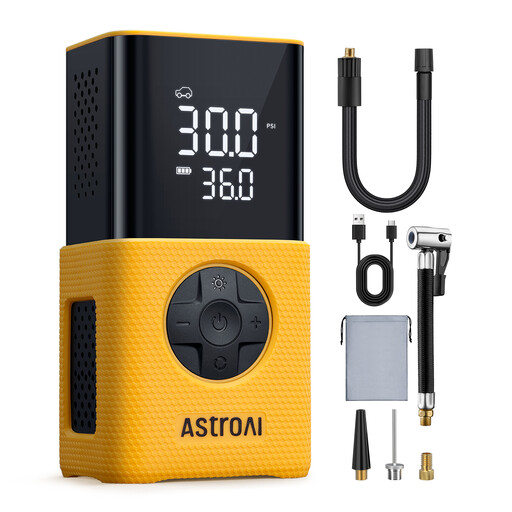
Why This Fits Their Persona: This model is ideal for the daily driver who values reliability and ease of use. It's compact enough to live in the glovebox, and its smart modes make routine pressure checks simple and quick, providing essential peace of mind for the daily commute or school run.
Its 4000mAh battery is paired with an efficient motor, capable of refilling up to 8 car tyres (from 30-36 PSI) on one charge, avoiding the "big battery, low performance" issue. The brand also provides a realistic inflation time for a specific tyre size.
Features an advanced digital screen for accurate readings and 5 smart modes for cars, motorcycles and bikes. It also doubles as a power bank via its USB-C port.
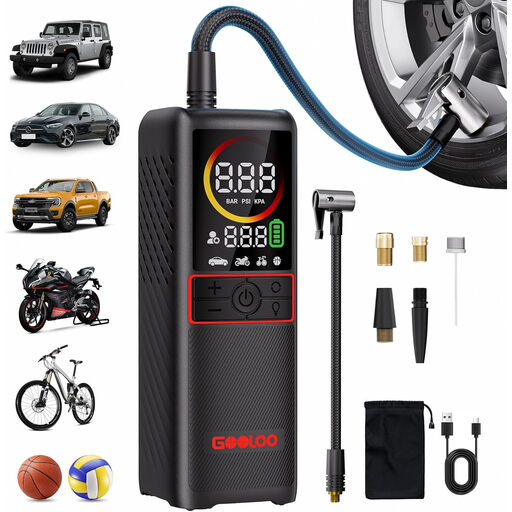
Why This Fits Their Persona: For those who venture further afield on road trips or camping holidays, this is a powerful and versatile companion. Its large battery and fast inflation speed provide confidence when far from a service station, and the power bank function is invaluable for keeping devices charged outdoors.
It backs up its large 7500mAh battery claim with a high airflow rate of 35L/Min and a stated 45-minute continuous runtime. This combination ensures it has the power and speed for demanding tasks, avoiding the trap of slow, underpowered performance.
A high maximum pressure of 160 PSI makes it suitable for a wide range of vehicles. The large LED screen and built-in torch with strobe mode are practical additions for roadside emergencies.
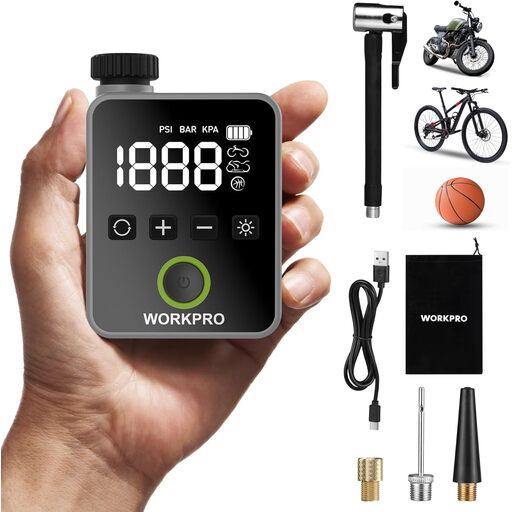
Why This Fits Their Persona: Portability is paramount for two-wheel enthusiasts. Weighing only 270g, this mini inflator is designed to be carried in a backpack or pannier without adding bulk. It's a purpose-built tool for maintaining tyre pressure on a bike or motorcycle before a ride or during a tour.
It avoids the "universal pump" trap by being transparent about its limitations, clearly stating it is *not suitable for car tyres*. This honesty ensures buyers with specific needs for a bike pump get a product optimised for their use case.
Its ultra-compact and lightweight design is its main strength. It still includes a digital display, auto shut-off and a 140 PSI maximum pressure, making it highly capable for high-pressure road bike tyres.
We have compiled a complete, real-time list of products that fully satisfy these strict selection criteria and UK safety regulations.
The lifespan of a rechargeable tyre pump depends on two things: the battery and the build quality. The lithium-ion batteries used in most models are typically rated for several hundred charge cycles. With average use (monthly top-ups), the battery should last for several years. The physical durability depends on the quality of the housing and motor. To prolong its life, avoid dropping the device and allow it to cool down between inflating multiple tyres to prevent the motor from overheating.
Most modern digital tyre inflators offer good accuracy, often within 1-2 PSI of a dedicated mechanical gauge. However, it's a sensible practice to check its reading against a reliable, separate tyre pressure gauge when you first get the device. This helps you understand if there is any minor discrepancy. The primary benefit of the built-in gauge is for consistent, repeatable inflation using the auto shut-off feature.