
24/7 Customer Support

Free returns

Same-day & Next-day Delivery

Quality Guaranteed

Unlock Your Welcome Offers: FREE Delivery | Up to 80% OFF | Free 30-day JoyPlus trial
Download the APP
A flat tyre can turn a routine journey into a roadside headache. While a portable tyre inflator seems like a simple fix, the market is flooded with gadgets that promise much but often fail when you need them most. As a Joybuy Product Recommendation Officer, my role is to help you see past the marketing clutter and choose a tool that offers genuine reliability and value.
Before you add any device to your basket, it's crucial to understand the common pitfalls that lead to buyer's remorse. Many UK drivers find their new gadget is either underpowered, breaks after a few uses or has a battery that gives up long before the job is done.
Here are the three most common traps to avoid:
To ensure you get a dependable tool, focus on these core parameters rather than flashy, non-essential features.
Your choice of power source dictates the convenience and reliability of your inflator.
While most inflators advertise a high maximum pressure (e.g., 150 PSI), this figure is often more than you'll ever need for a car tyre (typically 30-40 PSI). A more important, yet often hidden, specification is the airflow rate, measured in litres per minute (L/min).
A good digital tyre inflator should be simple to operate, especially in a stressful situation.
We've filtered the options to match different user needs, focusing on models that successfully navigate the common pitfalls.
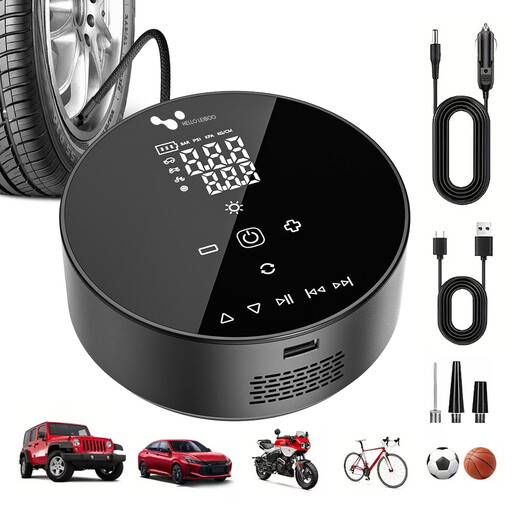
Why This Fits Their Persona: This is more than just an inflator; it's a multi-gadget for those who love tech. The combination of a power bank, LED work light and even a Bluetooth speaker makes it a versatile companion for camping trips, festivals or long drives.
Its dual-power functionality directly counters the "misleading battery" trap. You get cordless convenience with the 4500mAh battery, but can switch to the reliable 12V car supply if the battery runs low or you need continuous power.
4-in-1 Functionality: Combines an inflator, power bank, LED light and Bluetooth speaker.
Dual Power Source: Use it wirelessly or plug it into your car's 12V socket for guaranteed power.

Why This Fits Their Persona: For the family with multiple vehicles (cars, bikes) and sports equipment, this is a powerful and reliable workhorse. Its large battery and high airflow mean it can handle repeated use without faltering, making it a dependable tool for everyone in the household.
With a substantial 7500mAh battery and a high 35L/min airflow, it avoids both the weak battery and slow inflation pitfalls. It has the power and speed needed for larger car tyres, unlike smaller, less capable models.
High-Capacity Battery: The 7500mAh battery provides long runtime for multiple inflations.
Fast Inflation: A high airflow rate of 35L/min significantly reduces waiting time for car tyres.
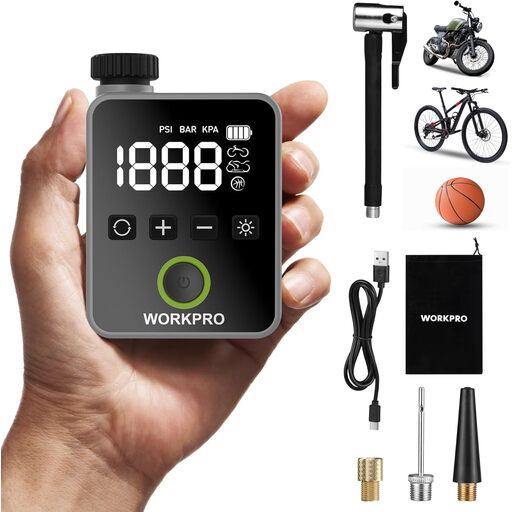
Why This Fits Their Persona: Weight and size are everything for a cyclist or motorcyclist. This mini inflator is exceptionally light (270g) and compact, easily fitting into a backpack or saddlebag without adding bulk. It's designed specifically for the high-pressure, low-volume needs of two-wheelers.
It sidesteps the "one-size-fits-all" myth by being a specialised tool. The product description is clear that it is *not suitable for car tyres*, guiding users to the correct application and preventing disappointment.
Ultra-Portable: Weighs only 270g, making it easy to carry on any ride.
Specialised Use: Optimised for the higher pressure requirements of motorcycle and bicycle tyres.
We have compiled a complete, real-time list of products that fully satisfy these strict selection criteria and UK safety regulations.
The lifespan of a portable tyre inflator depends on its build quality and usage. For cordless models, the battery is a key factor; most lithium-ion batteries are rated for several hundred charge cycles. The motor's durability is also critical. To prolong its life, avoid running the inflator continuously for longer than the manufacturer's recommended duty cycle (e.g., 10 minutes on, 10 minutes off) to prevent overheating. Storing it in a cool, dry place also helps.
Most modern digital tyre inflator gauges offer good accuracy for general use, typically within +/- 1-2 PSI. They are certainly more precise than the old analogue dials. However, for performance vehicles or for those who want maximum precision, it's still a good practice to occasionally cross-reference the reading with a separate, high-quality pressure gauge.
You can, but with caution. Many car-focused pumps come with the necessary adaptors (like a Presta valve adaptor) for bikes. The main issue is that a powerful car tyre pump with high airflow can inflate a narrow bicycle tyre extremely quickly. Always use the auto shut-off feature set to your bike's recommended pressure to avoid a dangerous and sudden over-inflation. For serious cyclists, a dedicated bike pump with gauge is often a better choice.