
24/7 Customer Support

Free returns

Same-day & Next-day Delivery

Quality Guaranteed

Unlock Your Welcome Offers: FREE Delivery | Up to 80% OFF | Free 30-day JoyPlus trial
Download the APP
There are few modern frustrations quite like watching your phone's battery icon turn red when you are miles from a wall socket. A reliable power bank is no longer a gadget for travellers; it is an everyday essential for anyone who depends on their devices. But with a vast market of different capacities, speeds and features, choosing the right one can feel overwhelming.
As a Joybuy Product Recommendation Officer, my role is to help you find practical solutions that fit your needs. This guide cuts through the technical jargon to help you understand what matters, followed by our top recommendations for keeping your devices charged throughout 2026.
Before looking at specific models, it is useful to understand the three key factors that determine a power bank's performance and suitability for your lifestyle.
Capacity, measured in milliampere-hours (mAh), tells you how much energy a power bank can store. A higher number means more charging potential.
A large capacity is of little use if it takes all day to transfer its power. Charging speed is measured in watts (W). For a fast charging power bank, look for models that support Power Delivery (PD), a standard that enables much higher speeds.
A USB C power bank is now the standard for modern electronics, offering both high-speed charging input (to recharge the power bank itself) and output. Many also feature wireless capabilities, with a magnetic power bank offering the most convenience by snapping securely onto compatible phones.
Finally, consider the physical design. A high-capacity power bank will naturally be larger and heavier. You must balance your need for power against your desire for portability. Do you need something that disappears into your pocket, or are you carrying a backpack where a larger, more powerful unit is no issue? Features like a wireless power bank function or a built-in stand can add significant convenience to your daily routine.
After analysing the market for options that balance performance, features and practicality, here are our recommendations.
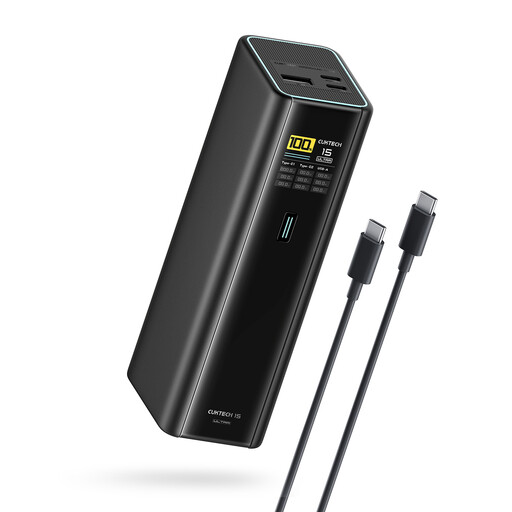
Why It Stands Out: This is a serious piece of charging equipment. With a massive 20,000mAh capacity and a staggering 140W output via its PD3.1 USB-C port, the CUKTECH 15 is one of the few portable chargers that can genuinely power and fast-charge a modern laptop, like a MacBook Pro, at high speed. Its multi-port design allows you to charge three devices at once, making it a mobile command centre for all your tech.
Pros:
Who is it for? Digital nomads, business travellers, students and tech enthusiasts who need a single, reliable solution to charge their laptop, phone and accessories simultaneously without being tied to a wall.
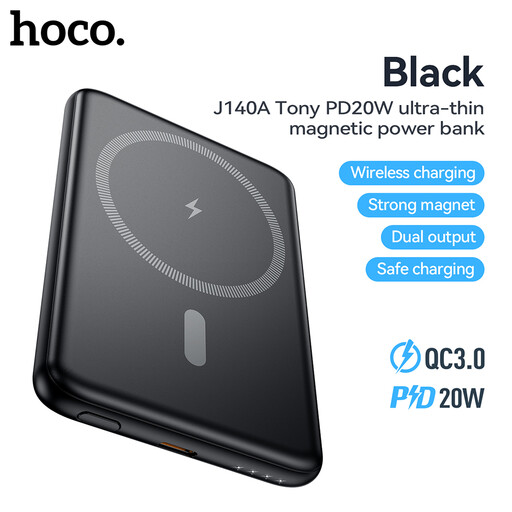
Why It Stands Out: The HOCO J140A prioritises convenience above all else. At just 10mm thick and weighing 110g, this magnetic power bank is designed to be forgotten until you need it. It snaps onto the back of a MagSafe-compatible iPhone or case, providing a cable-free power boost. Despite its small size, it still offers fast charging, with up to 15W wirelessly and 20W via its USB-C port.
Pros:
Who is it for? Daily commuters and minimalist users who want a discreet, cable-free way to top up their phone during the day. It is the perfect "fit and forget" solution for preventing battery anxiety.
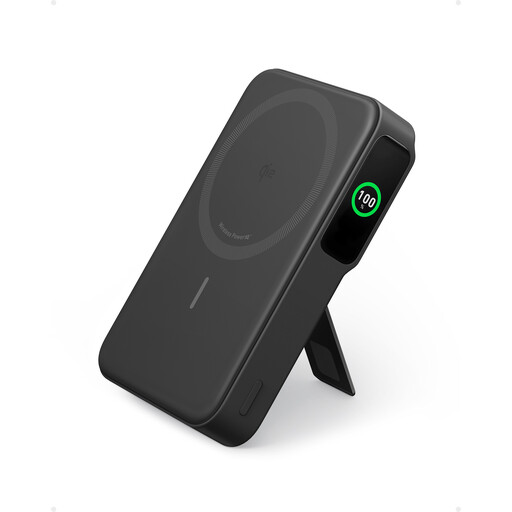
Why It Stands Out: The Anker MagGo strikes an excellent balance between capacity, portability and features. Its 10,000mAh battery provides enough power for around two full phone charges, while its clever design includes a foldable stand. This transforms the portable charger into a viewing dock, perfect for watching videos or taking video calls while your phone powers up. It offers both magnetic wireless charging and a 20W USB-C port for flexibility.
Pros:
Who is it for? Anyone looking for a multi-purpose daily charger. It is ideal for office workers, students and commuters who value the convenience of a built-in stand for media consumption or video conferencing on the go.
These recommendations cover a range of common needs, but the world of portable power is vast. If you are searching for a different capacity, feature set or a specific colour, there are many other models to consider.
Explore our complete range of power banks to find your perfect match.
1. Can I take a 20,000mAh power bank on a plane in the UK? Yes. UK and international aviation regulations typically restrict batteries to 100 watt-hours (Wh) for carry-on luggage. A 20,000mAh power bank is approximately 74Wh, well within the limit. Remember, power banks of any size must be placed in your carry-on bag, not in checked luggage.
2. How many times will a 10,000mAh power bank charge my phone? This depends on your phone's battery size. For an average modern smartphone with a 4,000-5,000mAh battery, you can expect between 1.5 and 2 full charges. This is due to energy loss during the power transfer process, which is a normal part of how all power banks operate.
3. What is the difference between a wireless and a magnetic power bank? A magnetic power bank is a type of wireless power bank. While a standard wireless charger requires you to manually align your phone on a charging pad, a magnetic one uses magnets (such as Apple's MagSafe system) to automatically snap into the perfect position. This ensures a secure connection and more efficient charging.