
24/7 Customer Support

Free returns

Same-day & Next-day Delivery

Quality Guaranteed

Unlock Your Welcome Offers: FREE Delivery | Up to 80% OFF | Free 30-day JoyPlus trial
Download the APP
A dead phone battery at a critical moment is a modern-day frustration we all know too well. Whether you're navigating with maps, presenting a ticket or just trying to stay in touch, a reliable power bank is no longer a luxury but a daily essential. Yet, the market is flooded with options, and it's easy to make a poor choice.
As the Joybuy Product Recommendation Officer, I see where consumers often go wrong. Many are lured in by marketing hype, only to be disappointed by a portable charger that underperforms or fails after a few months. Before you buy, be aware of these common pitfalls:
To choose wisely, you need to look past the marketing and focus on three key technical details. Understanding these will ensure you get a portable charger that truly meets your needs.
The number you see on the box, like 10000mAh or 20000mAh, refers to the capacity of the internal battery cells. However, the energy delivered to your device, known as the Rated Capacity, is what actually matters. Due to power conversion, you typically lose around 30-35% of the advertised capacity. So, a 10,000mAh power bank will realistically deliver about 6,500-7,000mAh.
For travellers, the most important metric is Watt-hours (Wh). UK and international aviation regulations generally restrict power banks in carry-on luggage to 100Wh. A typical 20,000mAh power bank is around 74Wh, making it perfectly safe for flights. Always pack your power bank in your hand luggage, never in a checked bag.
A power bank's speed is measured in Watts (W). For modern devices, look for a USB C power bank that supports Power Delivery (PD). This is the universal standard for fast charging.
Consider what you need to charge. A good all-rounder will have at least one USB-C port (for both input and output) and a USB-A port for older devices. If you value minimalism, a model with an integrated cable can be excellent, provided it's from a reputable brand to ensure durability. The form factor—be it a lipstick-sized mini charger or a high-capacity brick—should match your lifestyle, whether you're a daily commuter or a long-haul traveller.
Instead of a generic list, we've matched specific power banks to the people who will benefit from them most.

Why This Fits Their Persona: This is for the person who needs a single, reliable top-up to get through the day. Its tiny size fits in any pocket or handbag, making it ideal for the commute to work or university without adding bulk.
It avoids the "convenience trade-off" by offering a foldable, built-in connector from a trusted brand known for durability. Its purpose is clear: one emergency charge, not massive capacity.
The integrated foldable USB-C connector means no extra cables are needed. It delivers a respectable 22.5W output for a quick power boost.
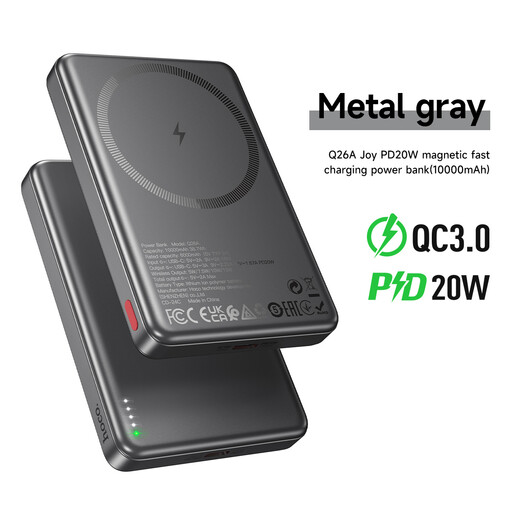
Why This Fits Their Persona: For the iPhone user (12 series or newer) who values the seamless 'snap-on' convenience of magnetic charging. It provides a full day's power with the elegance of a cable-free connection.
It clarifies the "fast charge" ambiguity by specifying both 15W wireless and 20W PD wired charging speeds, allowing users to match its capabilities directly to their iPhone for optimal performance.
It offers strong magnetic alignment for a secure wireless charge and features a premium aluminium alloy body for better heat dissipation than plastic alternatives.
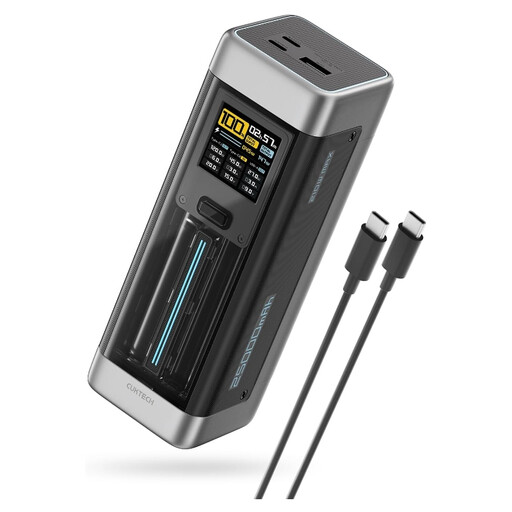
Why This Fits Their Persona: This is a workhorse for the digital nomad or business traveller who needs to power a MacBook, tablet and phone from a single, airline-compliant unit. It's built for high-demand, multi-device environments.
It tackles the "capacity myth" head-on. Its high efficiency and clear 90Wh rating confirm it's a true laptop power bank that is also safely within the 100Wh airline limit, removing travel anxiety.
Its massive 140W PD3.1 output can fast-charge high-power laptops like a MacBook Pro. The smart colour display provides real-time data on power input and output for each port.
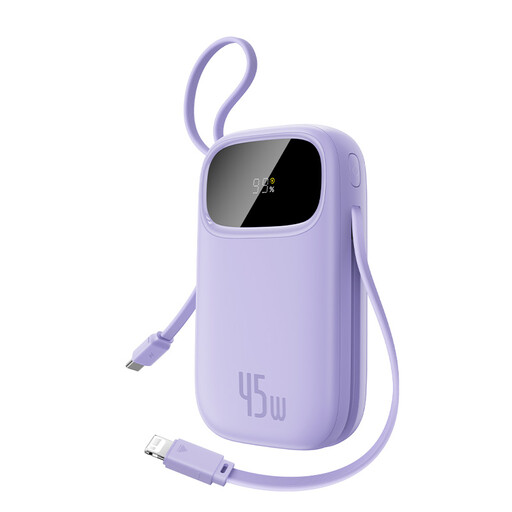
Why This Fits Their Persona: This is for the user who wants one device to charge everything without carrying a mess of cables. It's perfect for family trips or sharing with friends who have different devices (older iPhones, new iPhones and Android).
This power bank with built in cable avoids the durability pitfall of cheaper models by using robust, integrated USB-C and Lightning cables, while still offering separate ports for total flexibility.
It can charge up to four devices simultaneously using its built-in cables and ports. The 45W output via the USB-C cable is also capable of charging some smaller laptops and tablets.
We have compiled a complete, real-time list of products that fully satisfy these strict selection criteria and UK safety regulations.
This depends on the power bank's rated capacity and your phone's battery size. A typical 10000mAh power bank has a usable (rated) capacity of around 6,500mAh. For a smartphone with a 3,500mAh battery, you can realistically expect about 1.5 to 2 full charges.
Yes. Airline regulations are based on Watt-hours (Wh), not mAh. The limit for most airlines, including those operating in the UK, is 100Wh per battery in your carry-on luggage. A 20000mAh power bank is typically around 74Wh, which is well within the safety limit. Remember to always pack it in your hand luggage, not your checked baggage.
Both are types of magnetic power bank that offer cable-free charging. MagSafe is Apple's proprietary technology for iPhone 12 and newer, offering a secure magnetic connection and up to 15W charging. Qi2 is a new universal wireless charging standard that incorporates a magnetic ring, essentially bringing MagSafe-like 'snap-on' convenience and 15W fast charging to a wider range of future devices, including Android phones.