
24/7 Customer Support

Free returns

Same-day & Next-day Delivery

Quality Guaranteed

Unlock Your Welcome Offers: FREE Delivery | Up to 80% OFF | Free 30-day JoyPlus trial
Download the APP
There are few modern frustrations quite like watching your phone's battery icon turn red when you are miles from a wall socket. Whether you are navigating with maps, coordinating with colleagues on your commute, or capturing memories on a day out, a dead battery can bring your day to a halt. A reliable power bank is no longer a gadget for tech enthusiasts; it is an essential accessory for students, professionals and travellers across the UK.
But with so many options available, choosing the right portable charger can be confusing. This guide is designed to cut through the clutter, helping you understand the key features to look for and highlighting some excellent options for different needs.
Before diving into specific models, let's cover the essential factors to consider. Focusing on these will help you find a device that genuinely suits your lifestyle.
A power bank's capacity is measured in milliampere-hours (mAh). A higher number means more charging power. For context, a modern smartphone has a battery of around 4,000-5,000mAh.
A large-capacity power bank is not much use if it takes all day to charge your device. Look for these features:
Modern power banks offer more than just a battery in a box. Features like a power bank with built in cable eliminate the need to carry extra wires, while a magnetic wireless power bank offers a seamless, snap-on charging experience for compatible phones.
Here are a few standout models that cater to different needs, from high-power users to those who prioritise portability.
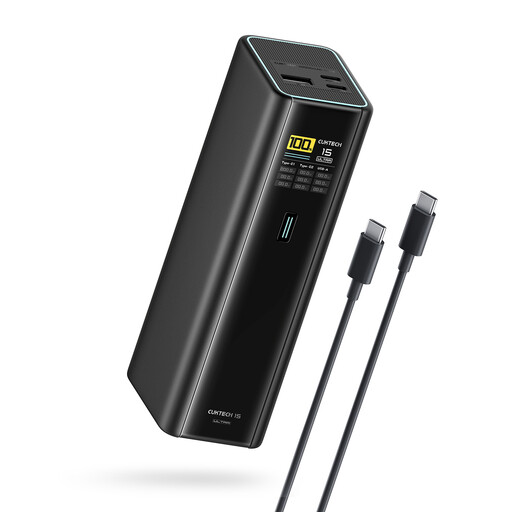
Why It Stands Out: The CUKTECH 15 Ultra is built for those who need serious power on the move. Its standout feature is the massive 140W output via its PD3.1 USB-C port, making it a genuine laptop power bank capable of charging even demanding devices like a MacBook Pro at high speed. Combined with a substantial 20000mAh capacity, it can keep all your gadgets running.
Pros:
Who is it for? Digital nomads, business travellers and tech professionals who rely on a laptop and other devices throughout the day and cannot afford to be tethered to a wall.
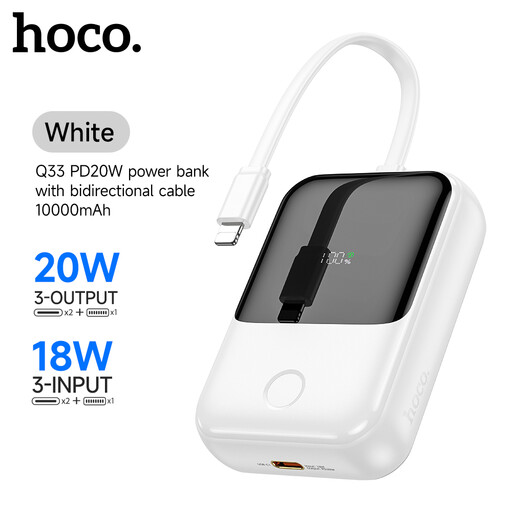
Why It Stands Out: This model from HOCO is all about practicality. It is a power bank with built in cable functionality, featuring both Lightning and Type-C connectors. This means you never have to remember to pack a separate charging lead. Its 10,000mAh capacity and PD 20W fast charging make it a versatile all-rounder.
Pros:
Who is it for? Daily commuters, students and anyone who values a grab-and-go solution without the fuss of carrying extra cables.

Why It Stands Out: The Anker Nano is a true mini power bank designed for absolute portability. Its key feature is the integrated foldable USB-C connector that plugs directly into the bottom of your phone, eliminating cables entirely. Despite its small size, it delivers a respectable 22.5W output for a quick power boost.
Pros:
Who is it for? Users who prioritise minimalism and need a small, lightweight charger for a night out, a concert or as an emergency backup in their bag.

Why It Stands Out: This magnetic wireless power bank combines function with a premium feel. Its ultra-slim power bank profile (only 9mm thick) and aluminium alloy construction give it a sleek look. The strong magnets snap securely onto the back of compatible iPhones and other devices for effortless 15W wireless charging. It also includes a 20W fast-charging USB-C port for wired connections.
Pros:
Who is it for? iPhone users with MagSafe who want a stylish, cable-free charging experience and anyone who appreciates premium materials and a slim design.
Our recommendations cover some of the most common needs, but the world of portable charging is vast. If you are looking for a different capacity, colour or feature set, there are many more models to consider.
Explore our complete range of portable usb power bank charger to find the perfect match for your devices and lifestyle.
This depends on your phone's battery capacity and the power bank's efficiency. As a general rule, a 20000mAh power bank can charge a typical smartphone (with a ~4,500mAh battery) about 3 to 4 times. Some energy is always lost during the transfer, so you will not get the full theoretical capacity, but it is more than enough for several days of use.
Yes, but with restrictions. Power banks must be carried in your hand luggage, not in checked baggage. The limit is typically 100 Watt-hours (Wh) per battery without needing airline approval. Nearly all consumer power banks, including 20,000mAh models, fall well below this limit (a 20,000mAh unit is around 74Wh). However, it is always wise to check the specific policy of your airline before you fly.
Absolutely. For anyone with a modern smartphone, tablet or laptop, a fast charging power bank is a significant quality-of-life improvement. A model with USB-C Power Delivery can reduce charging times dramatically, allowing you to get a substantial power boost in just 30 minutes. This is incredibly useful when you only have a short window to recharge before heading out again.