
24/7 Customer Support

Free returns

Same-day & Next-day Delivery

Quality Guaranteed

Unlock Your Welcome Offers: FREE Delivery | Up to 80% OFF | Free 30-day JoyPlus trial
Download the APP
Nothing brings a productive day to a halt quite like a phone battery hitting zero. A reliable power bank seems like a simple fix, but the market is flooded with options that often over-promise and under-deliver. Many of us have bought a portable charger only to find it's slower than advertised, bulkier than expected or dies after a few months.
As the Joybuy Product Recommendation Officer, my role is to help you see past the marketing clutter. Before you spend your money, let's look at the three most common pitfalls that catch UK shoppers out and how to choose a power bank that genuinely meets your needs.
To avoid these traps, focus on a few key specifications. Getting these right ensures you buy a portable charger that works for you, not against you.
Capacity, measured in milliampere-hours (mAh), indicates how much energy a power bank can store. However, the more important figure is the "rated capacity," which accounts for voltage conversion and efficiency loss. This is the true amount of power available to your devices.
A fast charging power bank is defined by its power output, measured in Watts (W), and its charging protocols.
The right ports and features make a power bank genuinely portable. Consider models with built-in cables to reduce clutter. If you own a recent iPhone, a power bank for iPhone with a built-in Lightning or USB-C connector can be incredibly convenient. For maximum versatility, look for a unit with multiple outputs (e.g., USB-C and USB-A) to charge several devices at once.
Based on these practical criteria, here are a few recommendations matched to different user needs.

Why This Fits Their Persona: Perfect for slipping into a pocket or small bag, this charger provides a crucial emergency boost for a smartphone during the daily commute or a day out. It's designed for absolute convenience, not for charging multiple large devices.
It solves the cable clutter problem with a foldable, built-in USB-C connector. No extra wires are needed to charge your Android phone or iPhone 15/16.
Its 22.5W output provides a genuine fast charge for compatible devices. The ultra-compact, lipstick-sized form factor is its main appeal.

Why This Fits Their Persona: This is for the iPhone user who values the seamless "snap-and-go" experience of magnetic charging. The 10,000mAh capacity is ample for keeping an iPhone and AirPods charged throughout a long day or weekend trip.
It delivers a true fast charge both wirelessly and wired. The 15W Qi2 wireless standard is a significant step up from older 7.5W MagSafe and the 20W PD wired output via the integrated cable is ideal for a quick power boost.
It combines a magnetic wireless power bank with a built-in USB-C cable, offering maximum versatility without needing to carry extra accessories.
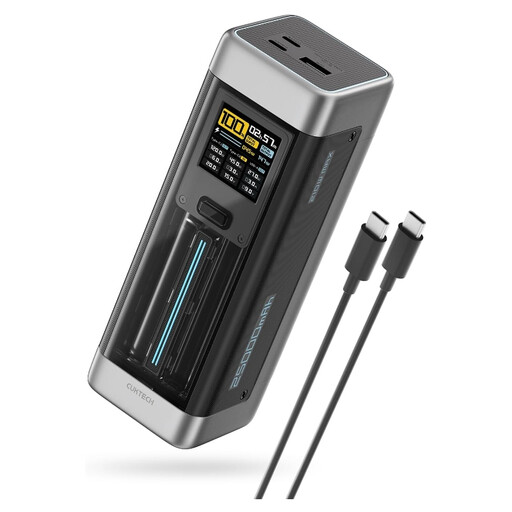
Why This Fits Their Persona: This is for the professional who works from coffee shops, airports and trains. It has enough capacity and power to charge a high-performance laptop like a MacBook Pro, plus a phone and earbuds, all at the same time.
It avoids the "fake fast charge" trap by offering a genuine 140W total output with the modern PD 3.1 protocol. This is not just fast for a phone; it's fast enough for power-hungry laptops.
Its 25,000mAh capacity is substantial yet remains under the 100Wh airline limit. The smart digital display provides real-time data on power output per port, which is useful for managing power distribution.
We have compiled a complete, real-time list of products that fully satisfy these strict selection criteria and UK safety regulations.
As a rule of thumb, you can estimate the number of charges by taking the power bank's rated capacity (usually around 60-70% of the advertised capacity) and dividing it by your phone's battery capacity. For a 10000mAh power bank with a rated capacity of ~6,500mAh, it could charge a 4,500mAh phone like the Samsung Galaxy S23+ about 1.4 times or a 3,279mAh iPhone 15 about two times.
Modern, certified power banks from reputable brands include safety features like overcharge protection, which automatically stops the charging process once the internal battery is full. Likewise, they stop sending power to your phone once it is fully charged. However, for general safety, it is always good practice to charge electronic devices on a hard, non-flammable surface and avoid leaving them unattended for extended periods.
Yes. Most airlines, including those in the UK, follow regulations that limit individual batteries in carry-on luggage to 100Wh. A 20000mAh power bank is approximately 74Wh, which is well within this limit. You must carry it in your hand luggage, not in your checked bags. Always check with your specific airline before flying, but this capacity is generally accepted worldwide.