
24/7 Customer Support

Free returns

Same-day & Next-day Delivery

Quality Guaranteed

Unlock Your Welcome Offers: FREE Delivery | Up to 80% OFF | Free 30-day JoyPlus trial
Download the APP
Running out of battery when you are on the move is a modern-day frustration for commuters, travellers and students across the UK. A reliable power bank, or portable charger, is the straightforward solution. However, the market is flooded with options, and it is easy to make a purchase you later regret. Many products are promoted with confusing technical jargon and features that sound impressive but fail to deliver in practice.
This guide, prepared by the Joybuy Product Recommendation Office, cuts through the clutter. We will highlight the common pitfalls to avoid and explain the key factors you should consider, helping you select a device that genuinely meets your daily power needs.
Before looking at features, it is crucial to be aware of the frequent issues that lead to buyer's remorse.
To ensure you get a portable charger that works for you, focus on these three non-negotiable specifications.
Capacity, measured in milliampere-hours (mAh), determines how much energy the power bank can store.
The speed at which a power bank charges your devices is measured in watts (W). For a modern smartphone, look for an output of at least 20W. The key technology to look for is Power Delivery (PD), which is the universal standard for fast charging over a USB C power bank port. It intelligently communicates with your device to deliver the fastest possible safe speed. Some power banks also support other protocols like Quick Charge (QC) for compatibility with a wider range of Android devices.
The right ports and features can make a huge difference in daily use.
We have selected a few models that align with different user needs, directly addressing the common pitfalls.

Why This Fits Their Persona: This ultra-compact portable charger for iPhone is designed for maximum portability. It fits easily into a pocket or small bag, making it perfect for daily commutes or a night out when you just need an emergency power boost without the bulk.
It completely solves the "forgotten cable" problem for iPhone users with its built-in Lightning connector. Its 20W PD output also delivers genuine fast charging, not a slow trickle.
Extremely lightweight and pocket-friendly design. The integrated cable means you have everything you need in one small package.

Why This Fits Their Persona: This user wants the latest technology with a balance of power and convenience. This 10000mAh power bank offers both high-speed wired and wireless charging, making it ideal for someone with a modern iPhone and other gadgets like wireless earbuds or an Android work phone.
It avoids the "slow charging" trap with 20W wired and 15W Qi2 wireless outputs. The integrated USB-C cable also prevents cable clutter and ensures you always have a fast-charging option ready.
Features the latest Qi2 wireless standard for efficient, 15W magnetic charging. The built-in USB-C cable provides versatile, high-speed power for a wide range of devices.
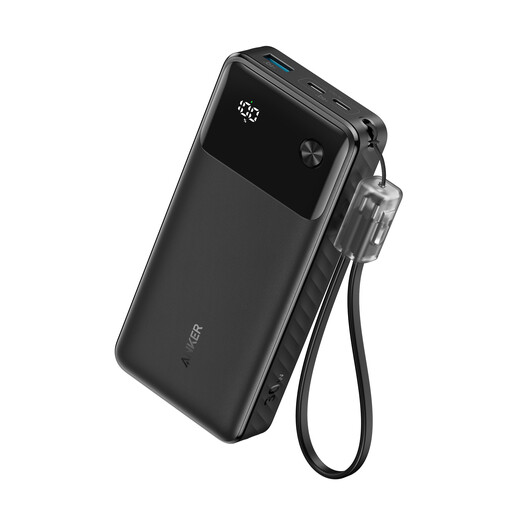
Why This Fits Their Persona: For weekend trips, long-haul flights or users who rely on multiple devices (phone, tablet, headphones), a high-capacity bank is essential. This 20,000mAh model provides ample power to keep everything running for days without needing to find a wall socket.
It avoids the "inflated capacity" trap by coming from a brand known for reliable specifications. The 30W PD output is genuinely fast, capable of charging phones quickly and even supporting some tablets and ultra-portable laptops.
A very large 20,000mAh capacity for multiple device charges. The ability to charge three devices at once and a digital display for precise power monitoring are major benefits.
We have compiled a complete, real-time list of products that fully satisfy these strict selection criteria and UK safety regulations.
This depends on your phone's battery size. As a general rule, a quality 10000mAh power bank can provide approximately 1.5 to 2.5 full charges for a typical modern smartphone. For a more precise calculation, look for the 'rated capacity' in the product specifications, which is usually around 6,000mAh for a 10,000mAh model.
Yes, modern power banks and smartphones are equipped with safety mechanisms to prevent overcharging. The power bank will automatically cut off the power supply once your device's battery reaches 100%. However, for the long-term health of both batteries, it is good practice to disconnect them once charging is complete.
Yes, but they must be packed in your carry-on luggage, not in your checked bags. UK and international aviation regulations limit the size of lithium-ion batteries to 100 Watt-hours (Wh) per battery. A 10,000mAh power bank is around 37Wh and a 20,000mAh model is about 74Wh, both of which are well within the permitted limit. It is always wise to double-check the specific policy of your airline before you travel.