Home clipping archivists
If you are digitising family, local-history or personal cuttings, controlled placement on a flatbed matters more than feeding sheets quickly. Check how you will save and organise the resulting images or PDFs.


Choose a multifunction printer with a flatbed scanner if most loose clippings fit on its scan bed and you also need everyday printing and copying. An automatic document feeder (ADF) is useful for recurring batches of sturdy, uniform sheets, but delicate or irregular cuttings need controlled placement. If an original must fit in one scan and exceeds A4, check for A3 scanning; for preservation-important or bound material, compare a dedicated flatbed scanner as well.
If you are digitising family, local-history or personal cuttings, controlled placement on a flatbed matters more than feeding sheets quickly. Check how you will save and organise the resulting images or PDFs.
If you scan many recent, intact sheets as well as print and copy, an ADF can reduce repeated loading. Keep flatbed access for cuttings that are torn, curled or irregularly shaped.
If you need a whole newspaper page or an oversized cutting in one image, check the scanner’s maximum original size. A printer’s A3 print capability alone does not establish that it scans A3 originals.
Start with the condition and size of the originals: these determine whether you need careful flatbed placement, a larger scan bed or a feeder for intact sheets. Then check whether the same machine meets your routine printing and copying needs.
| Concern | What to check | Who this matters to |
|---|---|---|
| Handling and complete capture | Confirm a flatbed and its maximum original size; check the lid arrangement for thick or bound material. | If my cuttings are fragile or irregular, I need to place them carefully and capture each one without forcing it through a feeder. Roughly 45% of consumers would put handling and complete capture first. |
| Batch scanning | Check ADF capacity, supported sheet sizes and whether the scanning workflow meets your single- or double-sided needs. | With many sturdy, similarly sized sheets to process, I want less repeated loading while keeping fragile pieces out of the feeder; around 28% of consumers would prioritise batch workflow. |
| Everyday multifunction use | Check print and copy functions, ink format and the connection and saving options you intend to use. | If I also need a machine for household paperwork, scanning clippings cannot be its only useful job. Everyday printing and copying would be the main concern for roughly 27% of consumers. |
A feeder can help with batches of intact sheets, but its capacity says nothing about whether brittle, curled or unevenly cut newspaper will pass through safely.
Make the flatbed your starting point for clipping work. Use an ADF only after checking the condition and uniformity of the sheets.
Print format and maximum scan size are separate specifications. A clipping larger than an A4 scan bed cannot be captured there in one image.
Check the exact model’s maximum scannable original size if full-page capture matters.
A print-resolution figure does not describe how much detail the scanner captures from text or images.
Compare stated optical scan resolution alongside scan-bed size and the file formats you need.
A multifunction printer combines scanning with printing and copying, while a dedicated scanner may offer handling features better suited to bound or preservation-important material.
If careful scanning is your main task, compare a dedicated flatbed before choosing a one-device arrangement; check its maximum original size too.
Compare specific scanner arrangements within each product line rather than treating a brand name as a guarantee that a model will handle your originals.
Epson’s EcoTank multifunction printers, WorkForce Pro models with ADFs and separate Perfection flatbed scanners address different parts of this task.
Canon’s PIXMA range includes A4 multifunction models combining a flatbed with an ADF, as well as an A3 all-in-one option.
Brother’s office-oriented A3 multifunction inkjets are relevant when larger originals and routine document work both matter.
These multifunction printers are worth checking for different clipping-scanning routines: controlled placement of loose cuttings and recurring batches of intact sheets. Confirm each model’s scanner arrangement and maximum original size against your own material before choosing.
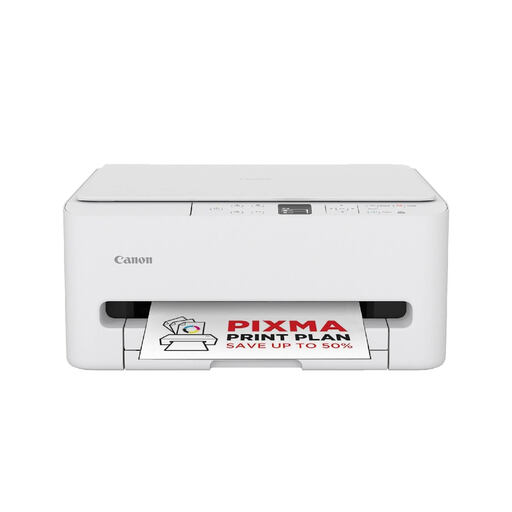 No image available
Consider this model if you want a printer for household tasks alongside scans of loose cuttings. For delicate or oversized originals, confirm the flatbed arrangement, maximum scan size and optical scan resolution before buying.
 No image available
Consider this model for printing and scanning alongside batches of sturdy, uniform sheets. Before using a feeder for cuttings, check its supported originals; also confirm whether this exact model has a flatbed and whether its maximum scan size accommodates your larger clippings. A3 printing alone does not establish A3 scanning.
Use a flatbed when a clipping is delicate, curled, torn or irregularly shaped, because you can position it by hand. Reserve an ADF for sturdy, flat, uniform sheets; The National Archives identifies flat scanning beds as suitable for digitisation work.
You need to check for A3 scanning if an original exceeds an A4 scan bed and must be captured in one image. Smaller loose cuttings may fit on an A4 flatbed, and an A3 printing specification alone does not confirm A3 scan capability.
No: print resolution and optical scan resolution describe different functions. Compare scanner specifications for the exact model; Canon UK lists 1,200 × 2,400 dpi optical scanning for the PIXMA TS7750i, while Epson United Kingdom states 4,800 dpi for its separate Perfection V39II scanner.
Check that the printer can save scans in a format that fits how you plan to file and share them, such as an image file or PDF. If you need searchable text or a multi-page PDF, confirm those features for the exact model rather than assuming that PDF output includes them.